

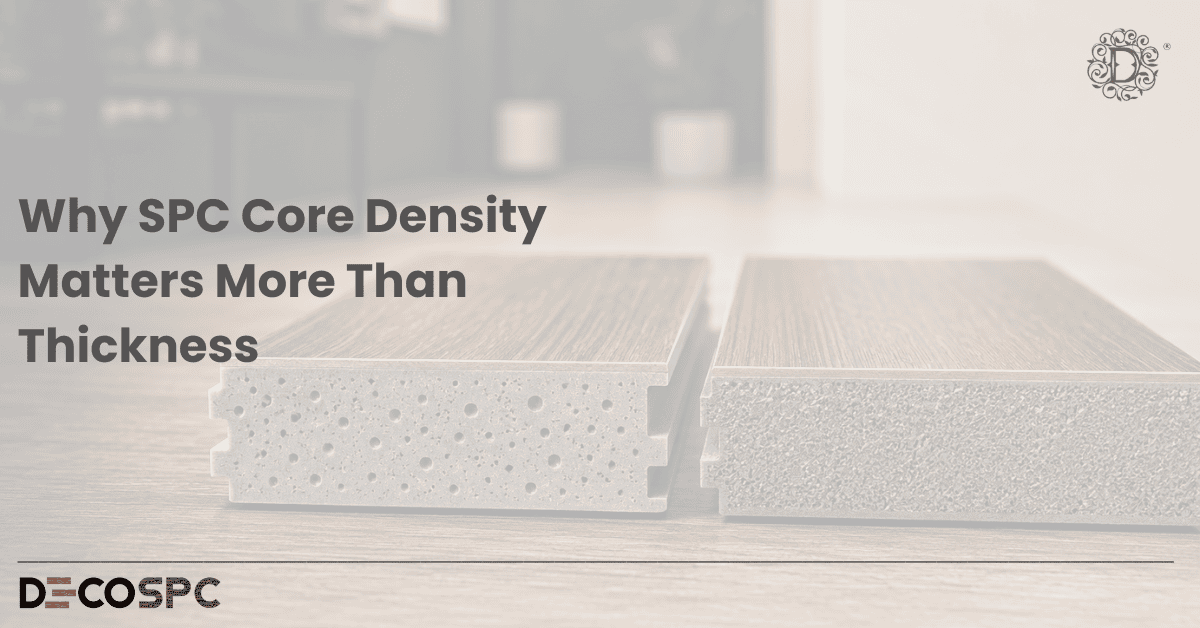
Ask any flooring buyer what specification they look at first when comparing SPC products and the answer is almost always thickness.A 6mm plank sounds more substantial than a 4mm plank.An 8mm plank sounds premium.Thickness is visible,measurable with a ruler,and easy to communicate in a product listing or sales conversation.It is also on its own one of the least reliable indicators of SPC flooring quality.The specification parameter that actually determines how an SPC floor performs under load,how dimensionally stable it is across temperature cycling,how well it holds its locking joints over time,and how long it lasts before surface and structural degradation become visible is core density the mass of material packed into each cubic centimetre of the plank's rigid core.A 6mm plank with a high-density core will outperform an 8mm plank with a low-density core across every meaningful performance metric.Understanding why and knowing how to evaluate core density before placing an order is one of the most commercially valuable skills any SPC flooring buyer can develop.
Table of Contents
What SPC Core Density Is and How It Is Determined During Manufacturing
What SPC Core Density Is and How It Is Determined During Manufacturing
SPC Stone Plastic Composite flooring takes its name from its core composition: a blend of limestone powder (calcium carbonate),PVC resin,and stabilising additives that are combined,heated,and extruded under pressure to form the rigid core board from which planks are cut and profiled.The density of this core is determined by the ratio of limestone to PVC in the formulation,the particle size and grade of the calcium carbonate used,the extrusion temperature and pressure applied during processing,and the proportion of stabiliser and processing aids in the compound.
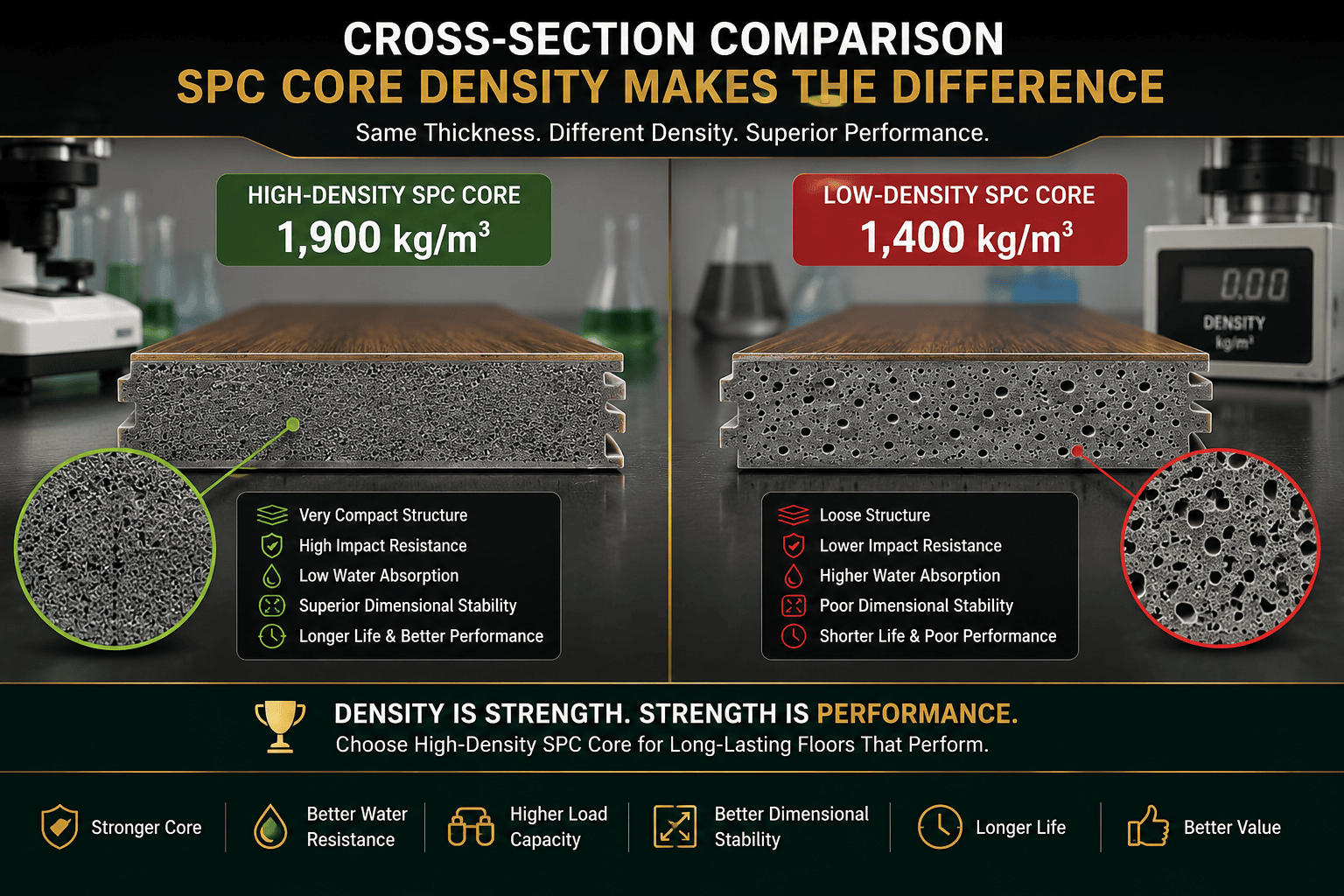
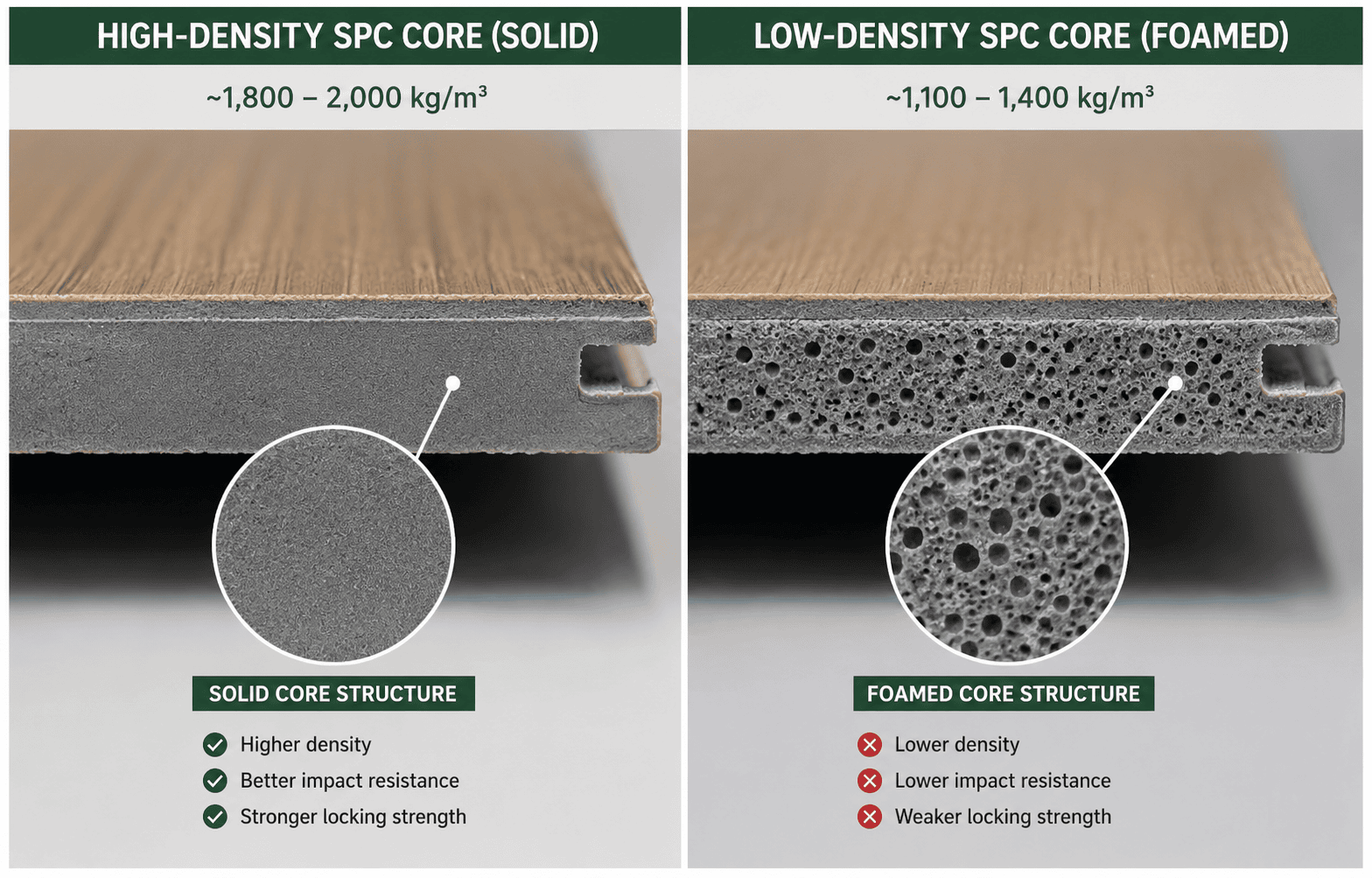
Core density is expressed in kilograms per cubic metre (kg/m³).A premium SPC core has a density between 1,800 and 1,950 kg/m³.A mid-range core falls between 1,600 and 1,800 kg/m³.A budget core which may still be marketed and sold under premium product names can fall below 1,500 kg/m³.These numbers represent a significant real-world difference in material volume and structural performance.The gap between a 1,900 kg/m³ core and a 1,400 kg/m³ core is not a marginal specification difference it is the difference between a dense,rigid,thermally stable structural board and a lighter,more porous,less dimensionally stable core that will perform measurably worse across every stress it is subjected to in an installed floor.
The challenge for buyers is that core density is invisible.Two planks of identical overall thickness both measuring exactly 6mm on a calliper can have core densities that differ by 400 to 500 kg/m³.The only ways to determine the actual core density of a plank are to weigh a precisely measured piece and calculate density from the result,to request a laboratory density certificate from the manufacturer,or to commission independent laboratory testing.None of these options are available in a showroom or at the point of supplier evaluation without deliberate effort which is precisely why core density is the parameter most easily compromised by budget manufacturers without immediate detection by buyers.
What Thickness Tells You And What It Does Not
What Thickness Tells You And What It Does Not
Thickness is a real specification parameter with genuine performance implications but only within a defined context.Understanding what thickness does and does not tell you about an SPC product is the starting point for understanding why density matters more.
What Thickness Genuinely Affects
Overall plank thickness affects the depth of the locking profile that can be machined into the plank edge a thicker plank accommodates a deeper,more structurally robust locking geometry.It affects the height of the transition from the SPC surface to adjacent floor coverings at doorways and room boundaries.It affects the acoustic performance of the installed floor a thicker plank transmits less impact sound through its mass than a thinner one at equivalent density.And it affects the subfloor tolerance the product can accommodate a thicker,more rigid board bridges minor subfloor imperfections more effectively than a thinner one.
What Thickness Does Not Tell You
Thickness does not tell you how rigid the core is under point load two 6mm planks from different manufacturers can flex under identical loads by materially different amounts if their core densities differ.Thickness does not tell you how dimensionally stable the plank is under temperature change a low-density core expands and contracts more under the same temperature differential than a high-density core of the same thickness.Thickness does not tell you how well the locking system will hold its joint over years of thermal cycling a low-density core provides less mechanical purchase for the locking profile,reducing joint retention strength regardless of how well the profile was designed.And thickness does not tell you how resistant the plank is to indentation under sustained point load a heavy piece of furniture on a low-density core will produce visible denting that a high-density core of the same thickness would resist.
How Core Density Affects Real-World Performance
How Core Density Affects Real-World Performance
The performance implications of core density manifest across every dimension of SPC flooring behaviour that matters to the end user and they accumulate over time rather than being immediately obvious at installation.Understanding how density affects each performance dimension is the best preparation for making the specification decision correctly the first time.Rigidity and Underfoot FeelThe most immediately perceptible consequence of core density is the rigidity and solidity of the installed floor underfoot.A high-density core produces a floor that feels genuinely solid firm,stable,and consistent across the full surface.A low-density core produces a floor that feels slightly hollow,that deflects very slightly under the weight of a standing person,and that produces a subtly different acoustic response when walked on a slightly more resonant sound that experienced installers and users associate with lower quality even when they cannot articulate the technical reason.This difference in underfoot character is not a minor aesthetic distinction it is the primary sensory quality that separates a premium-feeling floor from one that generates buyer complaints even when all other specification parameters appear correct.Dimensional Stability Under Temperature CyclingCore density directly determines how much the plank expands and contracts as ambient temperature changes.Limestone powder the primary component of a high-density SPC core has a very low coefficient of thermal expansion.The higher the limestone content and the more densely it is packed in the core,the less the plank moves with temperature change.A high-density core at 1,900 kg/m³ typically demonstrates dimensional change below 0.05% at 80°C under ISO 23999 testing.A low-density core at 1,400 kg/m³ may show dimensional change of 0.12% or more under the same conditions more than double the movement,which produces visible gapping between planks in cold conditions and compressive joint stress in hot conditions,particularly in non-air-conditioned environments in tropical climates.Locking System Performance and Joint RetentionThe locking profile of an SPC plank is machined directly from the core material.The quality of the mechanical engagement that the locking system provides the tightness of the joint,the resistance to vertical separation,the longevity of the joint under repeated thermal movement depends entirely on the density and consistency of the core material into which the profile is machined.A high-density core provides dense,uniform material that holds the locking geometry precisely and maintains its dimensional tolerances under load and temperature change.A low-density core is more porous and variable the locking profile machined from it has less material integrity,produces a joint with marginally more play,and is more susceptible to dimensional change at the joint that produces gapping over time.This is why the same licensed locking system Unilin,Välinge,or I4F performs better from some manufacturers than others: the profile geometry is identical,but the density of the core it is machined from differs.Indentation Resistance Under Sustained LoadResidual indentation the permanent dent left in a floor surface after a sustained point load is removed is directly related to core density.The residual indentation test (ISO 10582) measures how much permanent deformation remains in the surface after a defined load is applied for 24 hours and then removed for a recovery period.A high-density core provides structural resistance to this compression the dense limestone matrix distributes the point load across a larger area of core material and limits the depth of permanent deformation.A low-density core compresses more readily under the same load,producing a deeper initial indentation and a larger residual deformation after the load is removed.In a furnished space where dining tables,refrigerators,wardrobe legs,and office furniture apply sustained point loads over years the difference between a high-density and a low-density core becomes visible in the floor surface within the first twelve to eighteen months of use.
How Manufacturers Reduce Density And Why Buyers Rarely Notice Until It Is Too Late
How Manufacturers Reduce Density And Why Buyers Rarely Notice Until It Is Too Late
Core density reduction is one of the most common and least visible cost-reduction mechanisms in SPC manufacturing.Because the core is hidden between the wear layer and the backing,and because overall plank thickness is easily verified with a calliper while core density requires calculation or laboratory testing,a manufacturer can reduce core density by 20 to 30 percent while maintaining the same overall thickness and the resulting product will pass a visual and dimensional inspection that fails to include density verification.
The Three Density Reduction Methods
The first and most common method is reducing the limestone-to-PVC ratio in the core compound using less calcium carbonate filler and more PVC resin,which is lighter than limestone and produces a lower-density core at the same extrusion settings.The second method is introducing foaming agents into the core compound chemical agents that create microscopic gas bubbles within the extruded core,reducing its mass and density while maintaining its outer dimensions.A foamed SPC core is identifiable by its lower weight and by a slightly different surface texture at the cut edge it looks more cellular than a solid dense core under close examination but it is not immediately obvious in a finished plank without deliberate inspection.The third method is reducing extrusion pressure during production which produces a core with the correct dimensions but lower internal compaction and consequently lower density and structural integrity.
Density vs Thickness A Direct Performance Comparison
Density vs Thickness A Direct Performance Comparison
The clearest way to understand the density-over-thickness principle is to compare two specific products directly a thicker,lower-density plank and a thinner,higher-density plank across the performance parameters that matter in a real installation.
| Performance Parameter | 8mm Plank 1,400 kg/m³ Core | 6mm Plank 1,900 kg/m³ Core | Better Performer |
| Underfoot rigidity and feel | Moderate slight hollow resonance | High solid,dense feel throughout | 6mm high-density |
| Dimensional stability at 80°C | 0.10% to 0.14% change | 0.04% to 0.06% change | 6mm high-density |
| Locking joint retention | Moderate lower core integrity at joint | High dense material holds profile geometry | 6mm high-density |
| Residual indentation (ISO 10582) | 0.12mm to 0.18mm under standard load | 0.04mm to 0.07mm under standard load | 6mm high-density |
| Subfloor tolerance | Better greater overall board thickness | Good rigid core compensates partially | 8mm low-density |
| Acoustic performance | Better greater mass at same density | Good density partially compensates | 8mm low-density |
| Weight per plank | Higher more material volume | Lower less volume but denser | Context-dependent |
| Long-term joint gapping risk | Higher more thermal movement | Lower minimal thermal movement | 6mm high-density |
| Indentation under furniture (12 months) | Visible in high-load areas | Minimal dense core resists compression | 6mm high-density |
| Cost to manufacture | Lower less limestone,more filler | Higher more limestone,denser compound | 6mm high-density (better value) |
How to Evaluate and Specify Core Density Correctly
How to Evaluate and Specify Core Density Correctly
Specifying core density correctly requires a combination of documentation requests,physical evaluation,and contractual protection.The following steps provide a complete framework for any buyer who wants to make density a verified specification parameter rather than an assumed one.
Request the core density specification in the TDS — The TDS should state core density in kg/m³ explicitly.If the TDS states overall thickness but not core density,ask specifically for the density figure.A manufacturer who cannot or will not state core density is either producing a product whose density they do not want to disclose or whose production process does not deliver a consistent enough density to state with confidence.Both situations are disqualifying for a buyer who requires performance reliability.
Perform the weight-per-plank density calculation on the physical sample — Weigh a full sample plank on a digital scale (in grams).Measure length,width,and total thickness precisely in centimetres.Calculate volume in cm³ (L × W × T).Divide weight by volume to get density in g/cm³,then multiply by 1,000 to convert to kg/m³.Cross-reference the result against the TDS stated density.A significant discrepancy between calculated and stated density more than 50 to 80 kg/m³ is a signal to investigate further before placing any order.
Request a third-party laboratory density certificate — For significant volume orders,request an original laboratory density certificate from an accredited body (SGS,Intertek,or Bureau Veritas) for the specific product SKU being ordered.This is the most reliable verification available and the only one that provides contractual protection in a quality dispute.
Include core density as a contractual specification in the purchase order — State the minimum acceptable core density in kg/m³ explicitly in the purchase contract.This converts density from an assumed characteristic into a contractual obligation and creates the legal basis for recourse if the delivered product fails to meet the specified standard.
Include density verification in the pre-shipment inspection protocol — Instruct the QC inspector to weigh and calculate density from production planks at the pre-shipment inspection stage and compare the result against the approved sample density and the contractual specification.Any production batch whose measured density falls more than 5 percent below the specified value should be flagged for buyer review before shipment release.
Want SPC flooring with verified high-density cores
Decospaa International supplies premium SPC flooring with documented core density specifications backed by third-party laboratory certificates for importers,distributors,and project buyers across India,the Middle East,Africa,and Southeast Asia.Contact our team for density-verified product samples,complete TDS documentation,and competitive wholesale pricing.
store.decospaainternational.com | info@decospaainternational.com | +91 86002 04089