

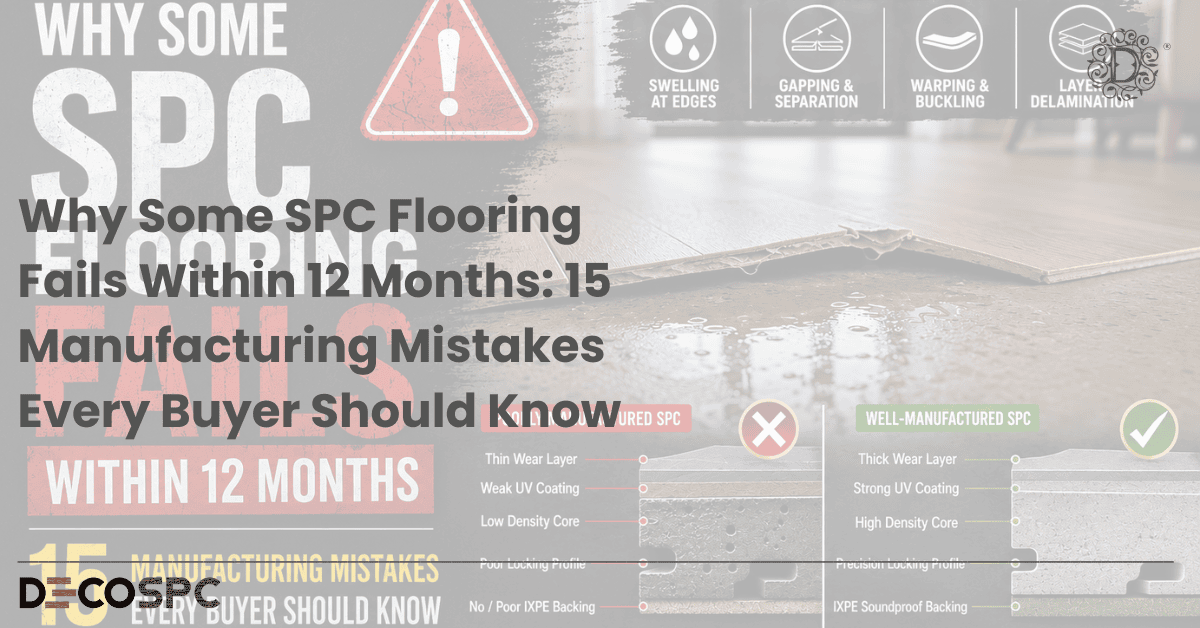
SPC flooring is one of the most durable and reliable hard flooring products available when it is manufactured correctly.When it is not,the failure timeline can be brutal.Wear layers that degrade within months.Planks that buckle under a single Indian summer.Locking joints that fail before the first year is out.UV fading that makes a new floor look old before the client has had a chance to appreciate it.These failures are not random.They are the predictable and entirely avoidable consequence of specific manufacturing shortcuts that cost-cutting producers make at the factory level shortcuts that are invisible in a showroom sample and only reveal themselves after the product has been installed and lived with for six to eighteen months.Understanding these fifteen manufacturing mistakes is the most effective quality education any SPC buyer can receive.It explains why two products at visually similar price points can deliver completely different real-world outcomes and gives buyers the knowledge to identify the difference before placing an order rather than after dealing with the consequences.
Table of Contents
Why SPC Flooring Failures Follow Predictable Patterns
Why SPC Flooring Failures Follow Predictable Patterns
SPC flooring failures are not random events.They follow patterns that directly correspond to specific decisions made or avoided during the manufacturing process.The fifteen mistakes in this guide represent the most commonly documented failure modes across the global SPC import market.Some are catastrophic producing failures within weeks of installation.Others are slow-burn producing gradual degradation that becomes visible only after twelve to eighteen months.All of them are detectable before purchase if the buyer knows what to look for and demands the right documentation from suppliers.
The reason these mistakes persist in the market is straightforward.SPC flooring looks the same in a showroom sample whether it was manufactured correctly or not.The cost savings from each shortcut are real and immediate for the manufacturer.The consequences appear only after the product is installed at which point the manufacturer is often unreachable or unwilling to accept responsibility.The buyer and their customer bear the cost of replacement,disruption,and damaged relationships that a cheaper purchase at the order stage has generated.
The most effective protection against SPC manufacturing failures is pre-purchase knowledge combined with verifiable documentation.This guide provides both.
Extrusion and Core Manufacturing Mistakes Mistakes 1 to 5
Extrusion and Core Manufacturing Mistakes Mistakes 1 to 5
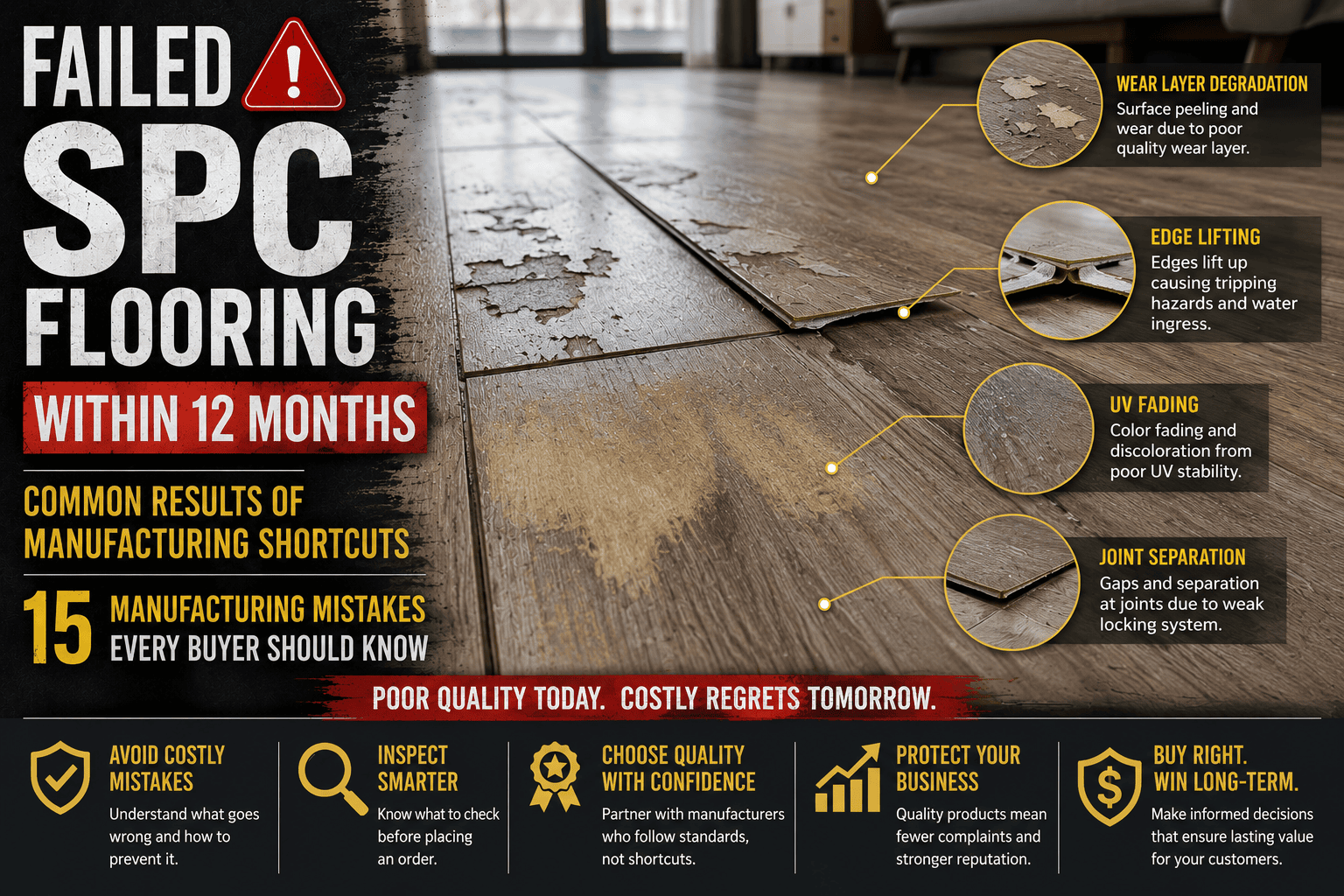
The SPC core is the structural foundation of the entire product.Mistakes made at the extrusion stage affect every performance parameter dimensional stability,rigidity,moisture resistance,and durability.These are the most fundamental manufacturing failures and the most difficult to detect without proper testing.
Incorrect Limestone-to-PVC Ratio
The rigid core of SPC flooring is a precisely engineered blend of limestone powder and PVC resin.The ratio of these two components determines the core's density,rigidity,and dimensional stability.Budget manufacturers reduce the limestone content which is heavier and more expensive to process and increase the PVC content to lower material cost.The result is a core that is lighter and less dense than the specification claims visibly apparent when handling a genuinely premium plank alongside a budget one of the same stated thickness.A lighter core flexes more underfoot,is less resistant to denting under furniture,and expands and contracts more under temperature change.
How to detect: Request core density specification in kg/m³.Premium SPC cores are 1,750 to 1,950 kg/m³.Budget cores are often below 1,500 kg/m³ despite similar stated thickness.
Insufficient UV Stabiliser in Extrusion Mix
UV stabilisers are chemical additives incorporated into the polymer blend during extrusion that protect the core and surface layers from degradation caused by ultraviolet light exposure.They are invisible in the finished product and their presence cannot be determined by visual inspection.Budget manufacturers reduce UV stabiliser content significantly sometimes to zero to cut production cost.The consequence is visible UV fading within six to twelve months in any installation with sunlight exposure.In Indian and Middle Eastern markets where direct sunlight through windows is intense and sustained,insufficient UV stabilisation is one of the most common causes of early product failure.
How to detect: Request ISO 4892-2 UV accelerated weathering test certificate confirming minimum 2,500 hours of UV exposure with no significant colour change.No certificate means no verified UV stabilisation.
Inconsistent Extrusion Temperature Control
During the extrusion process,the polymer blend must be heated and maintained at precise temperatures to ensure uniform mixing and consistent core density throughout the production run.Inadequate temperature control caused by poorly maintained or under-specified extrusion equipment produces cores with variable density and internal stress concentrations.These stress concentrations manifest as unexpected warping,cupping,or cracking in the installed floor as the product experiences real-world temperature cycling.The failure is unpredictable in location and timing,making it one of the most difficult manufacturing defects to diagnose after installation.
How to detect: Request evidence of temperature-controlled extrusion equipment and production QC records.Factory audit access is the most reliable verification method.
Low-Grade or Recycled PVC Resin Input
The quality of the PVC resin used in SPC core production directly affects the finished product's rigidity,chemical resistance,and long-term dimensional stability.Budget manufacturers substitute virgin PVC resin with lower-grade recycled PVC content often without disclosing this substitution.Recycled PVC from mixed or contaminated sources introduces variability in the polymer chain structure that reduces the core's mechanical consistency.The product performs adequately under light use initially but degrades faster under sustained load and temperature cycling than a virgin PVC core would.
How to detect: Request a raw material declaration confirming virgin PVC resin specification.Factory audit including raw material storage inspection is the strongest verification.
Insufficient Core Cooling Time Before Cutting
After extrusion,the SPC core sheet must be cooled for a defined minimum period before it is cut into planks.This cooling period allows the core to fully stabilise releasing internal thermal stresses that would otherwise remain locked in the material.If the cooling process is shortened to increase production throughput,the planks retain residual thermal stress that is released after installation causing bowing,cupping,or warping that appears within the first few months of use.The failure is often mistakenly attributed to subfloor problems or installation errors rather than traced back to its correct origin at the manufacturing stage.
How to detect: This defect is difficult to detect through product testing alone.Factory audit access observing the actual production and cooling process is the most reliable verification method.
Wear Layer and Surface Finish Mistakes Mistakes 6 to 9
Wear Layer and Surface Finish Mistakes Mistakes 6 to 9
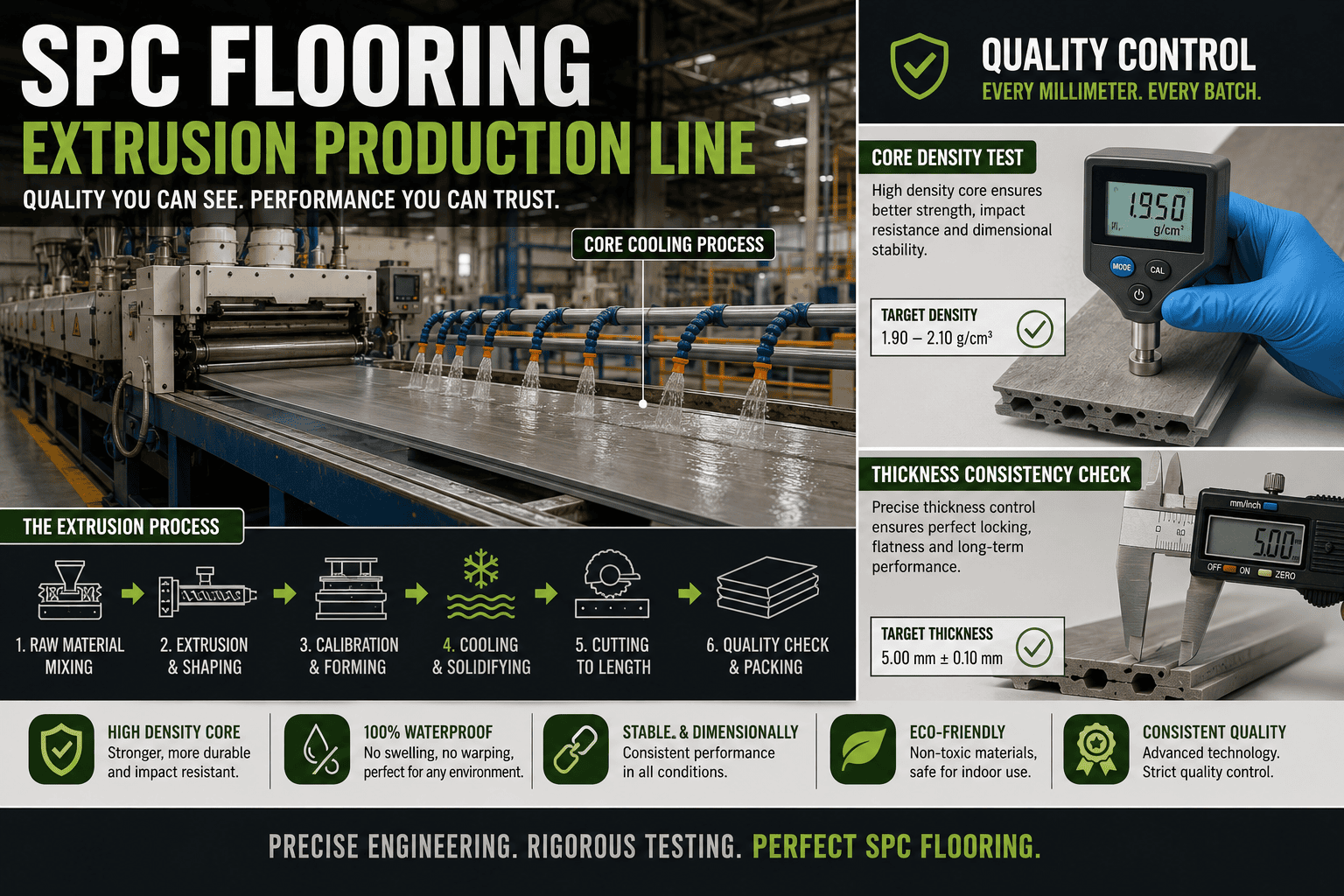
The wear layer is the most visible and most performance-critical component of an SPC plank.It is also the component where cost-cutting has the most immediate and most visible impact on product performance.These four mistakes are among the most commonly encountered in imported SPC flooring and the most directly responsible for early product failure complaints.Wear Layer Thinner Than SpecifiedThe stated wear layer thickness is one of the most frequently misrepresented specifications in the SPC import market.A manufacturer who quotes 0.5mm wear layer and delivers 0.3mm or a manufacturer whose production tolerance allows the wear layer to vary from 0.5mm at the sample stage to 0.35mm in bulk production — is delivering a product that will fail significantly sooner than the buyer expects.The consequences of an insufficient wear layer are visible surface scratching and scuffing within months in residential use and within weeks in commercial or high-traffic applications.How to detect: Request an SGS,Bureau Veritas,or Intertek lab test certificate confirming wear layer thickness from the specific production batch being shipped.Batch-specific testing is the only meaningful verification.Low-Quality UV Coating on the Wear Layer SurfaceThe surface of the wear layer is protected by a UV-cured coating that provides scratch resistance,stain resistance,and surface gloss or matte control.Budget manufacturers use lower-concentration UV coating formulations that cure incompletely or unevenly,producing a surface that appears acceptable initially but develops micro-scratches,surface hazing,and stain susceptibility significantly faster than a properly cured premium UV coating.This failure mode is particularly apparent in high-traffic areas and shows as a "cloudy" or "scuffed" appearance that cannot be cleaned or restored.How to detect: Request an abrasion resistance test certificate (EN 13696 or ASTM D3884) confirming wear layer surface performance.Premium product maintains surface integrity to a minimum of 2,000 rotations under Taber abrasion testing.Misaligned or Low-Resolution Print FilmThe decorative layer the printed film that gives SPC its wood or stone visual must be high resolution,colour-accurate,and precisely positioned relative to the surface texture above it.Budget manufacturers use lower-resolution print films with simplified colour palettes that look adequate in small samples but reveal their limitations when installed across a full floor producing a repetitive,obviously manufactured appearance rather than the natural variation of a premium visual.Misalignment between the print film and the surface emboss producing a texture that does not match the visual it is supposed to represent is an equally common budget-tier failure that is visible once the floor is installed.How to detect: Evaluate the visual at floor scale not sample scale.Request multiple boards from the same production batch and lay them together to assess repetition pattern and visual depth before approving.Surface Emboss Not Aligned with Print (Non-EIR)Premium SPC uses embossed-in-register (EIR) surface technology where the physical surface texture is precisely engineered to align with the printed wood grain or stone visual beneath it.This creates a surface that looks and feels genuinely natural.Budget SPC uses a generic emboss pattern applied independently of the print film producing a surface where the texture and visual are misaligned,creating an obviously synthetic appearance that buyers with any product knowledge will immediately identify.EIR is a manufacturing investment that budget producers consistently avoid because the tooling and process control it requires adds meaningful cost per square metre produced.How to detect: Run your finger across the surface of the sample in strong light.On a genuine EIR product,the texture peaks and valleys visibly align with the grain lines in the print.On a non-EIR product,they do not.
Locking System and Dimensional Mistakes Mistakes 10 to 12
Locking System and Dimensional Mistakes Mistakes 10 to 12
The locking system is the engineering interface that holds every plank in the floor together.It must maintain precise dimensional tolerances across thousands of joints in an installation and it must continue to do so through years of thermal expansion and contraction.Mistakes in locking system specification or dimensional control are responsible for some of the most dramatic and visible SPC failure modes.
Unlicensed Locking System with Poor Tolerance Control
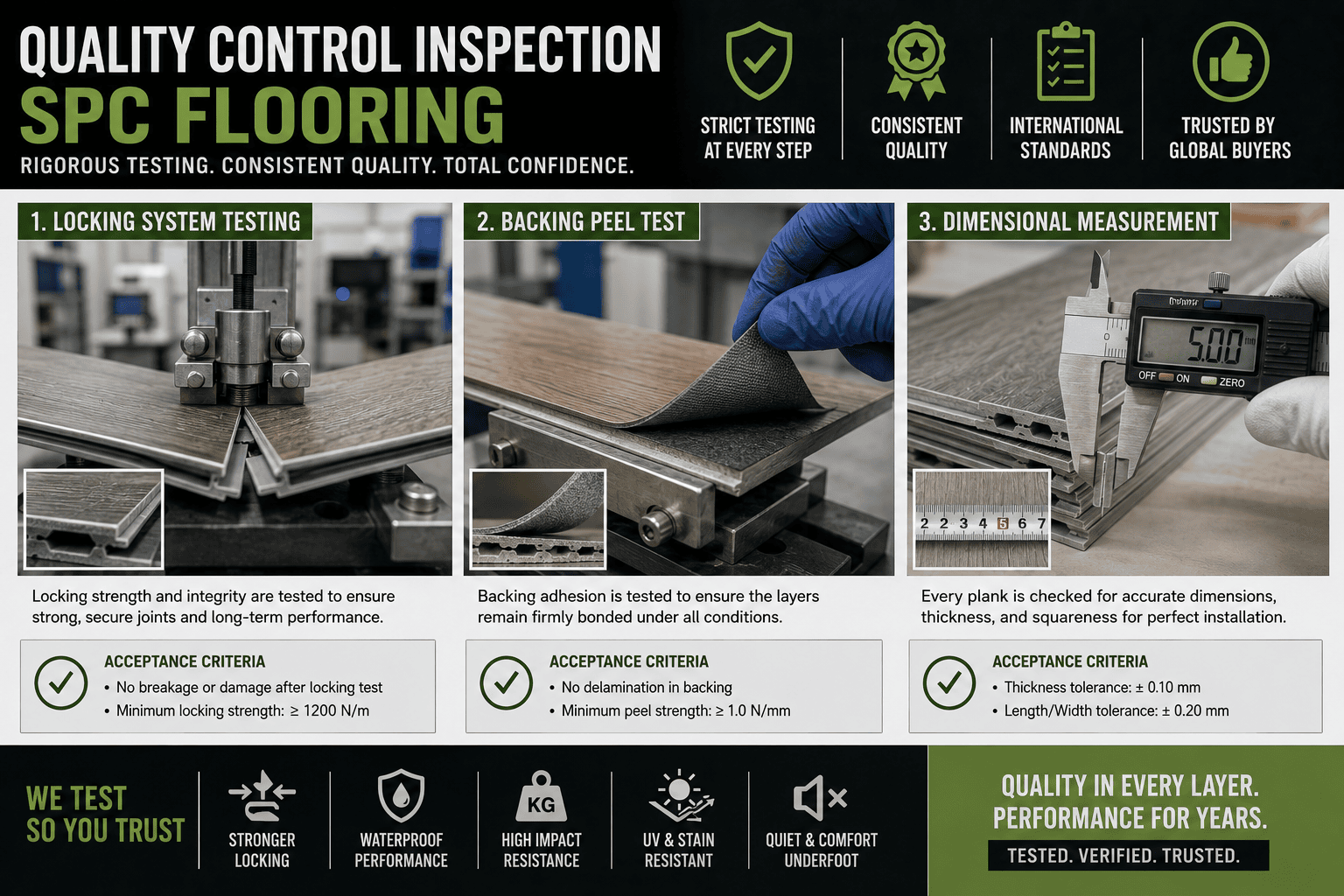
Licensed locking systems from Unilin,Välinge,or I4F are engineered to precise dimensional tolerances and tested for joint integrity across thousands of engagement and disengagement cycles.The royalty cost of these licences is included in the product price and represents genuine engineering value.Proprietary unlicensed locking systems the most common cost-cutting measure in budget SPC are manufactured without these engineering standards or testing protocols.The result is joints that engage loosely or unevenly,produce visible gapping between planks under thermal cycling,and in severe cases allow planks to disengage entirely under normal use.
How to detect: Ask for the locking system licence number.If the supplier cannot provide a verifiable Unilin,Välinge,or I4F licence reference,the system is proprietary.Test the sample joint engagement a correctly engineered licensed system clicks firmly and evenly with consistent resistance along the full length of the joint.
Plank Length and Width Variation Beyond Tolerance
SPC planks must be cut to precise dimensional tolerances for the floor to install flat and for the locking system to function correctly across the full installation.Budget manufacturers with poorly calibrated cutting equipment produce planks with dimensional variation that exceeds acceptable tolerance producing a floor with visible lippage (height differences between adjacent planks),uneven joint gaps,and locking system stress that accelerates joint failure.The problem is compounded by the fact that dimensional variation is not visible until multiple planks are laid together by which point the installation is already underway.
How to detect: Request dimensional conformance data from the manufacturer confirming that plank length,width,and thickness are controlled within ±0.2mm tolerance.Lay five to ten sample boards together before approving any bulk order.
Insufficient Expansion Allowance in Locking Profile
Even the most dimensionally stable SPC core expands and contracts slightly with significant temperature changes.The locking profile must be engineered with sufficient allowance for this movement to occur without generating stress at the joint.Budget locking profiles with insufficient expansion allowance produce visible gapping between planks in cold weather and joint buckling in extreme heat particularly in non-air-conditioned spaces in Indian and Middle Eastern climates where seasonal temperature ranges are large.This is a design failure in the locking system specification rather than a materials failure,and it cannot be resolved after installation without replacing the floor.
How to detect: Request dimensional stability test results (ISO 23999) confirming the product's thermal expansion coefficient and confirming that the locking profile has been engineered to accommodate that movement range.
Backing,Coating,and Packaging Mistakes Mistakes 13 to 15
Backing,Coating,and Packaging Mistakes Mistakes 13 to 15
The final three manufacturing mistakes relate to the backing,secondary coating,and packaging components that receive less buyer attention than the core and wear layer but generate significant failure modes when compromised.
Insufficient Secondary Backing Weight
The secondary backing is applied to the underside of the tufted primary backing to lock the structure together and provide the floor's base layer.Its weight measured in grams per square metre directly affects the floor's dimensional stability,its resistance to subfloor irregularities,and the durability of the acoustic underlay if pre-attached.Budget manufacturers reduce backing weight to cut material cost producing a floor that lacks the structural integrity to remain flat on challenging subfloors and that develops backing delamination under sustained load and temperature cycling in humid climates.
How to detect: Request backing weight specification in g/m² from the technical data sheet.Premium SPC backing typically weighs 150 to 250 g/m².Significant deviations below this range indicate a backing specification compromise.
Latex Backing Applied Too Thinly or Unevenly
In products using latex as the secondary coating,uneven or insufficient latex application produces areas of weak bonding between the fibre layer and the backing.These weak spots manifest as delamination the separation of the surface layers from the backing under sustained foot traffic,particularly in high-use areas like doorways,corridor edges,and areas adjacent to furniture legs.Delamination failures typically appear between six and eighteen months after installation and are effectively irreparable without replacement of the affected planks.
How to detect: Peel test attempt to separate the wear layer from the core at the edge of a sample plank.On a correctly bonded product,the layers resist separation firmly.Easy delamination in a sample is a direct indicator of insufficient or uneven bonding.
Poor Packaging Leading to Transit Damage
SPC flooring must be packaged to withstand the mechanical stresses of ocean freight,port handling,and local delivery a journey that typically involves multiple loading and unloading cycles,extended periods of stacked storage under weight,and exposure to temperature and humidity variation.Budget packaging thin cardboard,insufficient corner protection,inadequate stacking strength produces high rates of transit damage including edge chipping,surface scratching,and corner breakage that only becomes apparent when the cartons are opened at the delivery destination.Transit damage is the most avoidable of all the failure modes in this guide and the most directly attributable to a packaging decision rather than a product decision.
How to detect: Request packaging specification including carton board weight (minimum 5-ply for ocean freight),corner protector specification,and stacking strength rating.Inspect packaging on arrival before signing delivery documentation.
How to Protect Yourself A Pre-Purchase Verification Guide
How to Protect Yourself A Pre-Purchase Verification Guide
The fifteen manufacturing mistakes in this guide share one important characteristic: they are all detectable before purchase if the buyer asks the right questions and demands verifiable documentation.This pre-purchase verification guide consolidates the most important protective actions into a practical checklist.
| Manufacturing Risk | Verification Action | Document Required |
| Incorrect core composition | Request core density specification | Technical data sheet confirming kg/m³ |
| Insufficient UV stabilisation | Request UV stability test | ISO 4892-2 certificate 2,500 hours minimum |
| Wear layer thinner than specified | Request batch-specific thickness test | SGS or BV lab report from production batch |
| Poor UV coating on surface | Request abrasion resistance test | EN 13696 or ASTM D3884 certificate |
| Unlicensed locking system | Request licence number | Unilin,Välinge,or I4F licence reference |
| Dimensional variation | Request conformance data | Dimensional tolerance certificate ±0.2mm |
| Backing delamination risk | Conduct peel test on sample | Technical data sheet confirming backing weight |
| Transit damage risk | Request packaging specification | Carton board weight and stacking strength data |
- Never approve a bulk order from a sample alone — The sample tells you how the product looks.The documentation tells you what the product actually is.Both are required before any order is placed.
- Always conduct a pre-shipment inspection — An independent QC agency inspection before shipment release is the single most effective protection against receiving product that does not match the approved specification.Budget for it on every order.
- Request batch-specific test reports not generic certificates — Certificates from previous batches,different SKUs,or samples tested separately from bulk production do not verify the product you are actually receiving.Batch-specific documentation is the only meaningful verification.
- Conduct a factory audit before placing a first OEM or private label order — For significant volume commitments,a physical factory audit or a third-party audit report from a recognised agency is the most reliable way to verify that the manufacturer's production capability matches their claims.
- Treat price significantly below market average as a specification signal — Every manufacturing shortcut in this guide saves money for the manufacturer.A price that is significantly below the market average for the claimed specification almost always reflects one or more of the shortcuts described above.The saving at the order stage is real.The cost at the failure stage is larger.
Want SPC flooring that comes with full manufacturing documentation
Decospaa International supplies certified premium SPC flooring with verified core specifications,licensed locking systems,batch-specific test reports,and pre-shipment quality control for importers and project buyers across India,the Middle East,Africa,and Southeast Asia.Contact our team for product samples,specification sheets,and wholesale pricing.
store.decospaainternational.com | info@decospaainternational.com | +91 86002 04089