

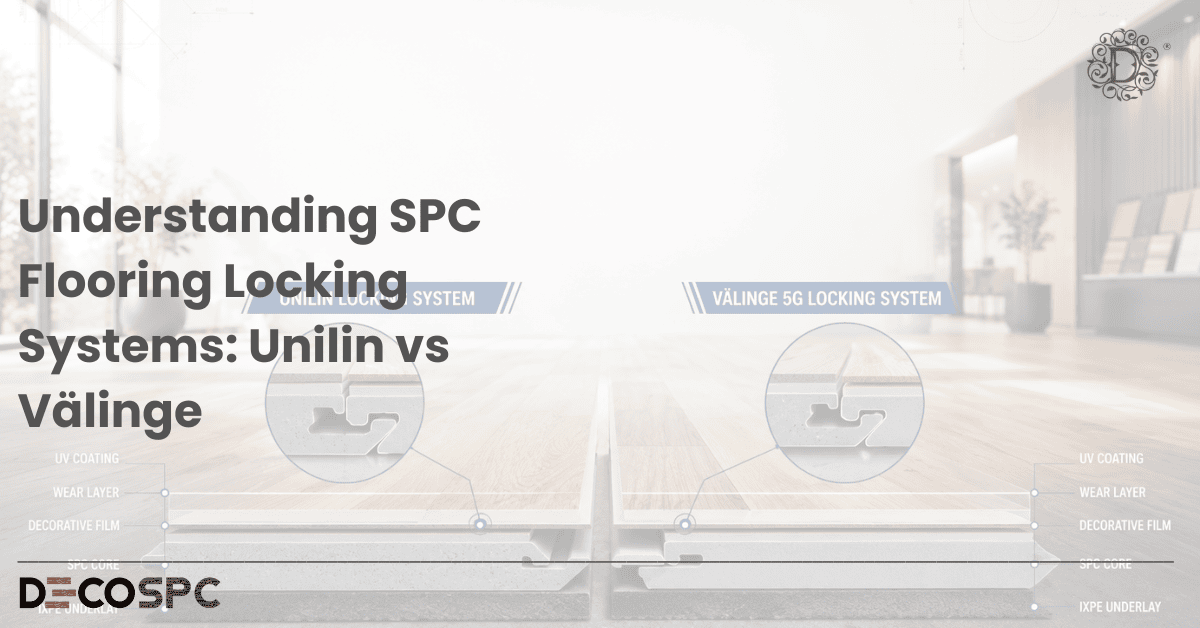
Of all the specification decisions that determine the long-term performance of an SPC flooring installation,the locking system is the one that receives the least attention from buyers and causes some of the most visible and costly failures when it is wrong.The locking system is the engineered joint that connects every plank in the floor to every adjacent plank.It holds the installation together across thousands of joints,through years of thermal expansion and contraction,under the daily mechanical stress of foot traffic,furniture movement,and cleaning.When it is engineered correctly,it is invisible the floor simply stays together and performs as expected.When it is not,the consequences become very visible very quickly: gapping between planks,joint separation,edge chipping,and a floor that the customer associates with the distributor or retailer who sold it to them.This guide explains how SPC locking systems work,what the difference is between the two dominant licensed systems Unilin and Välinge how I4F fits into the landscape,and why the choice between a licensed and an unlicensed system is one of the most commercially significant decisions in any SPC flooring procurement.
Table of Contents
How SPC Flooring Locking Systems Work The Engineering Basics
How SPC Flooring Locking Systems Work The Engineering Basics
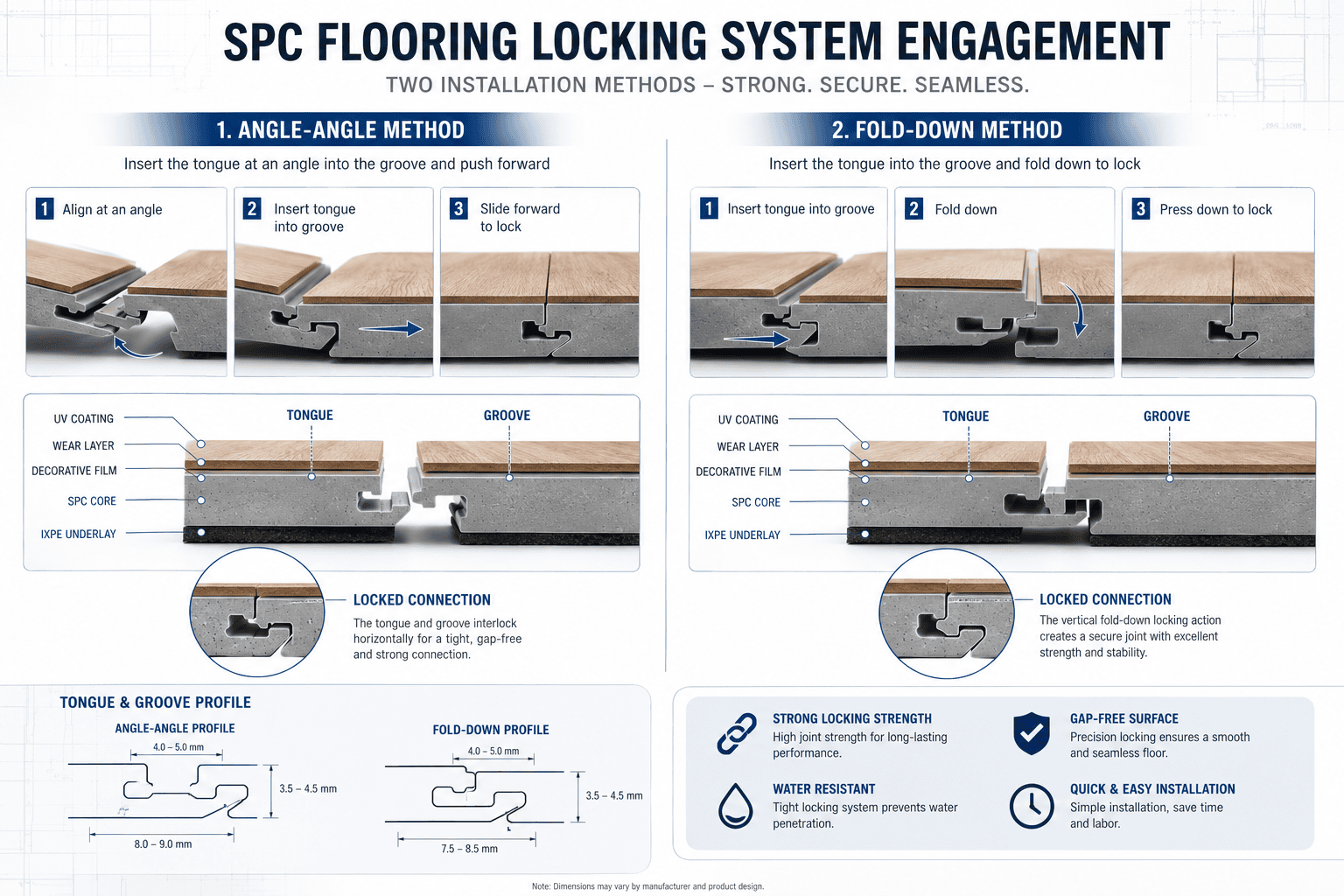
A click-lock locking system in SPC flooring is a precision-engineered mechanical joint machined into the long edges and short ends of every plank.When two planks are brought together at the correct angle and pressed down,the tongue-and-groove profile clicks into engagement creating a joint that holds the planks together horizontally (preventing gapping) and vertically (preventing one plank from rising above the adjacent one,a defect known as lippage).
The quality of this joint depends on three things: the precision of the machining that creates the locking profile,the engineering design of the profile geometry,and the consistency of the core material into which the profile is machined.All three must be correct for the locking system to perform as intended over the life of the installation.A locking profile that is machined from a lower-density or inconsistent core will not hold its dimensional tolerances under load and temperature cycling regardless of how well the profile geometry was originally designed.
There are two primary locking system engagement methods used in SPC flooring.The angle-angle method requires the installer to angle the new plank along the long edge and then rotate it down to engage the short end the most common method for standard click-lock systems.The fold-down method (also called drop-lock or 5G) allows the new plank to be placed flat and pressed straight down into engagement along both edges simultaneously significantly faster to install and more forgiving of installer technique.The fold-down method is a patented innovation and is only available in licensed system products.
Unilin The World's Most Widely Licensed Locking System
Unilin The World's Most Widely Licensed Locking System
Unilin is a Belgian company now part of the Mohawk Industries group that holds one of the most extensive portfolios of flooring locking system patents in the world.Its Uniclic locking system,introduced in the late 1990s,was one of the first commercially successful click-lock flooring systems and transformed the global laminate and later SPC flooring market by making glueless floating floor installation accessible to both professional installers and skilled DIY buyers.
Uniclic The Standard Bearer
The Uniclic system is an angle-angle click-lock profile that creates a tight,consistent joint along both the long edge and short end of each plank.It is licensed to manufacturers globally and is recognised by professional installers across every major flooring market as a benchmark for joint reliability and installation consistency.A product carrying the Uniclic licence has been manufactured to a defined specification standard and the royalty included in the product price reflects the engineering investment behind the joint design.
Uniclic Multifit
Unilin's Uniclic Multifit is an enhanced version of the original Uniclic system that allows both the standard angle method and a straight push-down engagement on the short end giving installers flexibility in tight spaces where angling a full plank is difficult.This dual-engagement capability is particularly valuable in renovation projects where the installation area has complex shapes,narrow corridors,or restricted access that make standard angle installation impractical.
Market Presence and Recognition
Unilin-licensed products are among the most widely recognised in the global flooring trade.Major brands across Europe,North America,Australia,and Asia have built their product ranges on Unilin-licensed systems which means that professional installers in these markets are familiar with the installation method and confident in the joint's reliability.For importers and distributors,specifying a Unilin-licensed product provides an installation quality assurance that a proprietary system cannot match because the Uniclic profile has been validated across billions of square metres of installed flooring in real-world conditions.
Valinge The Innovator Behind 5G and Push-to-Lock Technology
Valinge The Innovator Behind 5G and Push-to-Lock Technology
Välinge is a Swedish company founded in 1993 that has been responsible for some of the most significant innovations in flooring locking system technology over the past three decades.Where Unilin's strength is the breadth and depth of its licensing network,Välinge's strength is continuous innovation developing new joint technologies that improve installation speed,joint strength,and installer accessibility in ways that earlier systems could not achieve.5G Push-to-Lock SystemVälinge's 5G (fifth-generation) locking system is arguably the most significant innovation in flooring installation technology since the original click-lock concept.The 5G system incorporates a flexible tongue typically manufactured from a separate material inserted into the plank edge rather than machined from the plank core that allows the new plank to be placed flat beside the installed plank and pressed straight down into full engagement along the entire length of the joint simultaneously.This fold-down engagement eliminates the angling requirement of conventional click systems,dramatically reducing installation time,reducing installer skill requirements,and making SPC installation significantly more accessible in renovation projects and tight spaces.Woodloc SystemThe Välinge Woodloc system is an angle-angle click lock designed specifically for solid wood and engineered wood flooring but has been adapted for rigid core SPC applications.It is characterised by an exceptionally tight joint tolerance that minimises vertical movement between adjacent planks reducing lippage and producing a flatter,more consistent installed surface than standard click profiles achieve.Välinge 2G and 3G SystemsVälinge's earlier generation systems 2G and 3G remain in active use across the global flooring market and are licensed to a significant number of Chinese and European manufacturers.These systems use the standard angle-angle installation method but incorporate Välinge's engineered joint geometry improvements over first-generation proprietary click designs.Products carrying a Välinge 2G or 3G licence offer a verified quality standard that significantly exceeds proprietary alternatives even without the fold-down innovation of the 5G system.
I4F and Other Licensed Systems The Growing Competitive Landscape
I4F and Other Licensed Systems The Growing Competitive Landscape
The locking system licensing landscape has expanded significantly over the past decade as the global SPC flooring market has grown and the commercial opportunity for locking technology licensing has attracted new entrants.I4F is the most significant alternative to Unilin and Välinge in the current market.
I4F Innovative Flooring Technology
I4F is a Dutch intellectual property company that was formed from a consortium of major flooring manufacturers seeking an alternative to Unilin and Välinge licensing.I4F develops and licenses flooring locking system patents including push-to-lock and fold-down systems and has built a significant licensed manufacturer base across China,Europe,and Southeast Asia.I4F-licensed products offer the same fundamental quality assurance as Unilin or Välinge licensed products the licence fee represents a commitment to an engineered specification standard and I4F's push-to-lock system variants provide comparable installation speed advantages to Välinge 5G for products that carry this specification.
Comparison of the Three Major Licensed Systems
| Factor | Unilin (Uniclic) | Valinge (5G) | I4F |
| Country of origin | Belgium | Sweden | Netherlands |
| Installation method | Angle-angle (Uniclic Multifit offers dual method) | Fold-down push-to-lock (5G) and angle-angle (earlier systems) | Both angle-angle and push-to-lock variants |
| Installation speed | Standard skilled installer required | Fast 5G fold-down reduces skill requirement | Standard to fast depending on variant |
| Joint tolerance | High industry benchmark | Very high Woodloc minimises lippage | High equivalent to Unilin |
| Global recognition | Highest most widely recognised by installers globally | High 5G increasingly specified in premium segment | Growing well established in Europe and China |
| Licensed manufacturer base | Largest globally | Large particularly strong in premium segment | Significant and growing |
| Royalty cost to manufacturer | Standard | Slightly higher for 5G | Competitive alternative to Unilin |
| Best for | Standard residential and commercial SPC | Premium SPC,DIY markets,renovation projects | Mid-to-premium SPC,price-competitive markets |

Licensed vs Proprietary Locking Systems What the Difference Costs Buyers
Licensed vs Proprietary Locking Systems What the Difference Costs Buyers
The choice between a licensed locking system and a proprietary unlicensed system is one of the most commercially consequential decisions in SPC flooring procurement and it is a decision that is frequently made without full awareness of what is at stake.The cost difference between a licensed and an unlicensed system at the ex-factory level is relatively modest typically USD 0.08 to USD 0.18 per square metre.The consequence of choosing the wrong system can be a complete floor replacement.
What Licensed Systems Provide
A licensed locking system provides four things that an unlicensed proprietary system structurally cannot: engineered dimensional tolerances verified against a defined specification standard; ongoing quality control oversight by the licensor through periodic production audits; established installation guidance and technical support documentation that installers in all major markets can access; and legal clarity the manufacturer's right to use the locking geometry is documented and cannot be challenged,protecting the buyer from sourcing product whose locking profile infringes third-party patents.
What Proprietary Systems Risk
A proprietary locking system is one designed and produced by the manufacturer without a licence from a patent holder.This does not automatically mean the system is poor some proprietary systems perform adequately.But it means the system has been produced without independent specification oversight,without licensor quality audits,and without the engineering refinement that comes from decades of real-world performance feedback that the major licensed systems have accumulated.The most common proprietary system failures are joint engagement inconsistency across the length of the plank,insufficient vertical locking strength that allows lippage under load,gapping between planks under thermal cycling,and edge chipping during installation when the joint tolerance is too tight or too loose for the plank's actual dimensional variation.
| Factor | Licensed System | Proprietary System |
| Engineering specification standard | Defined by licensor independently verified | Set by manufacturer no independent oversight |
| Quality control oversight | Licensor conducts periodic production audits | Manufacturer's internal QC only |
| Installation consistency | High same profile geometry across all licensed products | Variable geometry differs between manufacturers |
| Installer familiarity | High licensed profiles are globally recognised | Low installers may be unfamiliar with specific profile |
| Joint failure risk | Low validated across billions of m² of real use | Higher limited real-world validation |
| Ex-factory cost premium | USD 0.08 to USD 0.18 per m² | None no royalty |
| Cost of joint failure | Rarely occurs in correctly manufactured licensed product | Potentially full replacement cost |
How to Verify Locking System Quality Before Purchasing
How to Verify Locking System Quality Before Purchasing
Verifying locking system quality before placing an order requires a combination of documentation checks and physical testing that any buyer can perform without specialist equipment.These steps protect against both the misrepresentation of licensed status and the specification of an unlicensed system that is inadequate for the intended application.
Request the licence number and verify it — Any manufacturer claiming a Unilin,Välinge,or I4F licensed system can provide a licence number.Verify this number directly with the licensor's licensing office or through their public verification tool.This takes five minutes and eliminates the risk of purchasing from a manufacturer who is misrepresenting their locking system as licensed when it is proprietary.
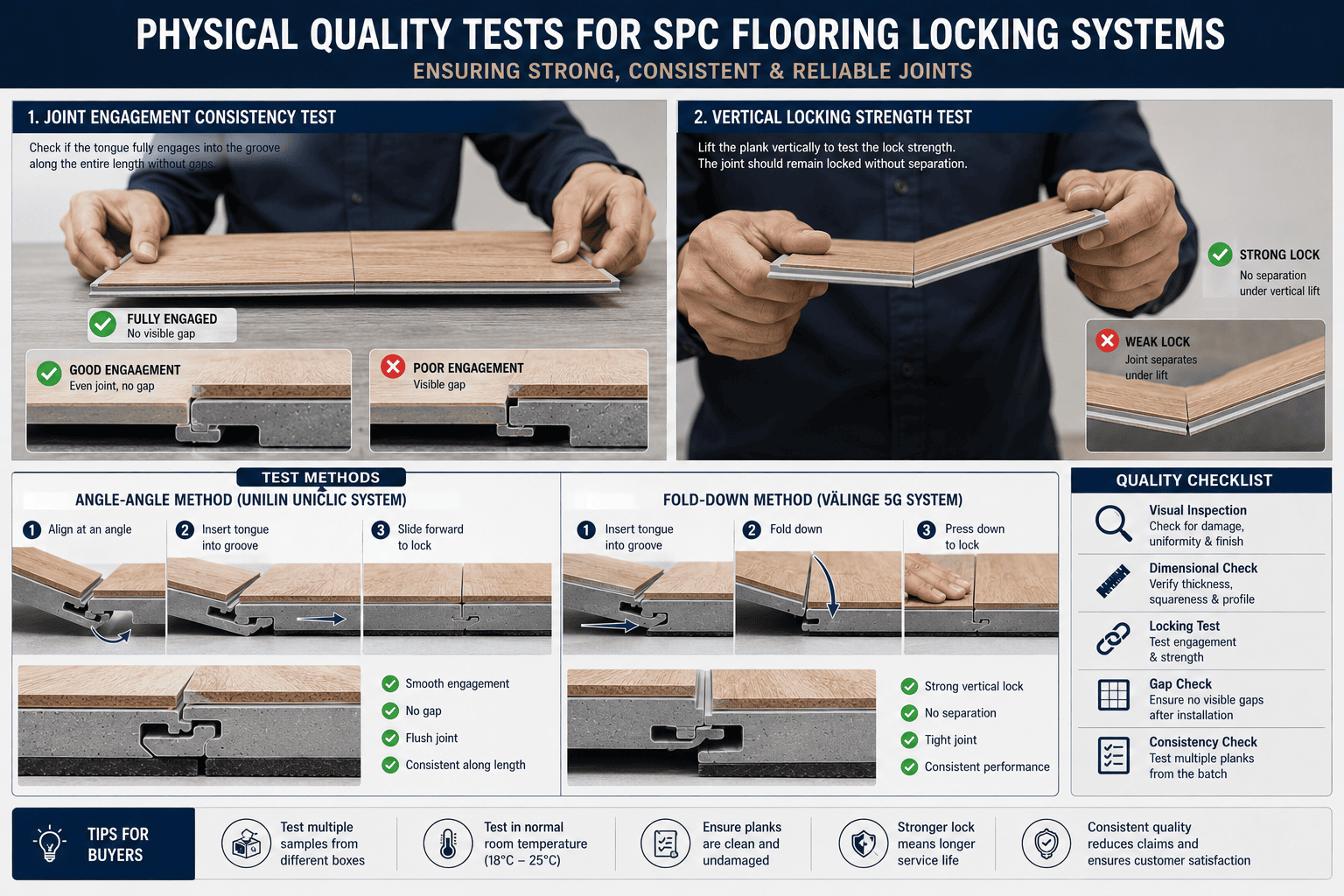
Test the joint engagement on the physical sample — Take two sample planks and engage them by hand using the correct installation method for the claimed system.A correctly engineered licensed system clicks firmly,consistently,and with even resistance along the full length of the joint.Any looseness,uneven resistance,or resistance that varies significantly between different points along the joint indicates a tolerance problem that will produce gapping or joint failure in an installed floor.
Test the vertical locking strength — After engaging two sample planks,attempt to lift one edge of one plank while holding the adjacent plank flat.A correctly engineered system should resist this movement firmly the vertical locking engagement should hold the plank down with significant resistance.Easy vertical separation indicates insufficient vertical lock geometry that will allow lippage under load in an installed floor.
Check the short-end joint separately — Many locking system problems manifest at the short end of the plank rather than the long edge.Engage two planks at the short end and apply the same engagement quality tests.Short-end joint quality is frequently lower than long-edge quality in budget products because less machining investment is applied to the shorter profile run.
Specify the locking system in the purchase contract — Include the specific licensed system Unilin Uniclic,Välinge 5G,I4F by name in the purchase contract.This creates a contractual obligation for the manufacturer to supply the licensed system rather than substituting a proprietary alternative between sample approval and bulk production a substitution that is more common than buyers expect and one of the most financially damaging specification changes a manufacturer can make without disclosure.
Need SPC flooring with a verified licensed locking system
Decospaa International provides full Technical Data Sheets backed by original third party laboratory certificates for every SPC flooring product in our range.Contact our team for product samples,complete TDS documentation,and competitive wholesale pricing for importers and project buyers across India,the Middle East,Africa,and Southeast Asia.
store.decospaainternational.com | info@decospaainternational.com | +91 86002 04089