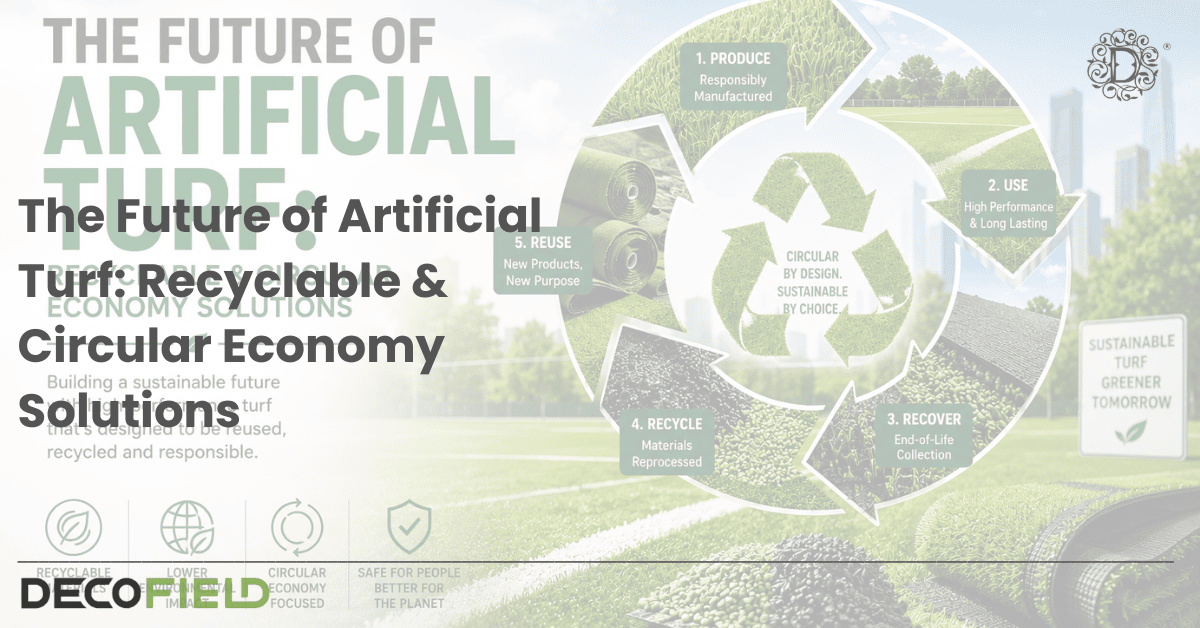
For decades,artificial turf carried a sustainability contradiction that the industry struggled to answer.It saved water,eliminated pesticides,and reduced lawn maintenance emissions but at the end of its useful life,the vast majority of it ended up in landfill.A single sports pitch contains 60 to 100 tonnes of synthetic material polyethylene fibres,rubber infill,polypropylene backing that takes centuries to decompose.Globally,an estimated 40,000 to 50,000 tonnes of end-of-life artificial turf entered landfill every year through the 2010s.In 2026,that is changing.Recyclable turf technology,circular economy business models,and alternative infill materials have matured to the point where sustainable artificial turf is no longer a niche aspiration it is a commercially available,specification-ready reality in most major markets.This guide covers where the industry stands,what is genuinely possible,and what buyers need to know to make purchasing decisions that align with both performance requirements and sustainability goals.
Table of Contents
Why Artificial Turf and Landfill Became Synonymous The End-of-Life Problem
Why Artificial Turf and Landfill Became Synonymous The End-of-Life Problem
Artificial turf is a composite product and composites are notoriously difficult to recycle.A standard artificial grass system consists of three distinct material layers bonded together during manufacturing: the synthetic fibre pile (typically polyethylene or polypropylene),the woven primary backing (polypropylene),and the secondary coating (latex or polyurethane).In sports turf applications,thousands of tonnes of SBR rubber or EPDM infill are embedded within the fibre pile.Separating these materials after 10 to 15 years of outdoor use when they have been exposed to UV radiation,temperature cycling,moisture,and physical compression has historically been technically complex,energy-intensive,and economically unviable at most commercial scales.
The practical consequence was straightforward.When a football pitch needed resurfacing or a residential lawn needed replacement,the old turf was rolled up,loaded onto trucks,and sent to landfill.In the UK alone,an estimated one million square metres of artificial turf reaches end of life every year.In the US,the figure approaches ten million square metres annually.Across Europe,pressure from regulators,environmental groups,and sustainability-conscious procurement managers has been building steadily for the past decade and it has forced the industry to develop solutions that simply did not exist ten years ago.The results are now commercially available and increasingly specified across leading markets.
Recyclable Turf Technology What Has Changed and What Is Now Possible
Recyclable Turf Technology What Has Changed and What Is Now Possible
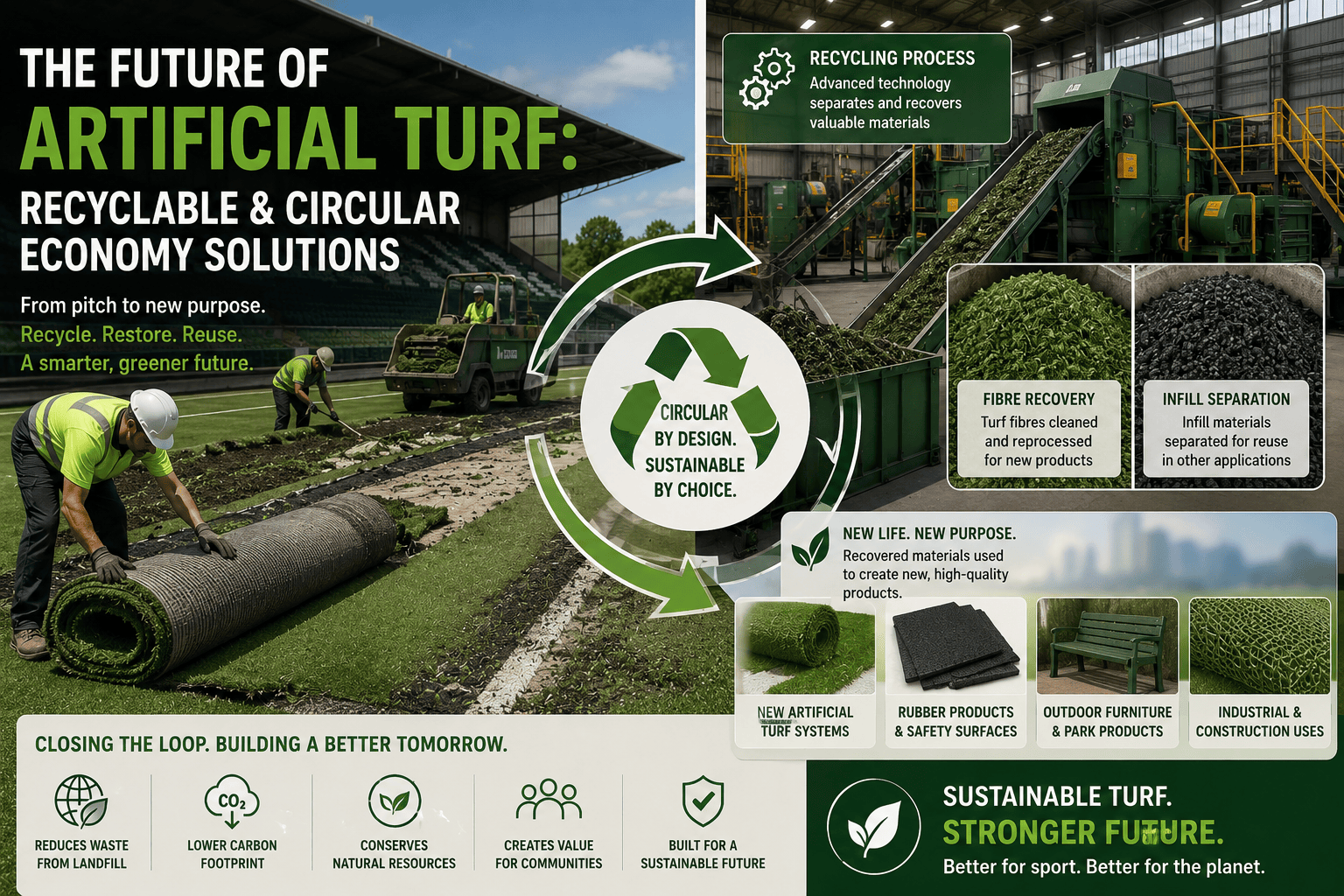
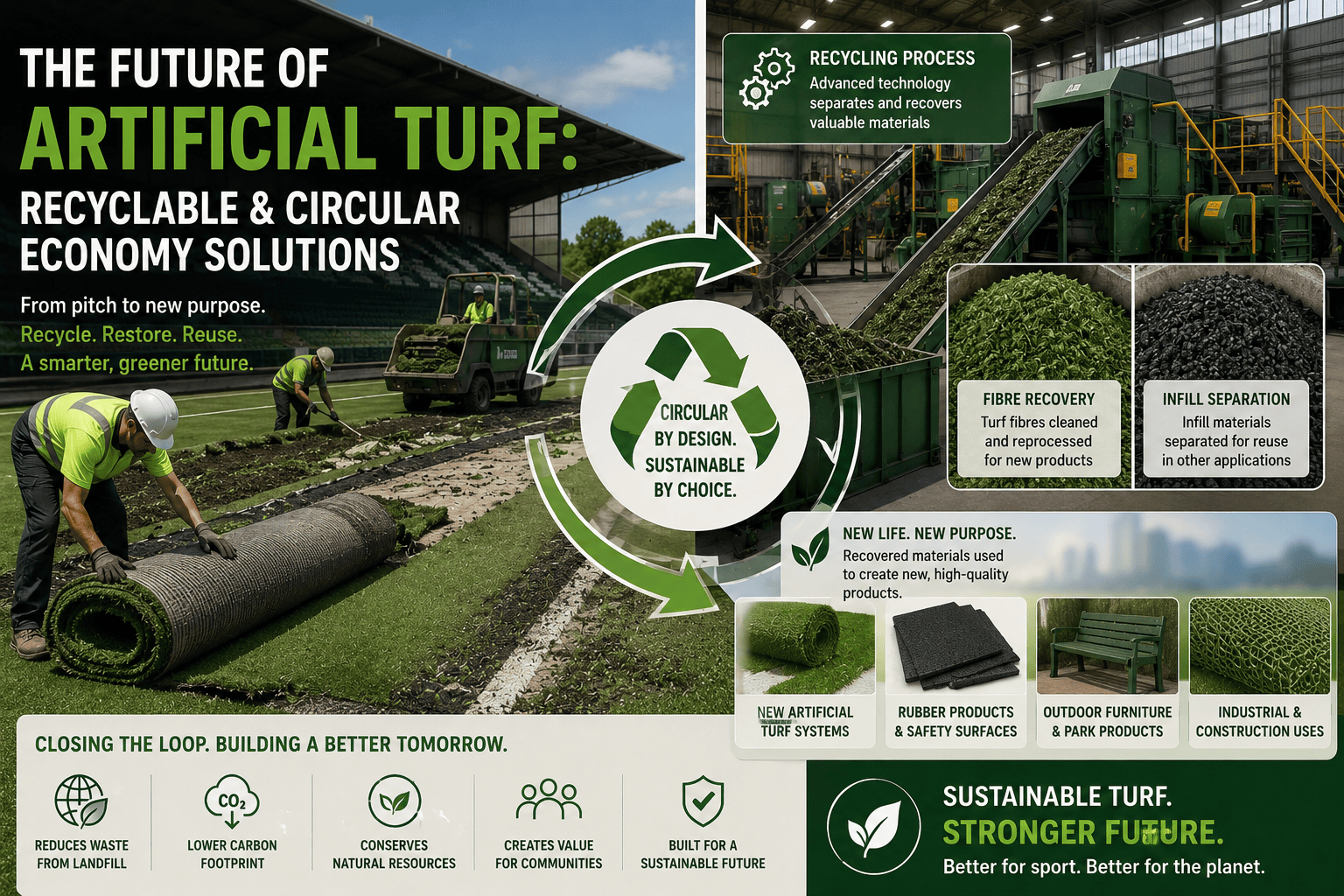
The technological shift that has made recyclable artificial turf a practical reality is the development of mono-material turf systems products in which the fibre,backing,and coating are all made from the same polymer family,typically polyethylene.When all components share the same base material,the entire product can be processed through standard plastic recycling infrastructure without the complex separation processes that made conventional composite turf unrecyclable.
Mono-Material Polyethylene Systems
Mono-material PE turf systems use a polyethylene fibre pile tufted into a polyethylene backing,coated with a polyethylene-based adhesive rather than traditional latex or polyurethane.At end of life,the entire roll can be processed through standard PE plastic recycling streams to produce recycled PE pellets used in the manufacture of new products.Several European manufacturers have commercialised mono-material turf systems and they are increasingly specified in sustainability-conscious procurement across Europe and Australia.Performance characteristics in well-engineered mono-material systems are now equivalent to conventional composite turf across all key specification parameters.
Thermoplastic Polyurethane Backing Systems
TPU backing is an alternative to traditional latex that offers significantly improved recyclability without requiring a full mono-material system.TPU can be mechanically separated from polyethylene fibre more easily than latex or standard polyurethane,enabling a two-stream recycling process.TPU backing also delivers performance advantages it is more flexible,lighter,and more resistant to hydrolysis in humid climates making it an increasingly attractive specification on performance grounds independently of its recyclability benefit.
Mechanical Recycling and Downcycling
For conventional composite turf that cannot be fully recycled,mechanical processing offers a partial solution.Specialist recycling facilities operating in the Netherlands,Belgium,Germany,and increasingly in the UK and US can shred end-of-life turf and use the resulting mixed polymer material as input for road surfacing,acoustic panels,and construction materials.While this is technically downcycling rather than true circular recycling,it diverts significant material volumes from landfill and represents a meaningful improvement over disposal in markets where mono-material turf is not yet widely available.
Circular Economy Models Operating in the Artificial Turf Industry
Circular Economy Models Operating in the Artificial Turf Industry
True circular economy thinking goes beyond making a product recyclable at end of life.It reimagines the entire product lifecycle from raw material sourcing through manufacturing,installation,use,and end-of-life processing as a closed loop in which materials retain their value and re-enter the production system rather than being discarded.Several models are now operating at commercial scale in the artificial turf industry in 2026.Manufacturer Take-Back ProgrammesSeveral European turf manufacturers now offer formal take-back programmes where they collect end-of-life product from customers,process it through their own or partner recycling facilities,and use recovered material in new product manufacturing.This model creates a closed loop within the manufacturer's supply chain and provides buyers with a guaranteed end-of-life pathway at the point of purchase rather than at the point of disposal a significant procurement benefit for institutional and commercial buyers with sustainability reporting obligations.Product-as-a-Service Leasing ModelsAn emerging model in which the turf manufacturer retains ownership of the product throughout its useful life and leases it to the buyer on a per-square-metre-per-year basis.At end of life,the manufacturer collects and processes the product as part of the service agreement,eliminating the buyer's disposal responsibility entirely.This model also incentivises the manufacturer to produce the most durable and recyclable product possible because the longevity and recyclability of the product directly affects the manufacturer's own cost of service.Currently at early commercial stage in Europe and the US,this model is expected to grow significantly through 2026 to 2030.Recycled Content in New Turf ProductionLeading manufacturers are incorporating recycled PE content sourced from post-consumer plastic waste including bottles,packaging,and recovered ocean fishing nets into the production of new synthetic turf fibres.Products with documented recycled content percentages are increasingly specified in sustainability-focused procurement globally.Recycled content fibres are now available with performance characteristics equivalent to virgin PE at comparable price points,making recycled content specification a zero-compromise sustainability choice for buyers in most market segments.
Alternative and Bio-Based Infill Solutions Replacing SBR Rubber
Alternative and Bio-Based Infill Solutions Replacing SBR Rubber
SBR rubber crumb rubber derived from shredded end-of-life vehicle tyres has been the dominant infill material in sports turf installations for decades.In 2026,that dominance is under serious regulatory and commercial pressure.EU restrictions on SBR rubber infill on sports surfaces took effect in 2022 with a five-year phase-out period that makes it effectively non-compliant for new EU installations by 2027.For children's play areas and school sports pitches in any market,the health and precautionary case for avoiding SBR infill is compelling regardless of local regulatory status.
| Infill Material | Source | Key Benefits | Limitations | Market Readiness |
| EPDM Rubber | Virgin or recycled synthetic rubber | Good performance,colour options,PFAS-free available | Higher cost than SBR,not bio-based | Commercially available globally |
| Cork | Harvested cork bark renewable | Natural,bio,based,biodegradable,good thermal properties | Higher cost,variable consistency | Growing specialist suppliers |
| Coconut Fibre (Coir) | Coconut husk processing byproduct | Fully,natural,biodegradable,low cost,good drainage | Shorter lifespan,requires topping up | Available popular in Europe and Australia |
| Olive Kernel | Olive oil production byproduct | Natural,renewable,good performance characteristics | Limited availability outside Mediterranean | Emerging growing in Southern Europe |
| Thermoplastic Elastomer (TPE) | Engineered polymer recyclable | Recyclable,PFAS,free,consistent performance,long lifespan | Higher cost than SBR,not bio based | Commercially available growing adoption |
| Sand Only | Natural silica sand | Zero infill waste,simple maintenance,low cost | Reduced performance for high-intensity sports | Widely available suitable for landscape and low-traffic use |
What Recyclable Turf Claims Actually Mean And How to Verify Them
What Recyclable Turf Claims Actually Mean And How to Verify Them
Sustainability marketing in the artificial turf industry has moved faster than the verification standards available to validate it.Terms like "recyclable","eco-friendly","sustainable",and "circular" appear across product marketing with varying degrees of accuracy and substantiation.Buyers need to understand what each claim should mean and what documentation is required to confirm it before making procurement decisions on sustainability grounds.
| Sustainability Claim | What It Should Mean | How to Verify | Red Flag |
| 100% Recyclable | All components processable through available recycling infrastructure | Specific recycling pathway and processing partner named for buyer's geography | Theoretically recyclable but no practical pathway in buyer's market |
| Recycled Content | Defined percentage made from post-consumer or post-industrial recycled material | Global Recycled Standard (GRS) certificate confirming percentage | Unverified percentage claims without third-party certification |
| Carbon Neutral | Lifecycle carbon emissions offset or eliminated through verified programme | Third-party lifecycle assessment (LCA) report from accredited body | Carbon offset claims without verified LCA methodology |
| Eco-Friendly Infill | Infill is bio-based,natural,or recycled content without restricted chemicals | Material safety data sheet plus third-party restricted substance test | Vague "natural" claims without material specification or testing |
| Take-Back Programme | Manufacturer commits to collecting and processing end-of-life product | Written programme terms with logistics and processing confirmation | Take-back limited to regions that exclude the buyer's market |
A Sustainability Procurement Guide for Artificial Turf Buyers
A Sustainability Procurement Guide for Artificial Turf Buyers
Whether you are specifying a sports pitch,building a sustainable product range as an importer,or making a conscious purchasing decision as a homeowner or developer,these are the demands and questions that move sustainability from marketing language into verified procurement criteria.
Request a complete product composition declaration — What polymer is the fibre? What is the backing material? What adhesive or coating is used? Is the product mono-material or composite? A manufacturer confident in their sustainability credentials will provide this without hesitation.
Demand the specific end-of-life pathway for your geography — Where does this product go at end of life in your market? Who collects it? Who processes it? What does it become? A recyclable claim with no practical answer to these questions is marketing without substance.
Specify alternative infill for children's areas and school sports pitches — Regardless of current local regulation,the precautionary case for avoiding SBR rubber in spaces used by children is compelling.Cork,coir,TPE,or EPDM should be standard specification for these applications in any market in 2026.
Request GRS or RCS certification if recycled content is claimed — Global Recycled Standard or Recycled Claim Standard certificates confirm recycled content through independent third-party verification.Unverified percentage claims from suppliers are not sufficient for any sustainability reporting purpose.
Include end-of-life responsibility in the purchase contract — For large commercial and sports installations,specify clearly in the contract whether the supplier or buyer is responsible for end-of-life collection and processing.If a take-back programme is offered,document the commitment,the logistics,and the processing destination explicitly before signing.
Prioritise longevity as your primary sustainability strategy — A turf product that lasts 18 years has a significantly lower environmental footprint per year of use than one that lasts 10 years even if both are made from identical materials.Specifying premium quality product with a documented long lifespan is one of the most effective and immediately available sustainability decisions any buyer can make,in any market,today.
Looking for sustainable premium artificial grass for your project
Decospaa International sources premium artificial grass from certified manufacturing partners with documented sustainability credentials,PFAS-free options,and alternative infill solutions for residential,commercial,and sports applications across India,the Middle East,Africa,and Southeast Asia.Contact our team for product samples,sustainability documentation,and competitive wholesale pricing.
store.decospaainternational.com | info@decospaainternational.com | +91 86002 04089