

Walk into any flooring showroom in 2026 and your customers face four product categories that look remarkably similar on the surface but perform very differently in real-world use.SPC,laminate,WPC,and LVT are the four dominant hard flooring formats in the global market and the confusion between them is one of the most common reasons buyers make the wrong choice for their space.Each has a distinct construction,a distinct performance profile,and a distinct set of applications where it genuinely excels.As a distributor,retailer,or project specifier,your ability to explain these differences clearly and guide customers to the right product is one of the most valuable services you can provide and one of the most effective ways to build the trust that generates repeat business.This guide gives you a complete,honest comparison of all four flooring types so you can have that conversation with confidence.
Table of Contents
Understanding the Four Flooring Types Construction and Core Differences
Understanding the Four Flooring Types Construction and Core Differences
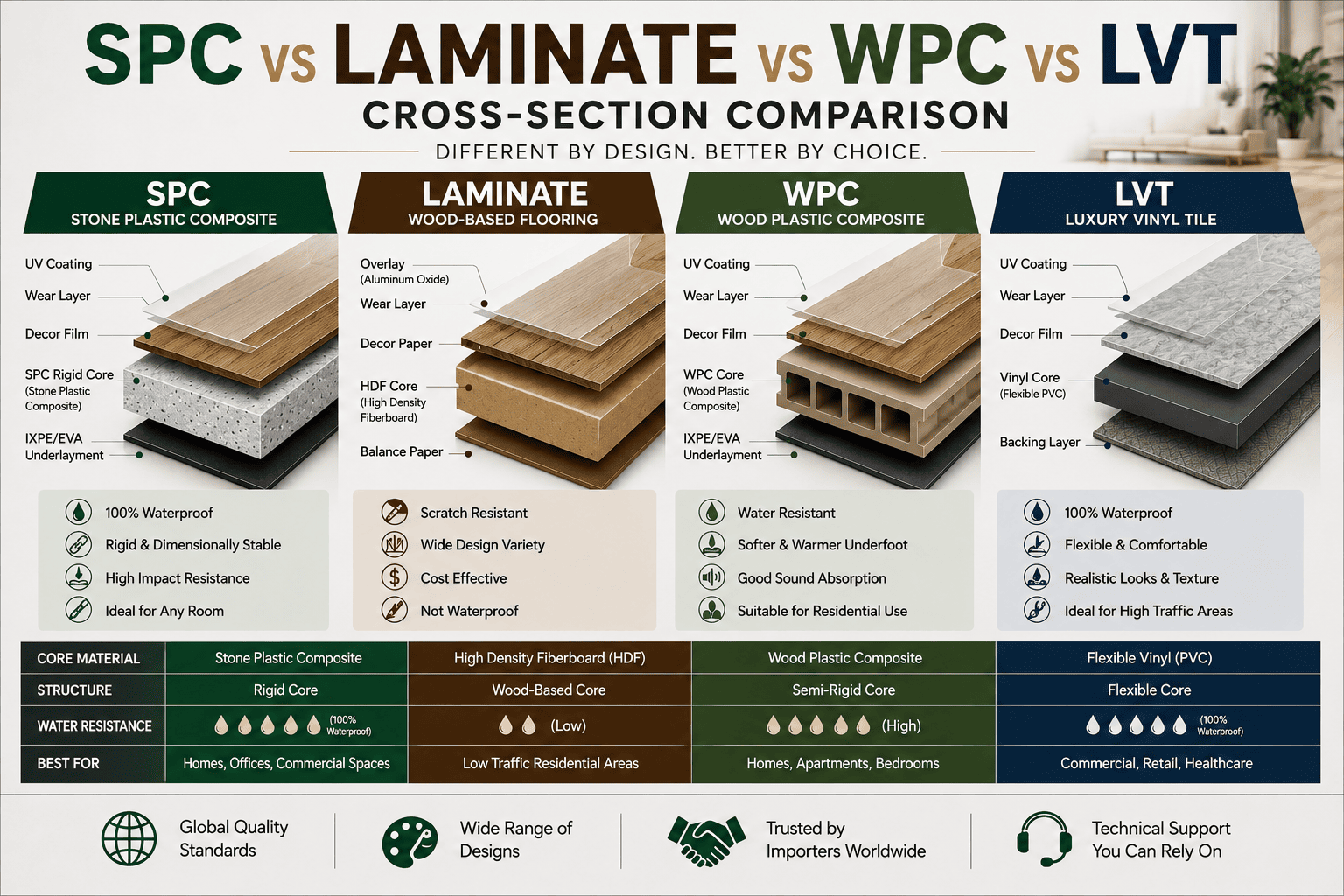
Before comparing performance,it is essential to understand what each product actually is at the construction level.The core material of a flooring product determines almost everything about how it performs its response to moisture,its dimensional stability under temperature change,its feel underfoot,and its long-term durability.These are not interchangeable products with different names.They are fundamentally different constructions that happen to share similar surface aesthetics.
SPC Stone Plastic Composite
SPC flooring has a rigid core made from a blend of limestone powder,polyvinyl chloride,and stabilising agents.This stone-plastic composite core is dense,dimensionally stable,and 100% waterproof.It does not expand,contract,or warp in response to changes in temperature or humidity making it genuinely suitable for installation in kitchens,bathrooms,and spaces subject to high moisture exposure.The rigid core also makes SPC the most stable of the four product types underfoot it does not flex or give when walked on,which many buyers associate with quality and durability.
Laminate High-Density Fibreboard Core
Laminate flooring is a wood-based product with a core made from high-density fibreboard compressed wood fibre bonded with resin under high pressure.The HDF core is laminate's defining structural characteristic and also its most significant limitation.Wood fibre absorbs moisture.In humid climates,around persistent water exposure,or after a significant spill that is not immediately addressed,laminate planks swell,buckle,and warp.The damage is usually permanent and cannot be reversed without replacement.Laminate is the oldest and most established of the four product types it has been on the market for over four decades but its moisture vulnerability is a fundamental limitation that no surface treatment fully resolves.
WPC Wood Plastic Composite
WPC flooring uses a core made from a blend of wood fibre and PVC or polyethylene a composite that sits between the pure polymer core of SPC and the wood-based core of laminate.WPC is waterproof unlike laminate but its core is less rigid and less dense than SPC because the wood fibre content introduces a degree of compressibility and dimensional variability.WPC planks are typically thicker than SPC (6mm to 8mm versus 4mm to 6mm for most SPC),which gives them a softer,warmer underfoot feel that some buyers prefer.However,the softer core also means WPC is more susceptible to denting under heavy point loads than SPC.
LVT Luxury Vinyl Tile
LVT is a flexible vinyl product the original luxury vinyl category from which SPC and WPC later evolved.A standard LVT plank has a flexible PVC core rather than a rigid composite core,which means it conforms to minor subfloor imperfections more readily than SPC or WPC.LVT is waterproof and durable but its flexibility means it requires a very flat and smooth subfloor for installation any lumps or dips in the subfloor telegraph through the flexible vinyl surface and become visible and tactile defects.LVT is available in glue-down and click-lock formats.Glue-down LVT provides the most stable installation but is significantly more labour-intensive to install and replace.
Full Head-to-Head Performance Comparison
Full Head-to-Head Performance Comparison
Here is a complete performance comparison across every factor that matters in a flooring purchase decision for residential buyers,commercial specifiers,and project managers alike.
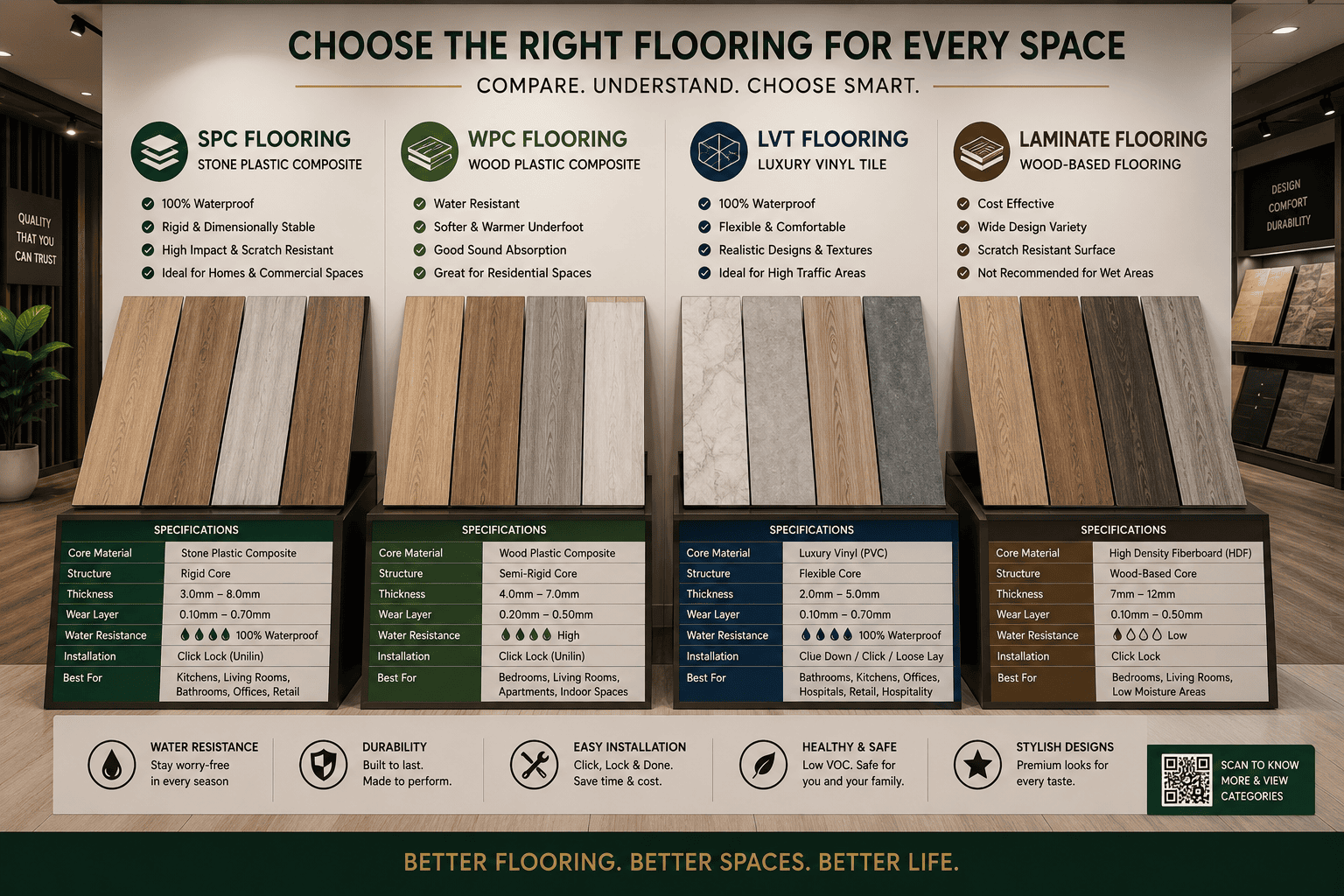
| Performance Factor | SPC | Laminate | WPC | LVT |
| Core material | Limestone and PVC composite | High-density fibreboard (HDF) | Wood fibre and PVC blend | Flexible PVC |
| 100% waterproof | ✅ Yes | ❌ No | ✅ Yes | ✅ Yes |
| Dimensional stability | Excellent rigid core resists all movement | Poor in humidity swells and gaps | Good better than laminate | Moderate flexible core moves with subfloor |
| Underfoot feel | Firm and solid | Warm and slightly hollow | Soft and comfortable | Soft and flexible |
| Subfloor requirement | Minor imperfections tolerated | Very flat subfloor needed | Minor imperfections tolerated | Very flat and smooth strict requirement |
| Wear layer thickness | 0.3mm to 1.0mm | AC3 to AC5 (0.2mm to 0.6mm) | 0.3mm to 0.5mm | 0.3mm to 0.7mm |
| Suitable for wet areas | ✅ Yes kitchens,bathrooms | ❌ No avoid all wet areas | ✅ Yes | ✅ Yes |
| Underfloor heating | ✅ Compatible | ⚠️ Limited check specification | ✅ Compatible | ✅ Compatible |
| Acoustic performance | Good with pre-attached underlay | Very good thick HDF absorbs sound | Excellent thick soft core | Good with underlay |
| Scratch resistance | Excellent hard wear layer | Good melamine surface | Good | Good to excellent |
| Expected lifespan | 15 to 25 years | 10 to 15 years (less in humid climates) | 15 to 20 years | 15 to 20 years |
| Installation method | Click-lock floating | Click-lock floating | Click-lock floating | Click-lock or glue-down |
Which Flooring Works Best in Indian and Tropical Climates
Which Flooring Works Best in Indian and Tropical Climates
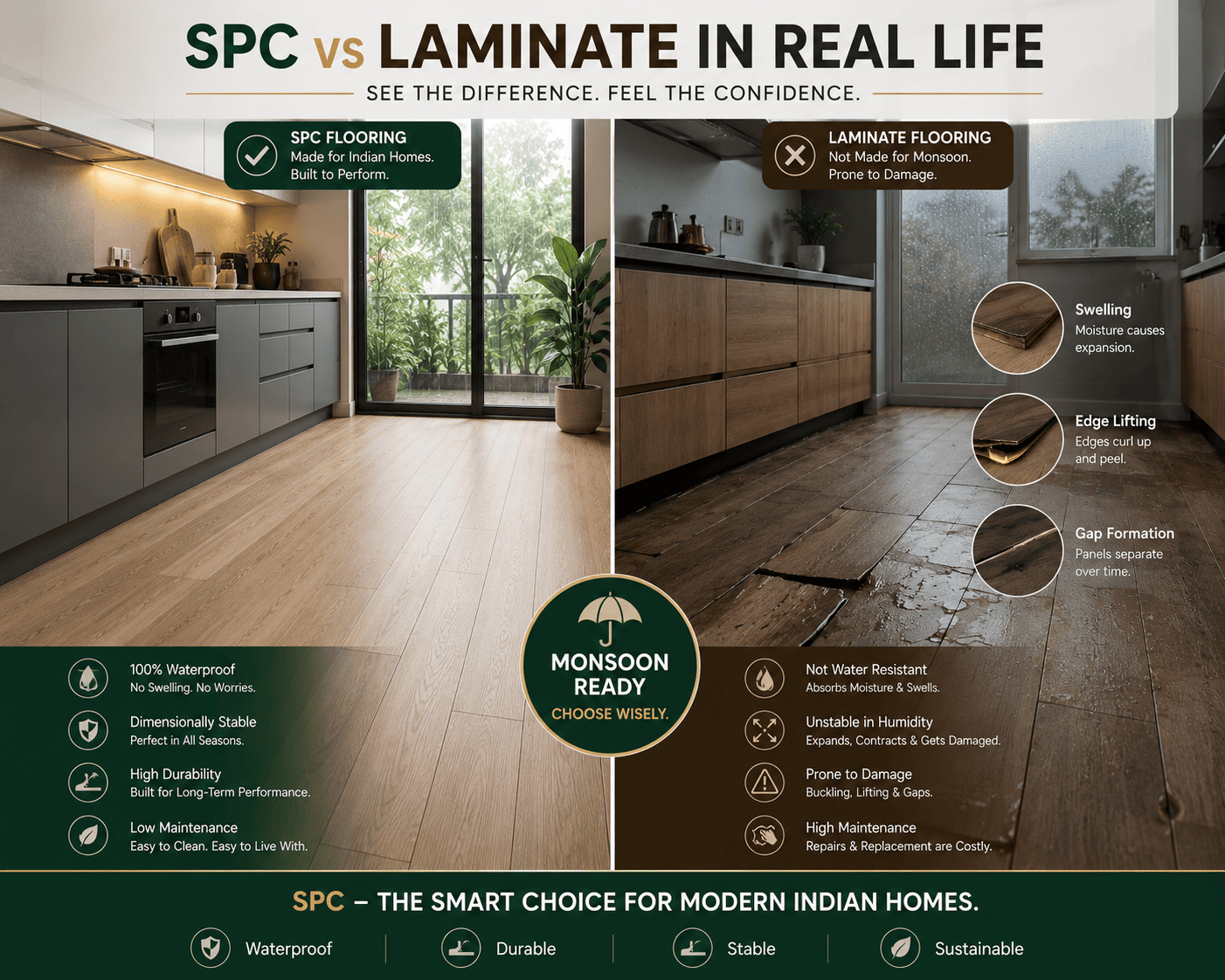
India and tropical markets present flooring with a unique and demanding set of climate challenges.Temperatures that swing from near-zero in northern winters to 48°C in summer.Monsoon humidity levels that regularly exceed 90%.Daily wet mopping as standard household practice.Ground-floor installations in direct contact with moisture-laden concrete slabs.These conditions are fundamentally different from the temperate European and North American climates for which many flooring products are originally designed and performance in Indian conditions must be evaluated specifically,not assumed from general product marketing.SPC in Indian and Tropical ConditionsSPC is the strongest performer in Indian and tropical climates of the four product types.Its limestone composite core is completely unaffected by humidity,temperature extremes,or standing water.It can be wet-mopped daily without any risk to the core or surface.Its dimensional stability means it does not gap,buckle,or warp through seasonal temperature and humidity cycling.For kitchens,ground-floor living areas,and any space in a monsoon-prone region,SPC is the default recommendation for buyers who understand what Indian conditions demand from a floor.Laminate in Indian and Tropical ConditionsLaminate performs poorly in Indian and tropical conditions.The HDF core absorbs ambient humidity over time and swells visibly at plank edges and joints a phenomenon known as edge lifting that is extremely common in Indian laminate installations.Daily wet mopping,even with a well-wrung mop,introduces sufficient moisture at the joints to accelerate this process significantly.Laminate installed in non-air-conditioned rooms in humid climates typically shows visible degradation within two to three years.For dry,air-conditioned bedrooms in homes where daily mopping with water is avoided,laminate can perform adequately but this represents a narrow use case in the Indian residential context.WPC and LVT in Indian and Tropical ConditionsWPC performs well in Indian conditions it is waterproof,dimensionally stable,and comfortable underfoot.Its slightly softer core and thicker profile make it a good choice for bedrooms and living areas where comfort is prioritised.LVT performs adequately in Indian conditions but its strict subfloor flatness requirement is a practical challenge in Indian construction where slab flatness is highly variable.Glue-down LVT in particular can be problematic if the adhesive is not appropriate for the high humidity and temperature cycling conditions of the Indian climate.
Cost Comparison Supply Price,Installation,and Total Cost of Ownership
Cost Comparison Supply Price,Installation,and Total Cost of Ownership
Price is almost always part of the flooring conversation but the upfront supply price is rarely the most important cost figure.Total cost of ownership which includes installation,underlayer if required,expected lifespan,and the cost of replacement at end of life is a more honest and more useful comparison for buyers making a decision that will last 10 to 20 years.
| Cost Factor | SPC | Laminate | WPC | LVT |
| Supply price (per sq ft) India | ₹55 to ₹140 | ₹35 to ₹90 | ₹65 to ₹150 | ₹50 to ₹130 |
| Underlayer required | Usually pre-attached | Separate ₹8 to ₹15 per sq ft | Usually pre-attached | Separate for click-lock |
| Installation cost (per sq ft) | ₹15 to ₹25 | ₹15 to ₹25 | ₹18 to ₹28 | ₹15 to ₹30 |
| Expected lifespan (India) | 15 to 25 years | 5 to 10 years (humid spaces) | 12 to 18 years | 12 to 18 years |
| Maintenance cost | Very low | Moderate avoids water | Very low | Low |
| Replacement risk | Low | High in humid climates | Low | Low to moderate |
| Total cost of ownership | Best over 15 years | Higher early replacement likely | Good | Good |
Space-by-Space Recommendation Guide
Space-by-Space Recommendation Guide
Different spaces within a home or commercial property have different performance requirements.Here is a clear,practical recommendation guide for the most common installation scenarios.
| Space | Best Choice | Acceptable Alternative | Avoid |
| Kitchen | SPC | LVT,WPC | Laminate |
| Bathroom and utility | SPC | LVT | Laminate,WPC |
| Living room (AC) | SPC or WPC | LVT,laminate in dry climates | Laminate in humid zones |
| Bedroom (dry,AC) | WPC or SPC | LVT,laminate in controlled environments | Laminate in non-AC rooms |
| Ground floor apartment | SPC | WPC,LVT | Laminate |
| Balcony or semi-outdoor | SPC (check UV spec) | LVT (covered only) | Laminate,WPC |
| Hotel corridor | SPC (0.5mm+ wear layer) | LVT (glue-down) | Laminate,standard WPC |
| Office or retail | SPC (0.7mm+ wear layer) | LVT (glue-down commercial) | Laminate,WPC |
| Children's playroom | WPC or SPC | LVT | Laminate |
How to Guide Your Customers to the Right Choice
How to Guide Your Customers to the Right Choice
The best flooring sales conversation is not a product pitch — it is a diagnostic process.The right product for any customer depends on their specific space,climate,usage intensity,and budget.These are the questions that lead to the right recommendation every time.
Where is the floor going — Kitchen,bathroom,bedroom,living room,commercial space? This single question eliminates laminate from most Indian residential applications and narrows the choice to SPC,WPC,or LVT based on the specific space requirements.
Is the space air-conditioned — Non-air-conditioned spaces in India are subject to much wider temperature and humidity swings.SPC's rigid core handles these conditions most reliably.WPC is a good second choice.LVT is acceptable.Laminate is not appropriate.
How will the floor be cleaned — If the customer mops with water — which is standard Indian practice — eliminate laminate immediately.SPC is the correct recommendation for any customer who mops with water.
What is the budget and over what timeframe — Present total cost of ownership rather than supply price alone.A customer who understands that SPC at ₹80 per square foot lasting 20 years costs less than laminate at ₹50 per square foot replaced after seven years will make a better decision — and will thank you for the guidance rather than returning with a complaint.
What matters most comfort,durability,or aesthetics — Comfort-focused buyers often prefer WPC for its softer underfoot feel.Durability-focused buyers should be directed to SPC with a 0.5mm or above wear layer.Aesthetics-focused buyers can be well-served by any of the four products — the visual quality of surface finishes across SPC,WPC,LVT,and laminate is now broadly equivalent at equivalent price points.
Is there any existing flooring on the subfloor — SPC and WPC can often be installed directly over existing tile or concrete with minor levelling.LVT requires a very flat surface.Laminate requires a dry,flat subfloor with no existing tile ridges.Subfloor condition is a practical constraint that should be assessed before any product recommendation is finalised.
Looking for the right flooring for your project or distribution range
Decospaa International supplies certified SPC flooring across residential,commercial,and hospitality specifications for projects and wholesale buyers across India,the Middle East,Africa,and Southeast Asia.Contact our team for product samples,specification guidance,and competitive wholesale pricing.
store.decospaainternational.com | info@decospaainternational.com | +91 86002 04089