

Flooring in a hospital,clinic,diagnostic centre,or cleanroom is not an interior design decision.It is an infection control decision,a patient safety decision,and in many jurisdictions a regulatory compliance decision.The wrong flooring in a healthcare setting does not merely look inappropriate it harbours bacteria in surface joints,releases chemical emissions that compromise air quality in enclosed clinical environments,creates slip hazards for patients with compromised mobility,and generates maintenance requirements that conflict with the disinfection protocols that healthcare facilities must operate under daily.SPC flooring has emerged as one of the most technically suitable flooring options for healthcare and cleanroom environments in 2026 but only when it is specified correctly.Not every SPC product is suitable for clinical use.The specifications that make SPC appropriate for a residential kitchen are materially different from those required for a hospital corridor,an operating theatre anteroom,or an ISO Class 7 cleanroom.This guide gives procurement teams,project managers,architects,and distributors the complete specification framework for SPC flooring in healthcare and cleanroom applications.
Table of Contents
Why Healthcare Flooring Demands a Different Specification Framework
Why Healthcare Flooring Demands a Different Specification Framework
The performance requirements of flooring in a healthcare environment are fundamentally different from those of any other building type and the consequences of specification failure are correspondingly more serious.In a residential or commercial office installation,a flooring failure is an aesthetic and financial problem.In a hospital or clinic,it can be an infection control failure that contributes directly to healthcare-associated infections (HAIs) one of the most significant patient safety challenges in healthcare facilities globally.
Healthcare flooring must satisfy requirements across four distinct dimensions simultaneously.It must be hygienic presenting a surface that does not harbour pathogens,that can be fully disinfected with hospital-grade chemical agents,and that does not develop surface conditions over time (cracking,joint separation,surface porosity) that create reservoirs for bacterial or fungal growth.It must be safe providing consistent slip resistance under both dry and wet conditions,including the wet conditions created by spills,patient incontinence,and cleaning operations.It must be durable withstanding the sustained mechanical demands of heavy medical equipment,wheeled beds and trolleys,and the concentrated foot traffic of clinical areas that operate continuously rather than intermittently.And it must be compliant meeting the specific regulatory and standard requirements that apply to healthcare facility construction in the applicable jurisdiction.
SPC flooring satisfies all four of these requirements more comprehensively than most alternative flooring types when correctly specified offering the waterproof core,chemical resistance,dimensional stability,and surface hygiene properties that healthcare environments require,at a cost point that makes it competitive with the sheet vinyl and homogeneous vinyl products that have historically dominated clinical flooring specification.
Core SPC Specification Requirements for Clinical Environments
Core SPC Specification Requirements for Clinical Environments
The baseline specification for SPC flooring in any healthcare application is materially more demanding than the standard residential or light commercial specification.Every parameter in the following section represents a minimum not a target for clinical use.
Wear Layer Thickness
Healthcare SPC should specify a minimum 0.7mm wear layer and 1.0mm for high-traffic clinical areas including hospital corridors,emergency departments,and any area subject to continuous heavy wheeled traffic.The 0.5mm wear layer that is adequate for residential use will not sustain the combination of concentrated mechanical load from medical equipment and the chemical exposure from clinical disinfectants across the maintenance cycle of a functioning healthcare facility.A worn wear layer in a clinical setting is not merely an aesthetic problem it exposes the core to moisture and disinfectant penetration that will compromise the floor's structural integrity and hygiene performance.
Surface Emboss and Texture
The surface emboss of clinical SPC must balance two competing requirements: sufficient surface texture to provide the slip resistance required by healthcare safety standards under wet conditions,and a surface profile shallow enough to prevent pathogen retention in surface recesses that cannot be fully reached by cleaning equipment.A deep wood-grain EIR emboss that provides excellent aesthetic naturalness in a residential setting creates micro-recesses in a clinical surface that are difficult to fully sanitise and that will accumulate organic matter over time.Healthcare SPC should specify a medium-depth,even-pattern emboss that provides consistent slip resistance R10 minimum for general areas,R11 for wet areas without creating surface topography that compromises disinfection efficiency.
VOC Emissions and Indoor Air Quality
Indoor air quality is a critical specification parameter in healthcare environments particularly in enclosed clinical spaces,patient rooms,and any area where immunocompromised patients spend extended time.Healthcare SPC must achieve the lowest available VOC emission classification French A+ VOC rating or FloorScore certification as a minimum and the TDS must include an original laboratory certificate confirming this classification for the specific product being specified.Phthalate-free plasticiser formulation should also be verified the TDS or a supplementary declaration should confirm that the product does not use DEHP,DBP,BBP,or other restricted phthalates that have been associated with endocrine disruption and that are prohibited in healthcare settings in an increasing number of jurisdictions.
Dimensional Stability and Joint Integrity
Joint integrity is a direct infection control parameter in healthcare flooring.Any gap between planks however small is a potential reservoir for pathogens,organic matter,and moisture.SPC flooring for clinical use must demonstrate dimensional stability to ISO 23999 of less than 0.05% change at 80°C a more stringent standard than the 0.08% acceptable in residential applications to minimise the joint movement that creates gapping under the temperature cycling of healthcare environments,which includes the high-temperature cleaning and steam sterilisation processes used in some clinical areas.For the most demanding clinical environments,a coved skirting installation with heat-welded seams should be considered in addition to the standard floating installation.
| Specification Parameter | Residential Standard | Healthcare Minimum | Critical Clinical Areas |
| Wear layer thickness | 0.3mm to 0.5mm | 0.7mm | 1.0mm |
| Dimensional stability (ISO 23999) | <0.08% at 80°C | <0.05% at 80°C | <0.03% at 80°C |
| Slip resistance (wet) | R9 minimum | R10 minimum | R11 for wet areas |
| VOC emission classification | E1 or FloorScore | A+ VOC or FloorScore | A+ VOC original lab certificate required |
| Residual indentation (ISO 10582) | <0.1mm | <0.08mm | <0.05mm |
| Fire classification (EN 13501-1) | Cfl-s1 | Bfl-s1 | Bfl-s1 certificate required |
| Phthalate content | Not always specified | Phthalate-free required | REACH + phthalate declaration required |
Chemical Resistance and Disinfection Compatibility
Chemical Resistance and Disinfection Compatibility
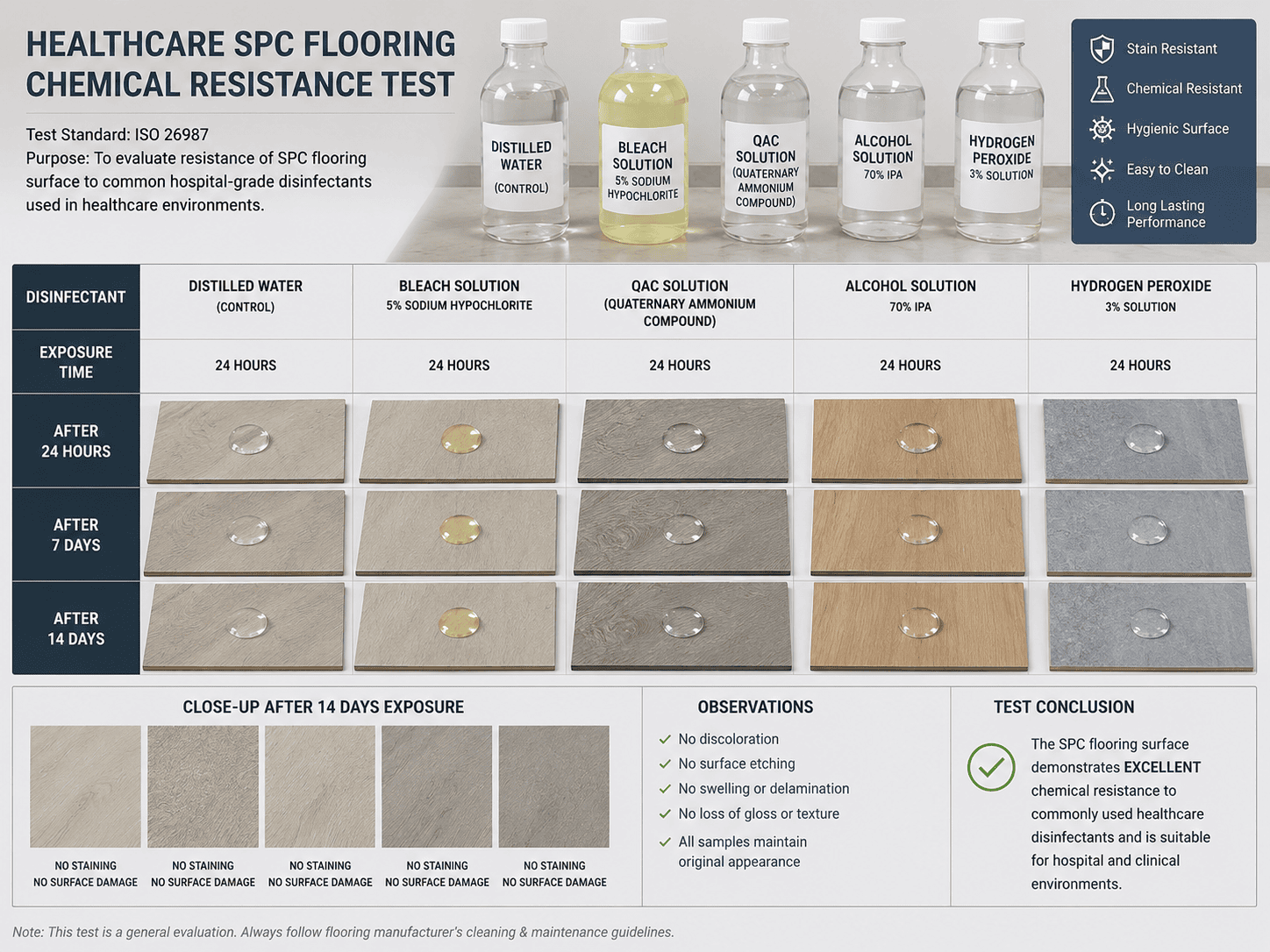
Chemical resistance is the specification parameter that most differentiates healthcare-grade SPC from standard commercial SPC and it is the parameter most frequently inadequately addressed in product documentation provided for healthcare project bids.Healthcare facilities use a range of disinfection agents that are significantly more chemically aggressive than the neutral cleaners used in commercial and residential settings and a wear layer formulation that provides excellent surface durability against normal cleaning may degrade rapidly under clinical disinfection protocols.Common Healthcare Disinfectants and Their ImpactQuaternary ammonium compounds (QACs) are the most widely used disinfectants in general hospital areas including wards,corridors,and outpatient areas.They are moderately aggressive to flooring surfaces but are tolerated by most premium SPC wear layer formulations when used at recommended dilution.Sodium hypochlorite (bleach solution) is used in higher-risk clinical areas and presents a more significant chemical challenge requiring a wear layer with specifically formulated resistance to oxidising agents.Hydrogen peroxide vapour (HPV) is used for room decontamination in isolation units and immunocompromised patient areas and is the most demanding disinfectant challenge for flooring surfaces.Alcohol-based disinfectants used for surface and equipment wiping are also used in high-frequency proximity to floor surfaces in clinical environments and must be confirmed as compatible with the specified wear layer.What the TDS Should StateThe TDS for any SPC product specified for healthcare use must include a chemical resistance table that lists the product's tested response to each relevant disinfectant class.The response should be stated as a classification typically no effect,slight effect,or significant effect after a defined exposure duration (typically 1 hour,24 hours,and 7 days of contact).Any product whose TDS does not include a chemical resistance table,or that states chemical resistance in general terms without specific agent references and test durations,should be treated as unverified for clinical use regardless of the supplier's verbal assurances.
Cleanroom Flooring ISO Classification and ESD Requirements
Cleanroom Flooring ISO Classification and ESD Requirements
Cleanroom environments pharmaceutical manufacturing facilities,electronics assembly areas,medical device production,and research laboratories present a distinct and highly specialised flooring specification challenge.The requirements of a cleanroom floor are determined primarily by the ISO cleanliness classification of the space and the specific contamination control requirements of the processes conducted within it.
ISO Cleanroom Classifications and Flooring Implications
ISO 14644-1 defines cleanroom classifications from ISO Class 1 (the most stringent fewer than 10 particles of 0.1 micron or larger per cubic metre) to ISO Class 9 (the least stringent comparable to a standard indoor environment).Most pharmaceutical and medical device cleanrooms operate at ISO Class 5 to ISO Class 8.The flooring specification for each classification level is determined by the particle generation rate of the floor material,its cleanability under the approved cleaning and sanitisation protocol for that class,and its compatibility with the garment and footwear requirements of personnel entering the controlled environment.
SPC flooring is suitable for ISO Class 6 to ISO Class 9 cleanroom environments when correctly specified providing a hard,non-shedding surface with minimal particle generation,excellent chemical resistance to the IPA (isopropyl alcohol) solutions widely used for cleanroom surface sanitisation,and a surface hardness that resists abrasion from the repeated cleaning operations that cleanroom maintenance protocols require.For ISO Class 5 and above,homogeneous vinyl sheet with heat-welded seams and coved skirtings is typically the more appropriate specification the joint-free surface eliminates the particle generation risk at click-lock joints that even the tightest locking system specification cannot fully address.
ESD (Electrostatic Discharge) Requirements
In cleanrooms and controlled environments where electrostatic discharge presents a risk to product quality or personnel safety primarily electronics manufacturing,explosive-atmosphere handling,and certain pharmaceutical processes the flooring must meet defined electrical resistance specifications.Standard SPC flooring is not electrically conductive and will not meet ESD flooring requirements.ESD-rated flooring requires either a specially formulated conductive or dissipative SPC product available from a small number of specialist manufacturers or an alternative flooring type such as conductive vinyl tile or ESD-rated epoxy coating.Buyers specifying for ESD environments must verify ESD classification (conductive or dissipative) and test method (EN 1081 or ANSI/ESD S20.20) with the manufacturer before specification.
| Cleanroom ISO Class | SPC Suitability | Key Requirements | Alternative to Consider |
| ISO Class 1 to 4 | Not recommended | Joint-free surface essential particle generation from click joints unacceptable | Homogeneous vinyl sheet with heat-welded seams |
| ISO Class 5 | Marginal assess case by case | Coved glue-down installation only heat-welded seams required | Homogeneous vinyl sheet |
| ISO Class 6 to 7 | Suitable with correct specification | 0.7mm+ wear layer,IPA resistance confirmed,low particle generation | SPC glue-down or homogeneous vinyl |
| ISO Class 8 to 9 | Fully suitable | Standard healthcare-grade SPC specification applies | SPC floating installation acceptable |
| ESD environment (any class) | Standard SPC not suitable | Conductive or dissipative SPC required verify EN 1081 compliance | Conductive vinyl tile or ESD epoxy |
Procurement Checklist and Documentation Requirements
Procurement Checklist and Documentation Requirements
Healthcare and cleanroom SPC procurement requires a more comprehensive documentation package than standard commercial flooring procurement.The following checklist covers every document that should be requested and verified before any healthcare SPC specification is finalised and any order is placed.
Wear layer thickness certificate — Original third-party laboratory certificate (SGS,Intertek,or Bureau Veritas) confirming wear layer thickness for the specific product SKU being specified.Nominal thickness stated in the TDS is not sufficient laboratory measurement confirmation is required.
VOC emission certificate — Original A+ VOC classification certificate or FloorScore certificate issued for the specific product SKU.Generic brand-level certification is not sufficient for healthcare specification.
Phthalate-free declaration — Written declaration from the manufacturer confirming the product does not contain DEHP,DBP,BBP,DINP,DIDP,or other restricted phthalates supported by a laboratory test report where the project specification or jurisdiction requires it.
Chemical resistance report — Laboratory test report confirming the product's surface response to each disinfectant class used in the facility — QAC,sodium hypochlorite,hydrogen peroxide,and alcohol-based agents at the concentrations used in the facility's disinfection protocol.
Fire classification certificate — EN 13501-1 certificate confirming Bfl-s1 or better classification for the specific product SKU.Required for all clinical area specifications.
Dimensional stability report — ISO 23999 test result confirming dimensional change at 80°C <0.05% for general clinical use,<0.03% for ICU and critical clinical areas.
Slip resistance certificate — EN 13893 wet and dry slip resistance test results for the specific product,confirming the R-rating appropriate for each area type in the facility.
REACH compliance declaration — Original REACH compliance declaration for the specific product SKU confirming absence of SVHC substances above threshold limits.
Specifying SPC flooring for a healthcare or cleanroom project
Decospaa International supplies healthcare-grade SPC flooring with complete clinical documentation VOC certificates,chemical resistance reports,fire classification,and REACH compliance for hospitals,clinics,diagnostic centres,and controlled environment projects across India,the Middle East,Africa,and Southeast Asia.Contact our team for product samples,specification support,and competitive project pricing.
store.decospaainternational.com | info@decospaainternational.com | +91 86002 04089