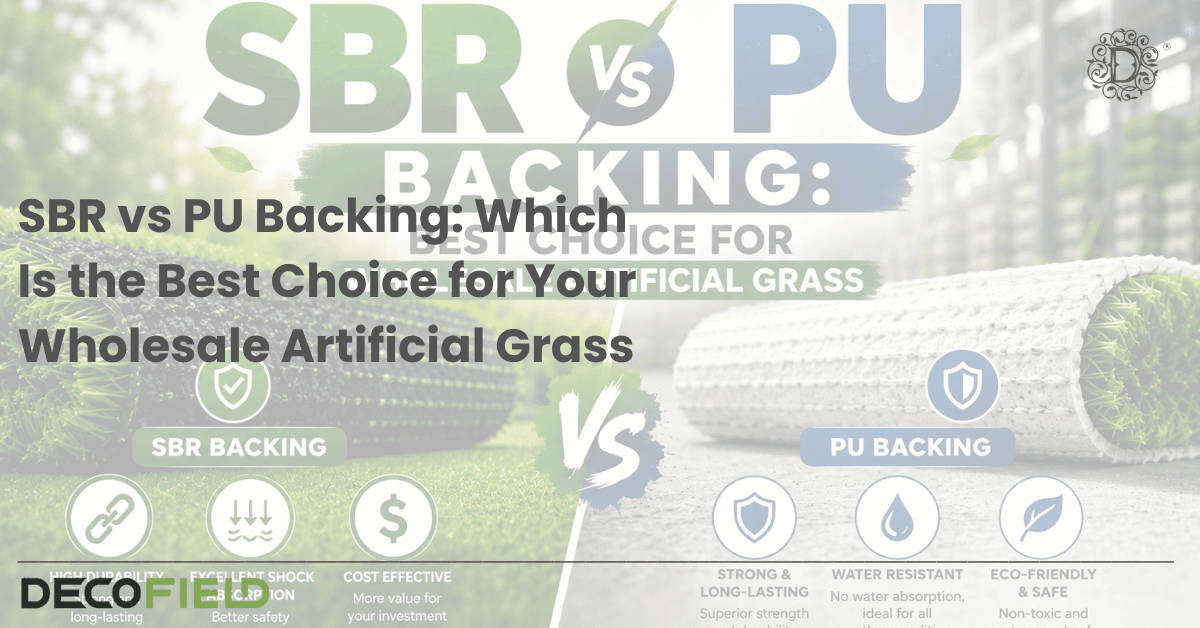
When wholesale buyers evaluate artificial grass,the conversation almost always starts with what is visible pile height, fibre colour, dtex density,and surface texture. What rarely gets enough attention is the component that determines how long the turf actually lasts, how well it drains,and whether the fibres stay anchored after years of heavy use:the backing.Specifically,the choice between SBR (Styrene-Butadiene Rubber) and PU (Polyurethane) backing is one of the most consequential specification decisions in any artificial grass procurement and it is frequently made without a full understanding of what each material actually delivers. This guide gives you that understanding.
Table of Contents
What Luxury Villa Outdoor Spaces Demand from Flooring Materials
What Luxury Villa Outdoor Spaces Demand from Flooring Materials
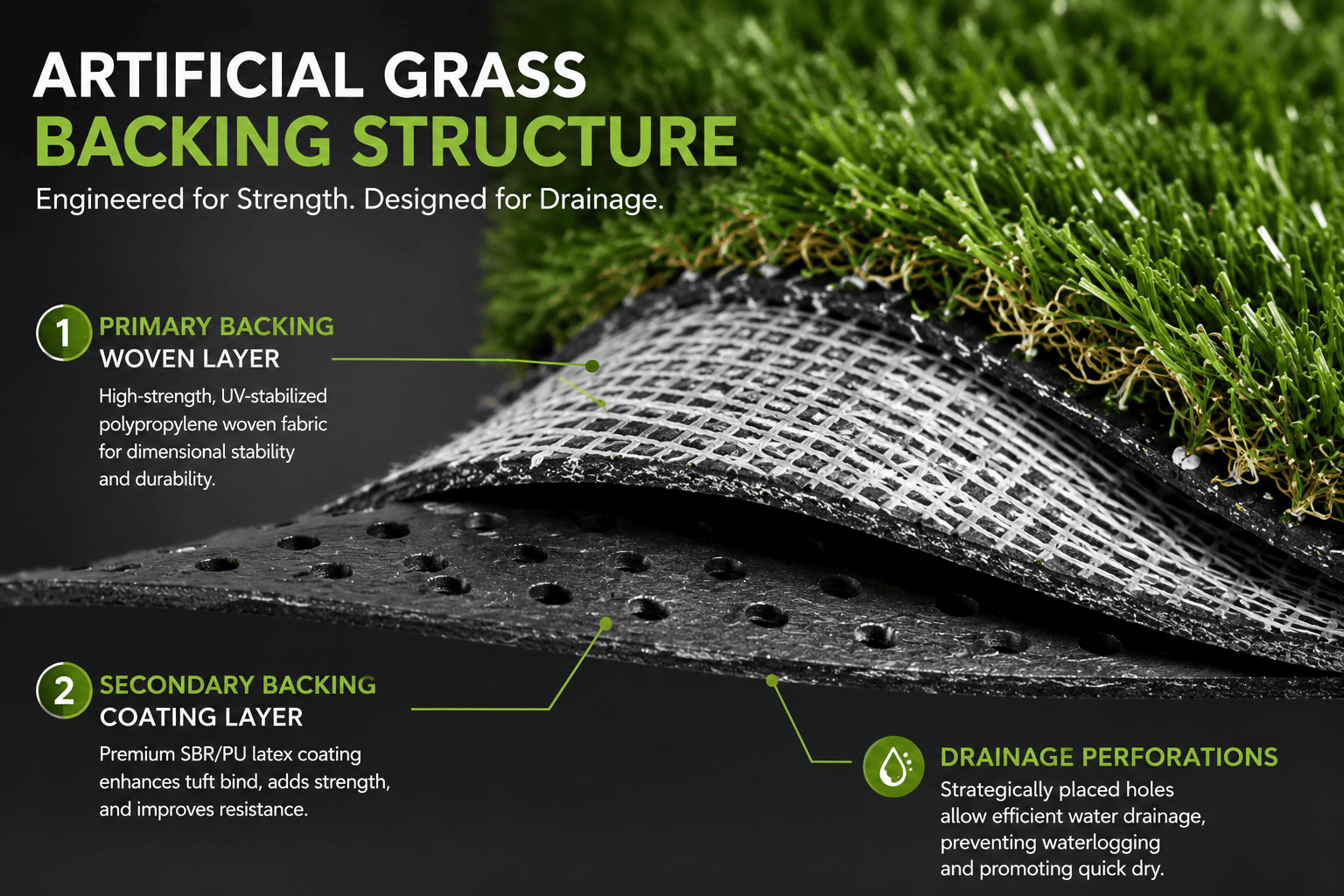
The backing of an artificial grass product is its structural foundation.It performs three critical functions that determine the long term performance of the entire installation none of which are visible once the turf is laid.
- Fibre retention The backing locks the tufted fibres in place. A backing with insufficient bond strength allows fibres to pull out under foot traffic and normal use a failure mode known as fibre shedding that becomes visible within months of installation in low-quality products.
- Drainage Artificial grass must allow rainfall and irrigation water to pass through freely. The backing's perforation pattern and material porosity determine how quickly water drains critical for preventing pooling on sports surfaces and residential lawns alike.
- Dimensional stability The backing must resist shrinkage, expansion, and delamination across a wide range of temperatures and humidity levels. In India's climate where temperatures swing from 10°C to 48°C and humidity varies dramatically between seasons dimensional stability is a non-negotiable performance requirement.
Every artificial grass product uses a primary backing the woven fabric into which the fibres are tufted and a secondary coating applied over the primary to lock the fibres permanently in place. It is this secondary coating that is the subject of the SBR vs PU debate.
SBR Backing What It Is,How It Performs,and Where It Works
SBR Backing What It Is,How It Performs,and Where It Works
SBR Styrene-Butadiene Rubber is the most widely used backing material in the global artificial grass industry. It is a synthetic rubber compound applied as a liquid coating to the underside of the primary backing, then cured to form a firm, rubber like layer that locks the fibre tufts in place.
How SBR Backing Is Applied
The liquid SBR compound is applied to the back of the tufted primary backing using a coating machine, then passed through an oven where it cures and solidifies.The weight of the SBR coating typically expressed in grams per square metre directly affects fibre retention strength. Standard SBR backing weights range from 900 g/m² to 1,500 g/m² depending on the product specification.
Performance Characteristics of SBR Backing
- Fibre retention Good to very good at standard coating weights. Sufficient for most residential and standard commercial applications.
- Drainage SBR backing requires mechanical perforation to allow water drainage. Perforation quality varies between manufacturers and directly impacts drainage performance.
- Flexibility SBR produces a stiffer backing compared to PU,which can make installation slightly more challenging in cooler temperatures when the backing becomes less pliable.
- Temperature performance SBR performs reliably across a wide temperature range but is more susceptible to cracking in extreme cold and to softening at very high temperatures compared to PU.
- Weight SBR backing adds significant weight to the finished roll a practical consideration for large-scale wholesale logistics and on-site installation.
- Environmental profile Standard SBR is not biodegradable and contains compounds that are increasingly restricted in European and premium export markets. Some buyers now specify SBR-free products for sustainability-conscious projects.
PU Backing What It Is,How It Performs,and Where It Works
PU Backing What It Is,How It Performs,and Where It Works
PU Polyurethane backing is the premium alternative to SBR, and it has gained significant market share in the wholesale artificial grass sector over the past five years as buyers have become more sophisticated about long-term performance requirements. PU is applied as a liquid coating in the same way as SBR but cures to a fundamentally different material with distinct performance advantages.
How PU Backing Is Applied
Polyurethane is applied in a thinner, more uniform layer than SBR typically 500 g/m² to 900 g/m² but delivers superior bond strength per gram of material applied. The curing process produces a flexible, lightweight coating that conforms closely to the primary backing fabric and the base of each fibre tuft, creating an exceptionally strong mechanical bond.
Performance Characteristics of PU Backing
- Fibre retention Excellent. PU delivers superior tuft bind strength compared to SBR at equivalent or lower coating weights a key reason it is specified for premium sports turf and high-traffic commercial applications.
- Drainage PU backing is inherently more porous than SBR, often allowing natural drainage without mechanical perforation. This results in more consistent drainage performance across the full surface area.
- Flexibility PU produces a significantly more flexible backing than SBR, making it easier to handle, cut, and install particularly important for large-scale commercial installations and complex shapes.
- Temperature performance PU maintains its flexibility and bond strength across a wider temperature range than SBR from sub-zero cold to extreme tropical heat making it the preferred specification for climates with significant temperature variation.
- Weight PU backing produces a lighter finished roll than equivalent SBR products, reducing shipping costs and making on-site installation faster and less labour-intensive.
- Environmental profile PU is increasingly preferred in sustainability-conscious markets. It is free from the aromatic compounds found in some SBR formulations and meets the chemical restrictions required for premium European and Middle Eastern markets.
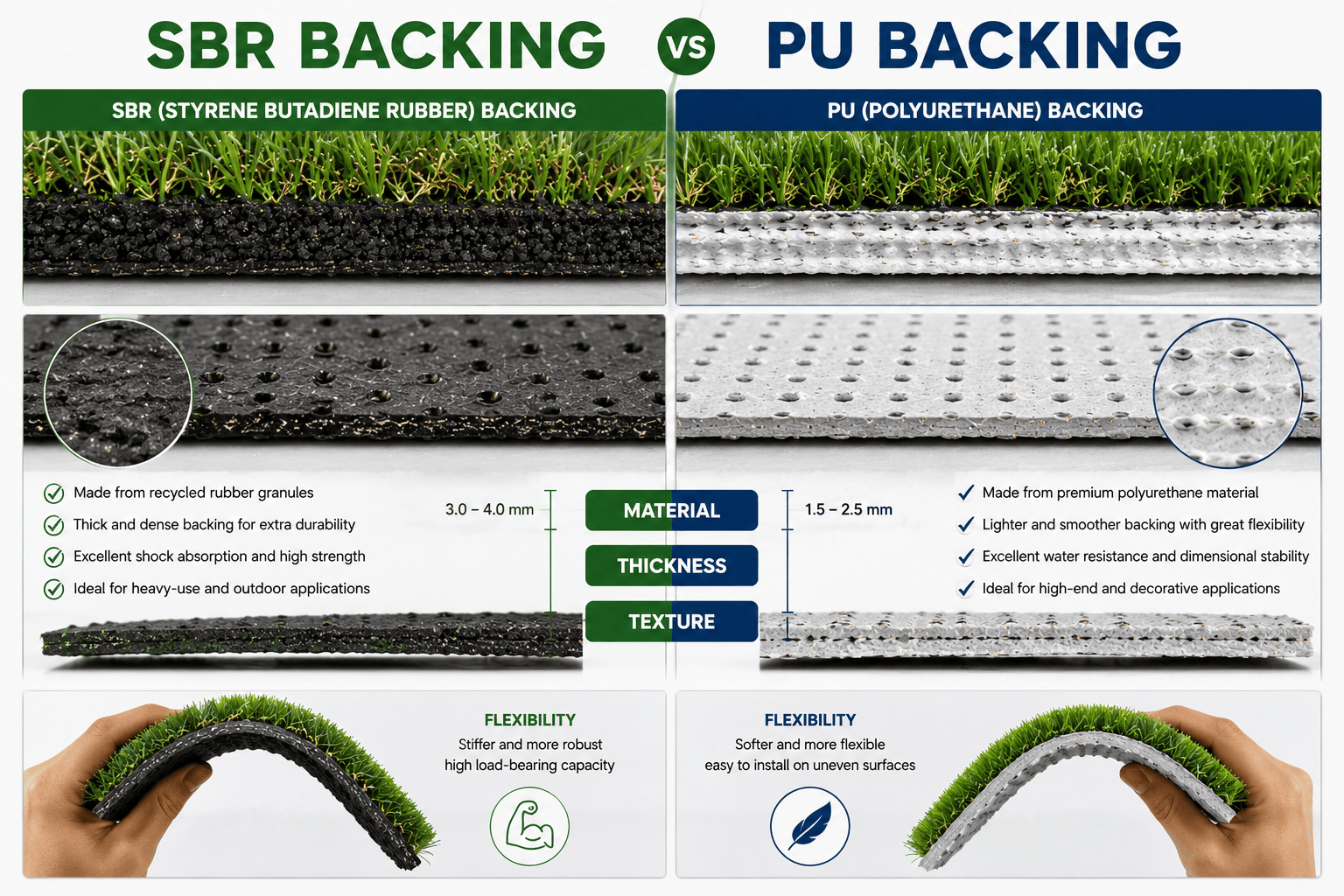
SBR vs PU Turf Backing
SBR vs PU Turf Backing
| Feature | SBR Latex Backing | PU (Polyurethane) Backing |
| Material Base | Synthetic rubber (liquid latex) | Polyurethane polymer |
| Durability | Good, but can become brittle over time | Excellent; maintains flexibility for years |
| Moisture Resistance | Absorbs some moisture; can expand/contract | Completely waterproof; won't swell or shrink |
| Tuft Lock Strength | Standard (approx. 30-40N) | Standard (approx. 30-40N) |
| Weight | Heavier and thicker | Lighter and more streamlined |
| Climate Suitability | Best for mild, stable climates | Ideal for extreme heat or high-humidity regions |
| Eco-Friendliness | Harder to recycle (multi-layer) | Generally easier to recycle (if single-polymer) |
| Cost | Economical (Budget-friendly) | Premium (Higher upfront investment) |
What to Specify in Your Purchase Order A Wholesale Buyer's Checklist
What to Specify in Your Purchase Order A Wholesale Buyer's Checklist
Backing specification is only as effective as the detail included in the purchase order. Vague specifications allow suppliers to make substitutions that meet the letter of the order while compromising the performance intent. Use this checklist to ensure your purchase order is watertight.
- Backing type Specify SBR or PU explicitly. Do not leave this open "standard backing" is not a specification.
- Coating weight Specify minimum coating weight in g/m². For SBR: minimum 1,000 g/m² for commercial applications. For PU: minimum 600 g/m².
- Tuft bind strength Specify minimum tuft bind in Newtons per ISO 4919. A minimum of 30N is standard for residential; 40N+ for sports and commercial applications.
- Drainage rate Specify minimum drainage rate in litres per square metre per hour. For Indian monsoon climates, target a minimum of 30 litres/m²/hour.
- Primary backing weight Specify the woven primary backing weight in g/m². A heavier primary backing improves overall dimensional stability.
- Chemical compliance For export markets, specify REACH compliance (Europe), RoHS compliance, or relevant local standards. Request original compliance certificates not self-declarations.
- Third-party test certificate Require a lab test certificate from an accredited testing body (SGS, Bureau Veritas, Intertek) confirming backing weight, tuft bind, and drainage rate from the actual production batch.
Need help specifying the right artificial grass backing for your project?Decospaa International supplies certified artificial grass with both SBR and PU backing options sourced from verified manufacturing partners with full third-party test documentation. Contact our team for technical data sheets, product samples, and wholesale pricing.store.decospaainternational.com | info@decospaainternational.com | +91 86002 04089