

There is a chemical conversation happening across the global artificial grass industry in 2026 that every serious buyer,importer,and project specifier needs to be part of.PFAS per- and polyfluoroalkyl substances have moved from a specialist environmental science concern to a front-line procurement issue in the space of just a few years.Regulatory restrictions are tightening in Europe,the United States,Australia,and beyond.Municipal and institutional buyers are making PFAS-free certification a contractual requirement.And importers who supply non-compliant product are facing shipment rejections,project disqualifications,and reputational damage that is expensive and slow to recover from.This guide gives global artificial grass buyers a complete,practical understanding of what PFAS are,why they matter in synthetic turf,where compliance is legally required,and exactly what to demand from suppliers to protect every order.
Table of Contents
What Are PFAS and Why Are They a Problem in Artificial Grass
What Are PFAS and Why Are They a Problem in Artificial Grass
PFAS is a collective term covering more than 10,000 individual synthetic chemical compounds that share one defining structural characteristic an exceptionally strong bond between carbon and fluorine atoms.This bond is what made PFAS industrially valuable for decades.It gives them remarkable resistance to heat,water,oil,and chemical degradation properties that made them useful in everything from non-stick cookware to firefighting foam to surface treatments for textiles and synthetic materials.
But that same resistance to degradation is precisely what makes PFAS dangerous.They do not break down in soil,in water,or in the human body.They accumulate in groundwater systems,in food chains,in human tissue earning them the label "forever chemicals." Their documented health effects include associations with certain cancers,thyroid hormone disruption,immune system impairment,and developmental effects in children.Studies continue to expand the understanding of PFAS health impacts,and the scientific consensus is that there is no known safe level of exposure for several key PFAS compounds.
In artificial grass,PFAS have historically entered the product through two main routes: as surface treatment coatings applied to synthetic turf fibres to enhance UV stability,stain resistance,and colour retention; and as processing chemicals used during fibre extrusion that leave residual traces in the finished product.Neither route is visible in a product sample or declared on a standard specification sheet.The only way to confirm PFAS status is through independent third-party laboratory testing of the finished product.

How PFAS Enter Artificial Grass During Manufacturing
How PFAS Enter Artificial Grass During Manufacturing
Understanding the specific manufacturing pathways through which PFAS enter artificial grass helps buyers ask more targeted qualification questions and evaluate supplier responses with greater confidence.There are three primary entry points in the artificial grass supply chain.
Surface Treatment Coatings on Synthetic Fibres
Historically the most significant PFAS source in artificial grass.Fluoropolymer-based surface coatings were widely applied to synthetic turf fibres to improve UV stability,colour vibrancy,and resistance to staining.The most commonly used long-chain PFAS compounds in this application including PFOA and PFOS are now banned or heavily restricted in most developed markets.However,short-chain PFAS alternatives introduced as replacements are themselves now under active regulatory review in the EU and the US.A genuinely PFAS-free fibre specification excludes all fluoropolymer surface treatments not just the specific compounds currently on restricted substance lists.
Processing Aids and Lubricants During Fibre Extrusion
PFAS compounds have also been used as processing aids,mould release agents,and lubricants during the extrusion of synthetic grass fibres.These process chemicals are not intentionally incorporated into the finished fibre but can leave measurable residual traces.In responsible manufacturing operations,PFAS-free alternatives for these process chemicals are available and increasingly specified.Verifying that a manufacturer uses PFAS-free processing aids requires upstream raw material declarations not just finished product testing because some processing-related PFAS traces may fall below the detection thresholds of standard finished product tests.
Infill Materials Particularly Recycled Rubber
SBR rubber infill the most widely used infill material in sports turf applications globally has been separately evaluated for PFAS and other restricted substances.While SBR rubber itself is not inherently a PFAS source,contaminated recycled rubber feedstock can introduce restricted compounds into the infill layer.For sports turf applications where infill is part of the system specification,PFAS testing of the infill material must be conducted alongside testing of the turf fibre.Buyers who test the fibre but not the infill have only verified half the system.
The Global Regulatory Landscape Where Restrictions Apply in 2026
The Global Regulatory Landscape Where Restrictions Apply in 2026
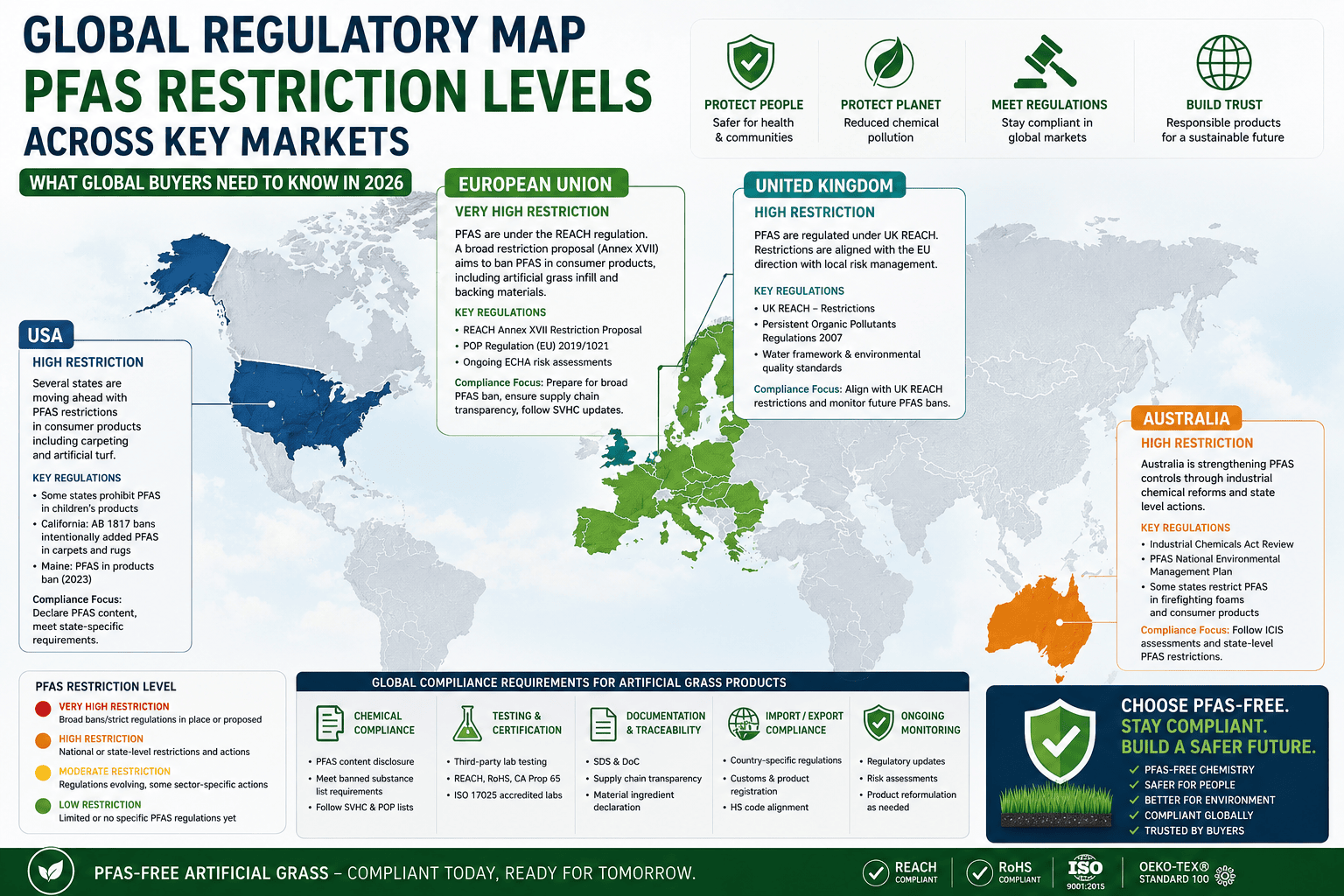
PFAS regulations are evolving faster than almost any other area of chemical compliance in the building materials and sports surface industries.The regulatory direction is consistent across all major jurisdictions thresholds are tightening,the list of regulated compounds is expanding,and enforcement is increasing.Buyers who understand where their target markets sit on this trajectory can make sourcing decisions that remain compliant not just for today's order but through the next regulatory cycle.European UnionThe EU has taken the most comprehensive regulatory stance on PFAS of any major jurisdiction.Under REACH,progressive PFAS restrictions have been applied to consumer and industrial products since 2020.In 2023,the EU proposed a universal PFAS restriction covering all non-essential uses one of the broadest chemical regulatory actions ever proposed with phased implementation expected to be fully active through 2026 to 2027.For artificial grass specifically,products containing PFAS above defined threshold levels cannot be legally placed on the EU market.Third-party laboratory compliance verification is mandatory and self-declaration is not accepted.United StatesPFAS regulation in the US operates across federal and state levels with considerable variation.The EPA has expanded its PFAS regulatory programme significantly since 2022 and has set legally enforceable maximum contaminant levels for key PFAS compounds in drinking water.At the state level,California,Massachusetts,Maine,New York,and Connecticut have enacted specific PFAS restrictions on consumer products and outdoor surfaces.For artificial grass buyers supplying US markets,state-specific compliance must be verified on a project-by-project basis based on the installation location.United Kingdom and AustraliaThe UK has maintained broadly equivalent PFAS regulations to the EU through its retained REACH framework,with active monitoring by the Environment Agency.Several UK local authorities have adopted PFAS-free certification requirements for publicly funded turf installations.Australia has been dealing with significant legacy PFAS contamination issues that have driven strong public awareness and increasingly precautionary procurement policies.The Australian government's National PFAS Position Statement guides institutional buying decisions,and PFAS-free certification is becoming standard for government and school installations.
What Genuine PFAS Free Certification Looks Like
What Genuine PFAS Free Certification Looks Like
The phrase "PFAS-free" is used loosely and sometimes misleadingly across the artificial grass market.Understanding what genuine compliance documentation requires helps buyers distinguish between meaningful third-party verification and unsubstantiated marketing language.
| Certification Standard | What It Covers | Issued By | Market Relevance |
| REACH SVHC Compliance | Substances of Very High Concern including regulated PFAS above 0.1% by weight in finished product | Accredited EU testing laboratory | Mandatory for EU and UK market access |
| EPA Method 533 or 537.1 Panel Test | Quantitative testing for 40 plus individual PFAS compounds in finished product | SGS,Bureau Veritas,Intertek | USA state and federal procurement requirements |
| Oeko-Tex Standard 100 | Comprehensive harmful substance testing including PFAS for fibre and textile products | Oeko-Tex Association | Europe,Australia,premium market positioning globally |
| Bluesign Certification | Responsible chemical use across full textile manufacturing process including PFAS exclusion | Bluesign Technologies | Premium global market strongest process-level assurance |
| California Proposition 65 Compliance | No chemicals on California's Prop 65 list above defined exposure thresholds | Third-party accredited laboratory | Mandatory for California installations |
| ISO 9001 with PFAS Exclusion Policy | Manufacturing quality management with documented PFAS-free raw material specification and supplier declarations | Accredited ISO certification body | Supporting documentation for all markets |
Market by Market Compliance Guide for Artificial Grass Buyers
Market by Market Compliance Guide for Artificial Grass Buyers
PFAS compliance requirements differ by market in terms of which compounds are regulated,what thresholds apply,and what documentation is required.Here is a practical breakdown across the most important artificial grass markets for global buyers in 2026.
European Union
Full REACH SVHC compliance mandatory.PFAS regulated under Annex XVII with ongoing expansion.Products above 0.1% PFAS by weight cannot be legally sold.Universal PFAS restriction expected to further tighten thresholds through 2027.Third-party test report from accredited EU laboratory is the minimum entry requirement.
Required: REACH SVHC test report — accredited EU laboratory
United Kingdom
UK REACH alignment with EU standards maintained post-Brexit.Local authority procurement increasingly requiring PFAS-free certification for public installations.Sports turf projects funded by UK Sport and Sport England subject to enhanced chemical safety standards.Environment Agency actively monitoring PFAS in water catchment areas near turf installations.
Required: UK REACH compliance equivalent to EU REACH
United States
Federal EPA guidance plus state-specific requirements create a complex compliance landscape.California,Maine,Massachusetts,New York lead on strictest state restrictions.School,playground,and public park installations under heightened regulatory scrutiny.EPA Method 533 or 537.1 panel testing covers 40 plus compounds and is the recommended standard for all US-bound product.
Required: State-specific verify per installation location
Australia
National PFAS Position Statement drives precautionary institutional procurement.Government,school,and council buyers increasingly requiring PFAS-free certification as standard.High public awareness of PFAS following legacy contamination at defence and airport sites.PFAS panel testing recommended for all institutional and government-funded turf projects.
Recommended: Third-party PFAS panel test for institutional projects
Middle East GCC
No PFAS-specific regulation currently in force but premium project buyers — international hotel brands,FIFA-affiliated sports authorities,premium villa developers — are increasingly aligning procurement with European chemical safety standards.PFAS-free certification is becoming a meaningful competitive differentiator in premium GCC project tenders in 2026.
Recommended: REACH compliance for premium project positioning
India
No specific PFAS regulation for artificial grass currently in force.However,Indian importers and project buyers supplying international hotel brands,FIFA-affiliated sports facilities,and export-quality residential projects are increasingly asked to demonstrate PFAS compliance by their end clients.PFAS-free certification is a meaningful differentiator for Indian buyers targeting premium and international project segments
How to Source PFAS-Compliant Artificial Grass A Buyer's Action Guide
How to Source PFAS-Compliant Artificial Grass A Buyer's Action Guide
The practical steps for sourcing PFAS-compliant artificial grass are well-defined and consistently applied by experienced buyers across every market.These actions protect buyers at every volume level from a single residential installation to a large scale sports infrastructure project.
Specify PFAS-free as an explicit contractual requirement in your purchase order — Do not rely on verbal assurances or general marketing claims.Include a specific PFAS compliance requirement in the purchase contract,naming the applicable test standard REACH SVHC for European markets,EPA Method 533 or 537.1 for US markets,or Oeko-Tex Standard 100 as a globally recognised baseline.A contractual requirement creates legal accountability that a verbal assurance does not.
Demand batch-specific test reports — not generic certificates — PFAS test reports must correspond to the specific production batch being shipped.A certificate from a previous batch,a different SKU,or a sample tested separately from the bulk production does not verify the product you are actually receiving.Batch-specific testing with the batch number and production date on the certificate is the only meaningful verification.
Verify every test certificate directly with the issuing laboratory — PFAS certificates have been falsified in the artificial grass supply chain.Every certificate should carry a unique laboratory reference number that can be independently verified by contacting the issuing laboratory directly.This takes five minutes and eliminates the falsification risk entirely.Make it a non-negotiable step on every new supplier and every new product line.
Request upstream raw material PFAS declarations alongside finished product tests — A responsible manufacturer can provide declarations from their raw material and processing chemical suppliers confirming that no PFAS-containing inputs are used in the production process.This upstream documentation demonstrates systemic compliance it complements the finished product test rather than replacing it and provides a much stronger assurance of ongoing compliance between tested batches.
Test infill materials separately for sports turf applications — For any sports turf installation where infill is part of the system specification,conduct PFAS testing on the infill material independently of the turf fibre test.SBR rubber infill sourced from contaminated recycled feedstock is a documented PFAS risk that a fibre-only test will not detect.
Monitor regulatory updates quarterly for your target markets — PFAS regulations are changing faster than almost any other area of product compliance.The threshold that satisfies a market today may be tightened within 12 months.Subscribe to updates from the EU Chemicals Agency,US EPA,and equivalent national bodies in your target markets.Build a supplier relationship with a manufacturer who monitors these changes proactively not one who reacts only after a compliance failure occurs.
Need PFAS-compliant artificial grass with full third-party documentation
Decospaa International sources premium artificial grass from certified manufacturing partners with documented PFAS compliance for buyers across India,the Middle East,Africa,Southeast Asia,and export markets globally.Contact our team for product samples,compliance documentation,and competitive wholesale pricing.
store.decospaainternational.com | info@decospaainternational.com | +91 86002 04089