

At some point in the development of almost every successful flooring import business,the same question arises: why am I selling someone else's brand when I could be building my own? OEM and private label SPC flooring programmes give importers and distributors exactly that opportunity the ability to source product manufactured to their own specification,packaged under their own brand name,and sold at margins that reflect the brand equity they are building rather than the brand equity they are funding for someone else.In 2026,the infrastructure for private label SPC flooring has never been more accessible.Chinese manufacturers with established export capabilities actively seek private label partnerships.Minimum order quantities have come down.Certification pathways are well-defined.But private label is not without risk and the importers who enter it without a clear strategy for specification,brand development,and quality control regularly discover that building a brand is significantly harder than buying one.This guide covers everything importers need to know to evaluate,plan,and execute an OEM or private label SPC flooring programme successfully.
Table of Contents
OEM vs Private Label Understanding the Difference and Choosing the Right Model
OEM vs Private Label Understanding the Difference and Choosing the Right Model
The terms OEM and private label are often used interchangeably in flooring import conversations but they describe two distinct business models with different levels of involvement,investment,and control.Understanding the difference is the starting point for choosing the approach that fits your business stage and market ambitions.
OEM Original Equipment Manufacturer
In a true OEM arrangement,the importer provides the manufacturer with a detailed product specification wear layer thickness,core density,surface finish,locking system,board format,and colour palette and the manufacturer produces the product to that specification.The importer owns the design and specification.The manufacturer supplies the manufacturing capability and capacity.OEM arrangements give the importer the highest level of product control every parameter of the finished product reflects the importer's decisions rather than the manufacturer's standard range.The trade-off is higher minimum order quantities and a longer development timeline as the manufacturer produces and refines samples against the specification before full production.
Private Label
Private label is a simpler and more accessible entry point for importers new to own-brand supply.In a private label arrangement,the importer selects products from the manufacturer's existing range rather than specifying custom products and has them packaged and labelled under their own brand name.The product specification is the manufacturer's,not the importer's.The importer's contribution is brand identity,packaging design,and market positioning.Private label requires lower minimum order quantities than OEM and a shorter development timeline because the product already exists only the packaging changes.The trade-off is less product differentiation a competitor could theoretically be selling the same product under a different label.
| Factor | OEM | Private Label |
| Product specification control | Full importer specifies every parameter | Limited manufacturer's standard range |
| Product differentiation | High unique to the importer's brand | Lower same product may be available elsewhere |
| Minimum order quantity | Higher typically 2 to 5 containers per SKU | Lower often 1 container or less |
| Development timeline | 3 to 6 months for first production | 4 to 8 weeks for first shipment |
| Investment required | Higher specification,sampling,tooling | Lower packaging design only |
| Brand equity built | High unique product supports premium positioning | Moderate brand on standard product |
| Best for | Established importers with volume and market knowledge | Importers entering own-brand for first time |
Why Importers Are Moving to Private Label SPC in 2026
Why Importers Are Moving to Private Label SPC in 2026
The shift toward private label in the SPC flooring import market is driven by a combination of commercial logic and competitive pressure.As more importers have entered the market,the margins available on third-party branded product have compressed.Retailers and project buyers have more supplier options than ever and price competition on branded product is more intense than at any previous point in the market's development.Private label addresses both problems simultaneously.
Margin Protection
When an importer sells a third-party brand,the retail price is constrained by the brand's pricing across all its distribution channels.When the same importer sells a private label product,the retail price is set by the importer's own brand positioning and the margin between landed cost and retail price is entirely the importers to determine.In competitive markets,private label SPC typically delivers gross margins of 30% to 50% compared to 15% to 25% on equivalent third-party branded product.The difference compounds significantly at volume.
Competitive Differentiation
A private label product cannot be directly price-compared by buyers across multiple suppliers because it is only available from one source.This eliminates the "I can get the same thing cheaper elsewhere" conversation that erodes margins on branded product.It also gives the importer full control over how the product is positioned,described,and marketed a strategic asset that third-party brand distribution never provides.
Customer Loyalty
Buyers who purchase and install a private label product and have a positive experience associate that experience with the importer's brand rather than with the manufacturer's brand.This builds direct customer loyalty that is significantly harder to build when selling a product whose brand the customer can find through multiple channels.In the flooring distribution business,customer retention and repeat purchase are the foundations of long-term profitability and private label builds both more effectively than reselling established brands.
How to Specify Your Private Label SPC Product Range
How to Specify Your Private Label SPC Product Range
The product specification decisions made at the start of a private label programme determine the brand's market positioning,its competitive performance,and its long-term reputation in the market.These decisions deserve significantly more attention than most first-time private label importers give them.Define Your Market Position FirstBefore specifying a single product parameter,define where your brand sits in the market.Budget,mid-range,or premium? Residential only,commercial only,or both? A brand that tries to cover all tiers with a single product range ends up positioned nowhere.A brand that targets the mid-to-premium residential market with a focused range of six to ten SKUs in the most commercially active formats and colours can build a clear identity and a loyal customer base within 18 to 24 months of launch.Core Specification ParametersFor a private label SPC range targeting the mid-to-premium residential market in India or export markets across the Middle East and Southeast Asia,these are the specification parameters that define the product's competitive positioning.
| Specification Parameter | Budget Tier | Mid-Range Tier | Premium Tier |
| Wear layer thickness | 0.3mm | 0.5mm | 0.7mm to 1.0mm |
| Total board thickness | 4mm to 4.5mm | 5mm to 6mm | 6mm to 8mm |
| Core density | Standard | Medium-high | High 1,800 kg/m³ plus |
| Locking system | Proprietary | Licensed preferred | Unilin,Välinge,or I4F |
| Surface finish | Standard emboss | EIR matte | EIR matte brushed or aged |
| Acoustic underlay | None or 0.5mm foam | 1mm IXPE pre-attached | 1.5mm to 2mm IXPE pre-attached |
| Board format (width) | 150mm to 180mm | 180mm to 200mm | 200mm to 230mm |
| Certification | Basic factory documents | SGS or BV lab reports | FloorScore,REACH,full portfolio |
Finding and Qualifying the Right OEM Manufacturing Partner
Finding and Qualifying the Right OEM Manufacturing Partner
The manufacturing partner is the foundation of a private label programme.A manufacturer who produces consistent quality,communicates transparently,and understands the requirements of export market compliance will make every aspect of the programme easier.A manufacturer who compromises on any of these dimensions will undermine the brand before it has had a chance to build.
What to Look for in an OEM Partner
Direct manufacturing capability — The partner must be a factory not a trading company with full control over the production process from extrusion to final packaging.Verify with business licence documentation,factory audit access,and production capacity confirmation.
OEM experience and track record — Ask for evidence of existing private label programmes the manufacturer supports for buyers in other markets.An experienced OEM partner understands the documentation,packaging,and certification requirements of export private label supply in a way that a manufacturer new to OEM does not.
Certification capability — The manufacturer must be able to obtain or already hold the certifications your target market requires FloorScore,REACH,SGS lab reports — under your brand name or in a format that supports your brand's compliance claims.
Packaging and labelling flexibility — The manufacturer must be able to produce custom packaging to your brand specification box design,label positioning,language,barcode,and any market-specific regulatory text.Confirm their packaging production capability and minimum order requirements before committing.
Communication and responsiveness — A private label relationship is ongoing — not transactional.The manufacturer will be your production partner for sample development,specification refinement,production scheduling,and quality control across multiple order cycles.Their communication quality before the first order is the best available indicator of how they will perform during it.
Brand Development,Packaging,and Market Positioning
Brand Development,Packaging,and Market Positioning
A private label SPC programme is only as strong as the brand identity built around it.The product specification determines what the floor actually delivers.The brand identity determines how the market perceives and values it.Both require deliberate investment and the brand investment is where most first-time private label importers underinvest,producing product that performs well but fails to build the market recognition that justifies the margin premium private label is designed to generate.
Brand Name and Identity
The brand name should be easy to pronounce and remember in your target markets,available as a trademark in those markets,and available as a domain name for digital presence.Avoid names that are too generic ("Premium Floors","Quality SPC") they cannot be trademarked effectively and do not build distinctive market identity.A short,memorable,slightly unexpected name that can be visualised graphically will serve the brand better over a ten-year horizon than a descriptive name that disappears into the category.
Packaging Design
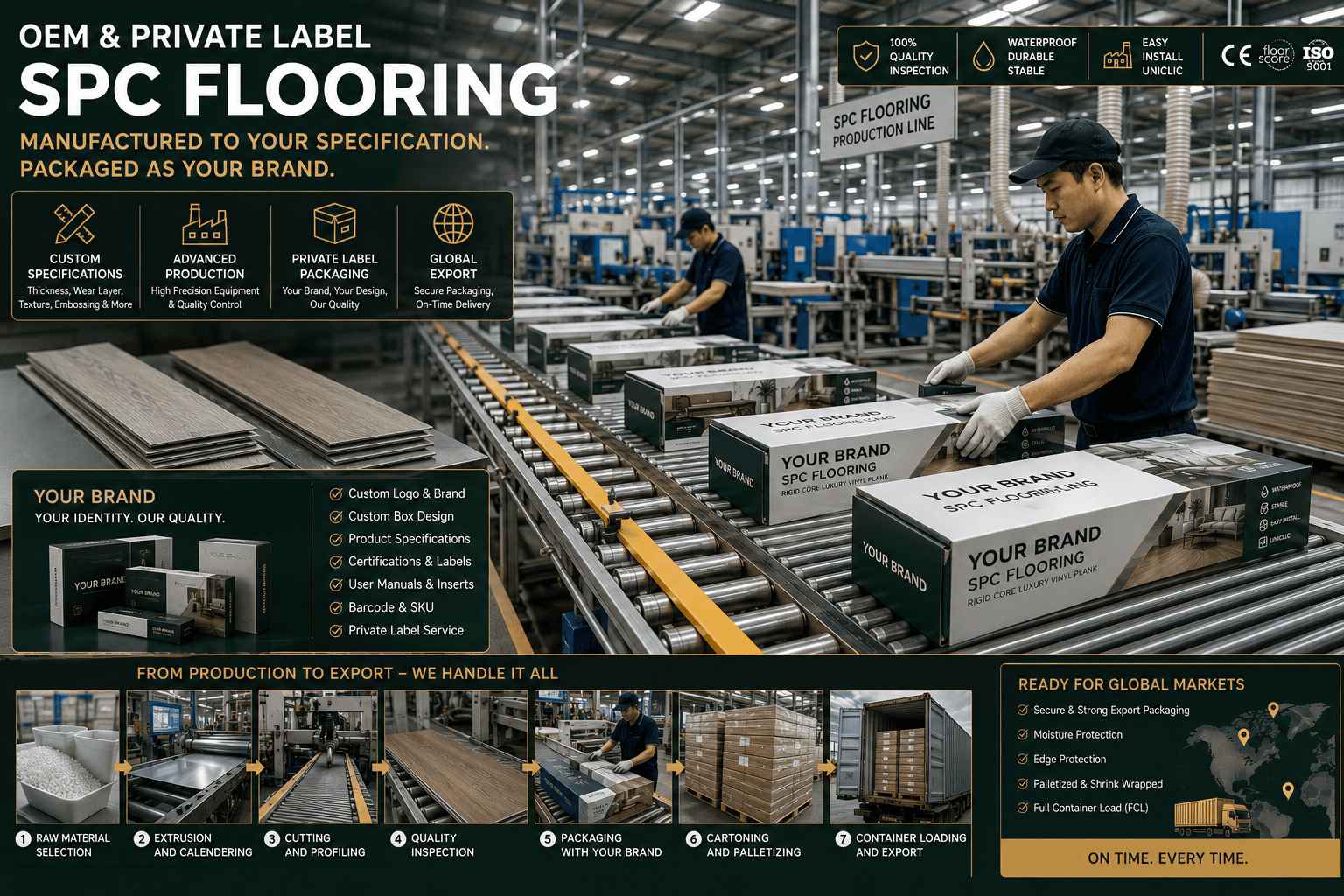
SPC flooring packaging is a sales tool that is seen by every buyer,contractor,and retailer who handles the product.It communicates quality,reliability,and brand positioning before a single plank is installed.Premium packaging quality print,clear specification communication,professional finish supports a premium price point.Budget-looking packaging undermines even a genuinely premium product specification.Invest in professional graphic design for the carton,specification label,and any marketing inserts.The cost is marginal relative to the brand value it supports.
Market Positioning and Pricing
Price your private label product based on its specification value and your brand's intended market positioning not as a minor discount to the third-party brands you are competing with.A private label product priced too close to commodity branded product signals that the importer does not believe in the brand's premium positioning.A private label product priced to reflect genuine specification superiority backed by certification and a clear product story commands the margin that makes the programme commercially worthwhile.
Quality Control,Certification,and Protecting Your Brand
Quality Control,Certification,and Protecting Your Brand
When you sell a private label product,every quality failure is a brand failure.Unlike third-party branded product where the quality failure is associated with the manufacturer's brand,a private label quality problem attaches directly to your name,your business,and your customer relationships.This makes quality control in a private label programme more consequential not less than in standard import supply.These are the quality protection measures that every private label SPC importer should have in place from the first production run.
Approve a sealed reference sample before production — Before any production order is placed,agree a signed-off reference sample with the manufacturer.This sample retained by both the importer and the manufacturer is the definitive quality standard against which every production batch is evaluated.Any deviation from the reference sample in colour,texture,wear layer thickness,or locking system performance is a production non-conformance that must be resolved before shipment release.
Conduct pre-shipment inspection on every order — Appoint an independent QC agency to inspect every production batch before shipment.The inspection should include visual comparison against the reference sample,wear layer thickness measurement,locking system functionality test,and dimensional verification.Release of final payment should be conditional on a satisfactory inspection report.
Own the certification not just reference it — For private label product,certifications should be obtained in your brand's name wherever possible not simply referenced from the manufacturer's existing certificates.FloorScore certification in your brand name,REACH compliance reports for your specific SKUs,and SGS lab reports referencing your product codes give your brand the independent certification identity that supports premium market positioning and protects against liability if product performance is challenged.
Specify batch-to-batch colour consistency tolerance — Colour variation between production batches is one of the most common and most damaging quality issues in private label flooring.Specify a maximum colour variation tolerance typically Delta E 1.5 or less in the purchase contract and require the manufacturer to provide a colour measurement report from every production batch confirming compliance with this tolerance.
Build a complaints and warranty response protocol before launch — Before the first private label order reaches the market,have a clear internal process for handling product complaints and warranty claims.Who receives the complaint? Who assesses it? What documentation is required? What is the remedy replacement,refund,or repair? A professional,fast,and fair complaints response protects brand reputation more effectively than trying to avoid complaints through perfection which is not achievable in any manufacturing programme.
Interested in building your own SPC flooring brand
Decospaa International works with importers and distributors across India,the Middle East,Africa,and Southeast Asia on private label and OEM SPC flooring programmes providing specification guidance,verified manufacturing partnerships,quality control support,and competitive wholesale pricing.Contact our team to discuss your private label programme.
store.decospaainternational.com | info@decospaainternational.com | +91 86002 04089