

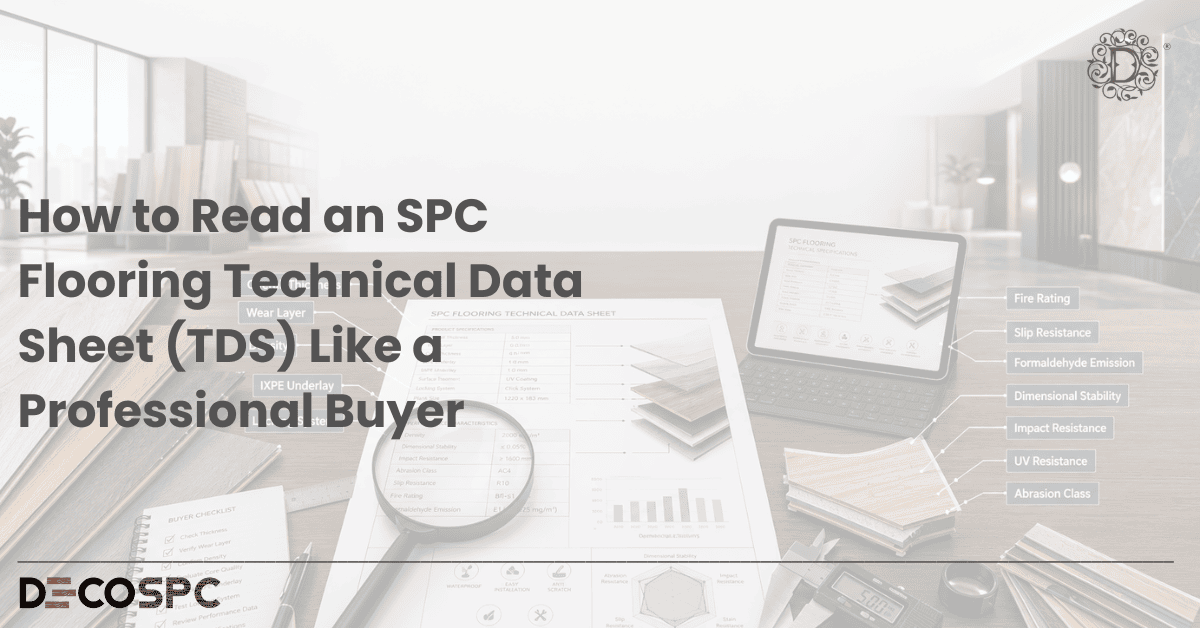
Every SPC flooring product comes with a Technical Data Sheet and most buyers either ignore it entirely or glance at it without understanding what the numbers actually mean.This is one of the most expensive habits in the flooring import business.A TDS is not a marketing document.It is a specification contract a statement of what the product is engineered to do and how it will perform under defined conditions.A buyer who can read a TDS correctly can identify a genuinely premium product from a budget one that has been dressed up in premium marketing.They can spot specification gaps that a smooth supplier presentation will never mention.They can compare two competing products on an objective,apples-to-apples basis that price alone never provides.This guide walks through every section of a professional SPC flooring TDS explaining what each parameter means,what the numbers should say for a quality product,and what to look for when the numbers raise more questions than they answer.
Table of Contents
What a TDS Is And Why Professional Buyers Treat It as the Primary Evaluation Document
What a TDS Is And Why Professional Buyers Treat It as the Primary Evaluation Document
A Technical Data Sheet is a structured document produced by the manufacturer that consolidates the key specification parameters of a flooring product in a standardised format.It covers what the product is made from,how thick each layer is,what performance tests it has been subjected to,what results those tests produced,what environmental certifications it holds,and what conditions it requires for correct installation and use.
For a professional buyer whether an importer evaluating a new supplier,a project manager specifying flooring for a hotel,or a distributor building a product range the TDS is the single most information-dense document available for any flooring product.It is the document that separates what the product claims to be from what it actually is.A supplier's sales presentation tells you what they want you to believe about the product.The TDS tells you what the product is engineered to do and the gap between those two things is often where the risk in a flooring purchase decision lives.
The challenge for most buyers is that a TDS uses technical terminology,test standard references,and measurement units that are unfamiliar without prior knowledge of the flooring industry.A buyer who does not know what "ISO 10582 residual indentation test" or "EN 13893 friction coefficient" means cannot evaluate whether the numbers in those rows represent good,average,or poor performance.This guide provides that translation so that any buyer can read any SPC flooring TDS with the same understanding that an experienced professional brings to it.

Section 1 of the TDS Product Identification and Construction
Section 1 of the TDS Product Identification and Construction
The opening section of any SPC flooring TDS covers the basic identity and construction of the product.These are the parameters that define what the product physically is before any performance testing is applied.Read this section carefully because the numbers here determine everything that follows.
Product Name,SKU,and Collection
Verify that the product name and SKU on the TDS match the product code on the sample,the purchase order,and any certificate documents provided.Mismatches between SKUs on the TDS and the actual product being ordered are one of the most common mechanisms by which suppliers inadvertently or deliberately provide documentation for a different product than the one being supplied.Every document in the procurement package should reference the same SKU.
Overall Thickness
Stated in millimetres typically 4mm to 8mm for SPC flooring.Overall thickness is the total measurement of the complete plank from the underside of the backing to the top of the wear layer.This is the specification most frequently stated accurately in TDS documents because it is the most easily verified with a simple calliper.For residential applications,4mm to 6mm is standard.For commercial applications,6mm to 8mm provides better structural performance and acoustic damping.Verify the stated thickness against the actual sample using a digital calliper any significant deviation is a signal to investigate the other specifications more carefully.
Wear Layer Thickness
The most commercially important specification on the TDS and the one most frequently misrepresented.Stated in millimetres: 0.3mm,0.5mm,0.7mm,1.0mm.The wear layer is the transparent protective coating on the surface of the plank that determines scratch resistance,stain resistance,and long-term surface durability.Professional buyers never accept the stated wear layer thickness without a third-party laboratory verification because the cost incentive for a manufacturer to overstate wear layer is significant and the consequence for the buyer of receiving a product with a thinner wear layer than specified is accelerated surface degradation that appears within months of installation.
Core Composition and Density
The TDS should state the core material composition (limestone powder percentage,PVC percentage,and stabiliser content) and the core density in kilograms per cubic metre.Premium SPC cores typically have a density of 1,750 to 1,950 kg/m³.Lower density cores produce a lighter plank that flexes more underfoot and is less dimensionally stable under load and temperature change.If the TDS does not state core density only overall thickness ask specifically for this figure.A manufacturer confident in their core specification will provide it immediately.
Locking System
The TDS should identify the locking system by name and if it is a licensed system by licence reference.The specification should include the joint type (click-lock,fold-down,or drop-lock) and whether the system is designed for floating installation only or is compatible with glue-assist installation.If the TDS states "click-lock system" without identifying the licensor,ask specifically whether the system is Unilin,Välinge,I4F,or proprietary.The answer to this question tells you significantly more about the quality tier of the product than the marketing materials ever will.
| TDS Parameter | What to Look For | Red Flag |
| Overall thickness | 4mm to 8mm verify with calliper against sample | Stated thickness does not match measured sample |
| Wear layer thickness | 0.5mm minimum for residential verify by lab certificate | Stated without third-party lab verification |
| Core density | 1,750 to 1,950 kg/m³ for premium specification | Not stated manufacturer cannot or will not specify |
| Core composition | Limestone and virgin PVC percentages stated | "Stone plastic composite" only no breakdown |
| Locking system | Named licensed system with licence reference | "Click-lock" with no licensor identified |
| Board format | Width,length,and thickness all stated in mm | Dimensions given as approximate or "standard" |
Section 2 of the TDS Physical and Mechanical Performance Data
Section 2 of the TDS Physical and Mechanical Performance Data
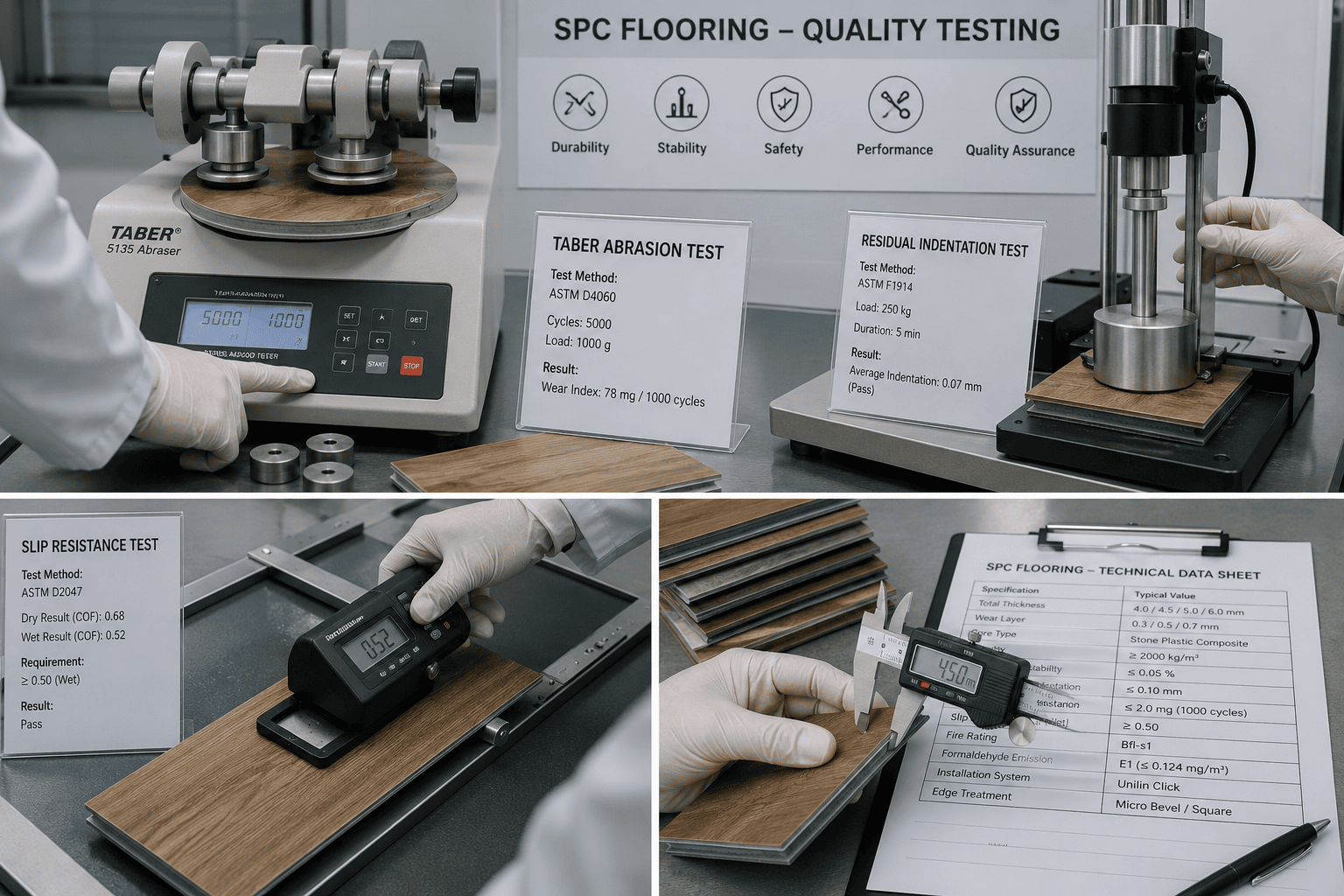
The performance data section is the technical heart of the TDS.It presents the results of standardised laboratory tests that measure how the product behaves under defined physical conditions heat,load,abrasion,slip,and impact.This is the section that most separates buyers who understand what they are reading from those who do not and it is where the most significant quality differences between products are documented.Dimensional Stability ISO 23999This test measures how much the plank expands and contracts when exposed to defined temperature changes.The result is expressed as a percentage change in length and width.For SPC flooring,a dimensional change of less than 0.08% at 80°C is the accepted standard for a product described as dimensionally stable.Products with higher dimensional change values will produce visible gapping between planks in cold conditions and joint stress in warm conditions particularly in non-air-conditioned spaces in Indian and Middle Eastern climates.This is one of the most important performance parameters for tropical and hot-climate markets and one of the most frequently omitted from TDS documents supplied by budget producers.Residual Indentation ISO 10582 or EN 433This test measures how much permanent deformation remains in the surface of the plank after a defined load is applied for a defined period and then removed.The result is expressed in millimetres the lower the number,the better the product's resistance to permanent denting under furniture legs,high heels,and heavy foot traffic.A residual indentation of less than 0.1mm is considered excellent for residential use.Values above 0.3mm indicate a core density or wear layer hardness insufficient for sustained load-bearing which will manifest as visible dents under dining table legs and chair castors within months of installation.Abrasion Resistance EN 13696 or ASTM D3884 (Taber Abrasion)The Taber abrasion test measures how resistant the wear layer surface is to mechanical abrasion the micro-scratching caused by foot traffic,grit,and daily cleaning.The result is expressed as the number of rotations under a defined abrasive wheel before the surface shows defined wear.Premium SPC wear layers maintain surface integrity to 2,000 rotations or above.Budget wear layers with insufficient UV coating cure or low-quality coating formulations typically fail below 1,000 rotations producing visible surface hazing in high-traffic areas within six to twelve months of installation.Slip Resistance EN 13893 or DIN 51130Slip resistance is measured under wet and dry conditions and expressed as either a coefficient of friction (COF) or a classification rating (R9 to R13 in the DIN system).For residential SPC,a minimum R9 or COF of 0.30 is standard.For commercial applications,R10 is the minimum.For wet areas including bathrooms,pool surrounds,and any hospitality application where spill exposure is likely,R11 is the minimum safe specification.The TDS should state slip resistance under both dry and wet conditions a product that only states dry slip resistance is leaving a significant performance parameter undisclosed.Thermal Resistance ISO 8302For any product intended for installation over underfloor heating,the TDS must state the product's thermal resistance value expressed in m²K/W.SPC flooring is generally compatible with underfloor heating systems but the thermal resistance of the full floor system (plank plus underlay) must be within the limits specified by the heating system manufacturer.A combined thermal resistance above 0.15 m²K/W is generally considered the maximum for efficient underfloor heating operation and some heating system warranties are voided if a floor covering with higher thermal resistance is installed above them
Section 3 of the TDS Environmental and Safety Parameters
Section 3 of the TDS Environmental and Safety Parameters
The environmental and safety section of the TDS documents the product's chemical emissions,restricted substance compliance,fire performance,and any sustainability certifications it holds.In 2026,this section has moved from a secondary consideration to a primary one for buyers supplying European,Australian,and premium Middle Eastern markets and it is increasingly relevant for Indian buyers supplying export-quality projects and international hotel brands.
VOC Emissions ISO 16000 or EN 16516
Volatile organic compound emissions are measured in micrograms per cubic metre of air (μg/m³) and classified into categories.For European markets,the key classification is the French A+ VOC rating a legal requirement for flooring installed in residential buildings in France and an increasingly adopted standard across Europe.For FloorScore certification the primary US and Australian indoor air quality standard the product must meet California Section 01350 emission limits.The TDS should state the VOC emission test result and the classification achieved.If neither FloorScore nor a VOC emission class is stated in the TDS,assume the product has not been tested to these standards.
Formaldehyde Emissions EN 717-1 or ASTM E1333
Formaldehyde is a known carcinogen that can be released from adhesives and binding agents used in flooring construction.The TDS should state the formaldehyde emission class E1 or E0 in European classification,CARB Phase 2 compliant in the US standard.E1 is the European baseline standard.E0 is a more stringent low-emission classification.CARB Phase 2 compliance is mandatory for flooring sold in California and is now effectively the de facto standard for any product targeting the North American market.A TDS that does not address formaldehyde emissions should be treated with caution for any market where indoor air quality is a buyer or regulatory concern.
Fire Classification EN 13501-1 or ASTM E648
Fire performance classification is mandatory for commercial and hospitality project specifications in most markets.Under the European standard EN 13501-1,SPC flooring is typically classified as Bfl-s1 or Cfl-s1 where the letter indicates combustibility and the s-rating indicates smoke production.For residential applications,fire classification is a secondary consideration.For hotel corridors,office spaces,healthcare facilities,and any public building application,fire classification must be verified against the applicable building code for the specific project and jurisdiction before specifying.
REACH Compliance and Restricted Substances
REACH compliance confirms that the product does not contain substances of very high concern above defined threshold levels.The TDS should reference REACH compliance explicitly and the buyer should request the original REACH compliance declaration from the manufacturer rather than accepting a generic statement in the TDS.For markets where PFAS restrictions apply primarily Europe and increasingly Australia and certain US states the TDS should also address PFAS content or the manufacturer should provide a separate PFAS test certificate.
Section 4 of the TDS Installation and Maintenance Requirements
Section 4 of the TDS Installation and Maintenance Requirements
The installation and maintenance section of the TDS is the most practically relevant section for contractors,installers,and end users.It defines the conditions under which the product can be correctly installed and the maintenance regime required to maintain the warranty and the product's long-term performance.Professional buyers read this section carefully because it reveals subfloor requirements,temperature and humidity constraints,and maintenance obligations that affect total cost of ownership and suitability for specific applications.
Subfloor Requirements
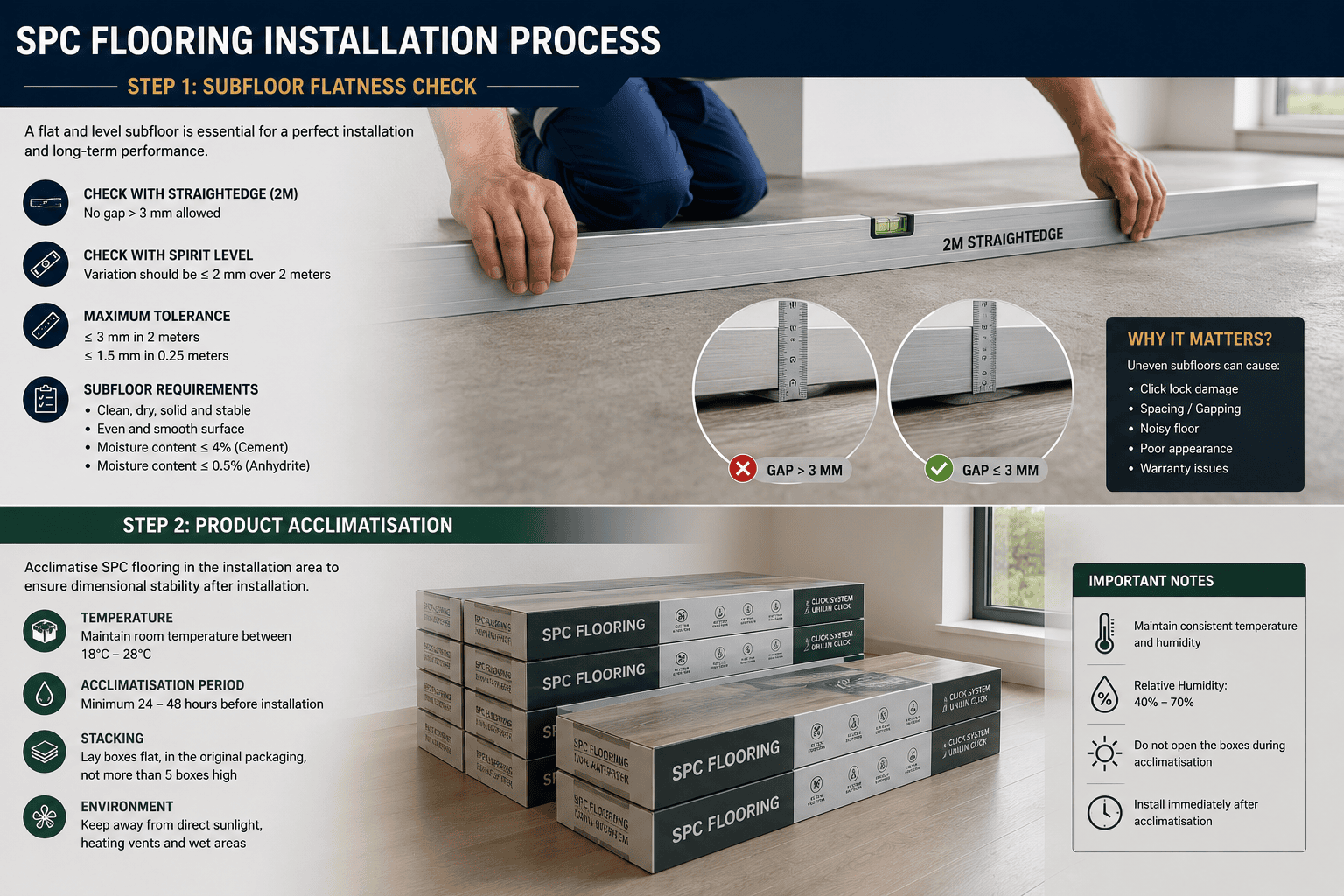
The TDS should specify the maximum subfloor flatness tolerance the product can accommodate typically expressed as a maximum deviation in millimetres over a defined measurement distance (e.g.,3mm per 1.8m).SPC flooring with a rigid core is less tolerant of subfloor unevenness than flexible LVT but more tolerant than laminate.If the existing subfloor exceeds the stated flatness tolerance,levelling compound must be applied before installation.The TDS should also specify acceptable subfloor materials (concrete,plywood,existing tile) and any moisture limit for the subfloor typically expressed as a maximum relative humidity percentage or a maximum moisture content reading.
Temperature and Humidity Conditions During Installation
SPC flooring must be acclimatised to the installation environment before fitting and the TDS specifies the acclimatisation period,the required temperature range,and the required humidity range.Installing SPC outside these parameters in temperatures below 10°C or above 35°C,or in humidity above 70% can compromise the locking system engagement and the dimensional stability of the installed floor.In Indian and tropical markets,these parameters are frequently exceeded during summer months and monsoon season and the TDS requirements for installation conditions must be communicated clearly to contractors to prevent installation failures that are then incorrectly attributed to product defects.
Maintenance Requirements
The TDS maintenance section specifies cleaning methods,recommended products,and any treatments that will void the warranty.For SPC flooring,the standard maintenance guidance includes dry sweeping or vacuuming for regular cleaning,damp mopping with a pH-neutral cleaner for deeper cleaning,avoidance of solvent-based or abrasive cleaners,and use of protective pads under furniture legs to prevent point-load denting.The TDS should also specify any periodic maintenance treatment such as refresher coating application that is required to maintain the warranty over the product's stated lifespan.
What a Complete,Trustworthy TDS Looks Like And What to Do When It Falls Short
What a Complete,Trustworthy TDS Looks Like And What to Do When It Falls Short
A complete,trustworthy SPC flooring TDS is a document that states every relevant specification parameter clearly,references the test standards used to establish each performance value,provides data that is internally consistent across all parameters,and is backed by third-party laboratory certificates that can be independently verified.Here is what professional buyers look for when evaluating a TDS and what they do when it does not meet the standard.
| TDS Element | What Complete Looks Like | What Incomplete Looks Like | Buyer Action |
| Wear layer specification | Thickness in mm plus lab certificate from accredited body | Thickness stated no certificate | Request SGS or BV lab certificate before ordering |
| Dimensional stability | ISO 23999 result stated less than 0.08% at 80°C | Not stated or stated without test reference | Request test result or treat as unverified claim |
| Residual indentation | ISO 10582 result less than 0.1mm | Not stated | Request test result especially for commercial use |
| Slip resistance | EN 13893 result under dry and wet conditions | Dry only or not stated | Request wet slip resistance data before wet area specification |
| VOC emissions | FloorScore or A+ VOC class stated with certificate | Not addressed | Assume non-compliant with European and US air quality standards |
| REACH compliance | Explicit REACH declaration with certificate reference | "Compliant with applicable regulations" vague | Request original REACH declaration document |
| Fire classification | EN 13501-1 class stated Bfl-s1 or Cfl-s1 | Not stated | Request fire test certificate for any commercial specification |
| Locking system | Named licensed system with licence reference | "Click-lock system" no licensor | Ask directly whether the system is licensed and from whom |
When the TDS Falls Short
A TDS that is incomplete,vague,or internally inconsistent is not automatically a reason to disqualify a supplier but it is always a reason to ask questions.Experienced buyers treat gaps in a TDS as a conversation starter rather than a conversation ender.A supplier who can promptly provide the missing data,backed by original laboratory documentation,has demonstrated the transparency and documentation capability that a reliable supply relationship requires.A supplier who responds to TDS questions with evasion,further vague statements,or documents that cannot be independently verified has revealed exactly the information the buyer needs and that information is a strong signal to look elsewhere.
Always cross-reference the TDS against the physical sample — Measure overall thickness with a calliper.Assess core density by weight and rigidity.Test the locking system engagement by hand.Evaluate the surface texture against the EIR claim.A TDS that matches the physical sample in every verifiable parameter is a TDS the buyer can trust for the parameters that require laboratory verification.
Request original certificates for every test result referenced in the TDS — A TDS that lists a test result without a corresponding original laboratory certificate is a document that states a claim without providing evidence.The certificate is the evidence.Always request it.
Compare TDS documents across competing suppliers for the same specification — The most efficient use of a TDS evaluation is a side-by-side comparison of two or three competing products at similar price points.Parameters that differ significantly between similar-priced products almost always reflect a quality difference that the price has not fully captured and identifying which supplier's TDS reflects the stronger specification is the most reliable guide to the better long-term purchase decision.
Use the TDS as the basis for your purchase contract specification — The TDS parameters that matter most for your application should be written into the purchase contract as minimum specification requirements.This converts the TDS from a marketing document into a contractual commitment that the supplier must deliver against and creates the legal basis for recourse if the delivered product does not match the documented specification.
Want a complete TDS package with every specification verified
Decospaa International provides full Technical Data Sheets backed by original third party laboratory certificates for every SPC flooring product in our range.Contact our team for product samples,complete TDS documentation,and competitive wholesale pricing for importers and project buyers across India,the Middle East,Africa,and Southeast Asia.
store.decospaainternational.com | info@decospaainternational.com | +91 86002 04089