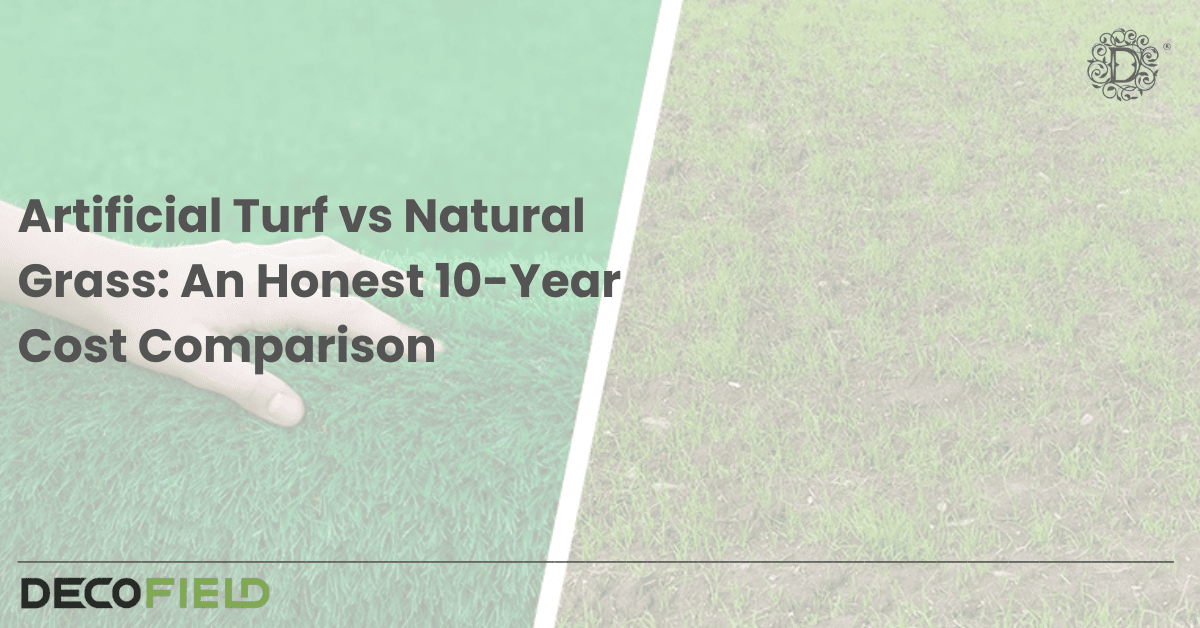
Every conversation about artificial turf eventually gets to the same point: it costs more upfront. That is true. A quality artificial turf installation costs significantly more than laying natural grass seed or turf. But a 10-year view of the numbers tells a very different story.
This comparison is based on a standard full-size football pitch of approximately 7,000 square metres in a warm, semi-arid climate the kind of installation common across the Middle East, North Africa, and large parts of sub-Saharan Africa. Adjust the numbers for your geography, but the relative pattern holds across most markets.
Table of Contents
Year Zero: Installation Costs
Year Zero: Installation Costs
Natural grass installation seeding with sub-base preparation, irrigation infrastructure, and drainage typically costs USD 80,000–120,000. You might also spend on a separate irrigation system: add another USD 20,000–40,000 in drier climates.
Artificial turf installation a complete system including quality fibres, infill, shock pad, and sub-base typically costs USD 350,000–550,000 for a FIFA-quality pitch. A non-certified community or school pitch can come in lower, at USD 200,000–320,000.
The upfront gap is real roughly USD 200,000–400,000 depending on specification. That is not a trivial difference. The question is what happens to that gap over time.

Annual Maintenance: Where the Gap Starts to Close
Annual Maintenance: Where the Gap Starts to Close
Natural Grass Annual Costs
- Mowing (2–3 times per week during growing season): USD 8,000–15,000/year
- Irrigation (in dry climates): USD 10,000–20,000/year
- Fertiliser, pesticide, and soil treatments: USD 3,000–6,000/year
- Overseeding and renovation after wear: USD 4,000–10,000/year
- Line marking (done weekly): USD 1,500–3,000/year
- Groundskeeper staff (full or part time): USD 15,000–30,000/year
- Total annual maintenance for natural grass: USD 41,500–84,000
Artificial Turf Annual Costs
- Brushing and grooming (monthly): USD 1,200–2,400/year
- Infill top-up (every 1–3 years): USD 800–2,000/year averaged
- Line marking (painted, lasts 6–12 months): USD 600–1,200/year
- Occasional repairs and inspection: USD 500–1,500/year
- Total annual maintenance for artificial turf: USD 3,100–7,100
- The annual saving sits at roughly USD 38,000–77,000 per year. That is not a small number.

The 10-Year Tally
The 10-Year Tally
Using mid-range figures:
- Natural grass USD 100,000 installation + USD 60,000/year × 10 years = USD 700,000 total
- Artificial turf USD 420,000 installation + USD 5,000/year × 10 years = USD 470,000 total
Over a decade, artificial turf costs less. The crossover point where the lower ongoing costs of artificial turf offset the higher installation typically falls between years 4 and 6 for most commercial facilities.
There is one significant additional consideration: at year 10 to 12, the artificial turf system will likely need replacement. The cost of replacing the fibres (but not the sub-base, which lasts 25+ years) is roughly USD 120,000–180,000. Even accounting for this, the 10-year economics still favour artificial turf in most scenarios involving regular use.
Factors That Shift the Balance
The comparison above is based on a commercially operated facility in a warm, dry climate. Several factors can shift the numbers:
- Low usage intensity — a pitch used only a few hours per week will see lower natural grass maintenance costs, making the comparison closer
- Mild, wet climate — where grass grows well and irrigation costs are minimal, natural grass is cheaper to maintain
- Water scarcity — in regions where water is expensive or restricted, the irrigation savings from artificial turf are substantial
- Labour costs — in markets where groundskeeping labour is inexpensive, the maintenance cost differential narrows
The honest answer is that for any facility used more than 20–25 hours per week in a warm climate, artificial turf is the financially rational choice. For lightly used private gardens or low-traffic school fields in wet climates, the case is less clear-cut.
One Number People Overlook: Revenue
One Number People Overlook: Revenue
The cost comparison above only looks at expenditure. It ignores the revenue side — and that is where artificial turf often makes its strongest argument.
A facility that can guarantee availability 365 days a year can charge higher booking rates, take on year-round academy contracts, and host tournaments that natural grass facilities cannot. Conservative estimates for a well-managed artificial turf facility suggest 20–40% higher annual booking revenue compared to an equivalent natural grass facility — simply because it is always available.
See the real cost advantage of artificial turf over time.Want a quick project-based estimate?Decospaa International