

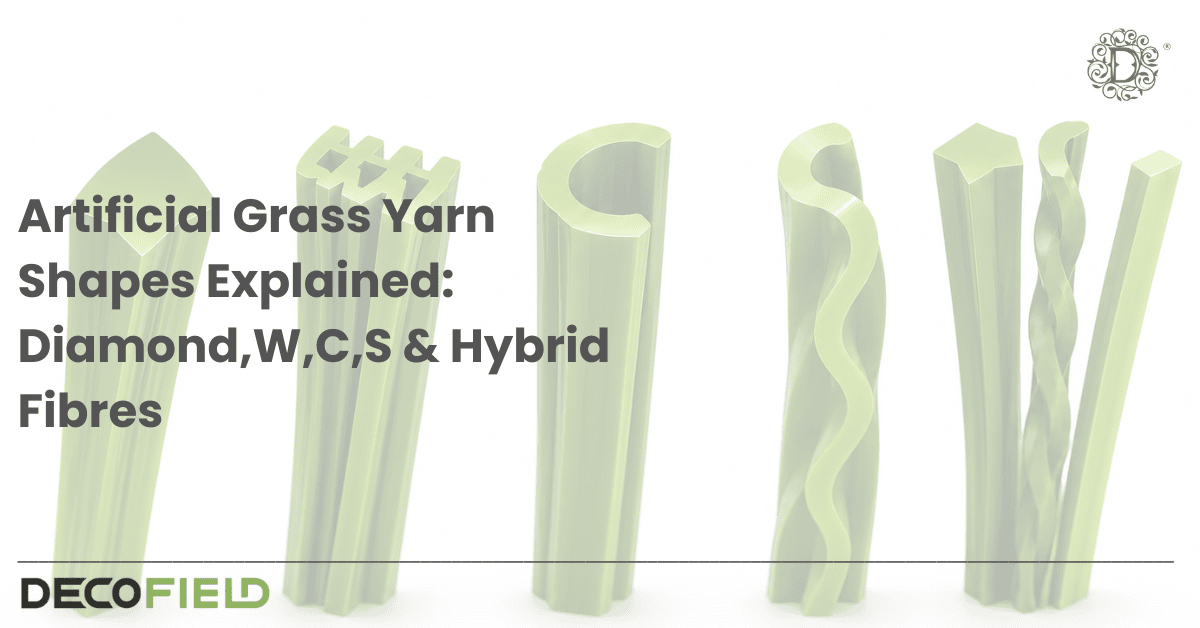
When buyers evaluate artificial grass,the conversation almost always starts with pile height,colour,and dtex density.What rarely gets enough attention is the cross-sectional shape of the yarn fibre and yet this single design decision has a more direct impact on how the turf looks,feels,performs,and recovers from use than almost any other specification parameter.The shape of the fibre determines how it stands upright,how it reflects light,how it feels underfoot,how quickly it recovers after being compressed by foot traffic,and how long it maintains its aesthetic appearance under sustained use and UV exposure.Diamond,W,C,S,and hybrid fibre shapes are not interchangeable alternatives.Each is engineered for a specific combination of application,performance priority,and aesthetic outcome.This guide explains the engineering logic behind each yarn shape,the applications each one is best suited for,and how to choose the right fibre profile for any artificial grass project.
Table of Contents
Why Fibre Shape Matters The Engineering Logic Behind Yarn Cross-Sections
Why Fibre Shape Matters The Engineering Logic Behind Yarn Cross-Sections
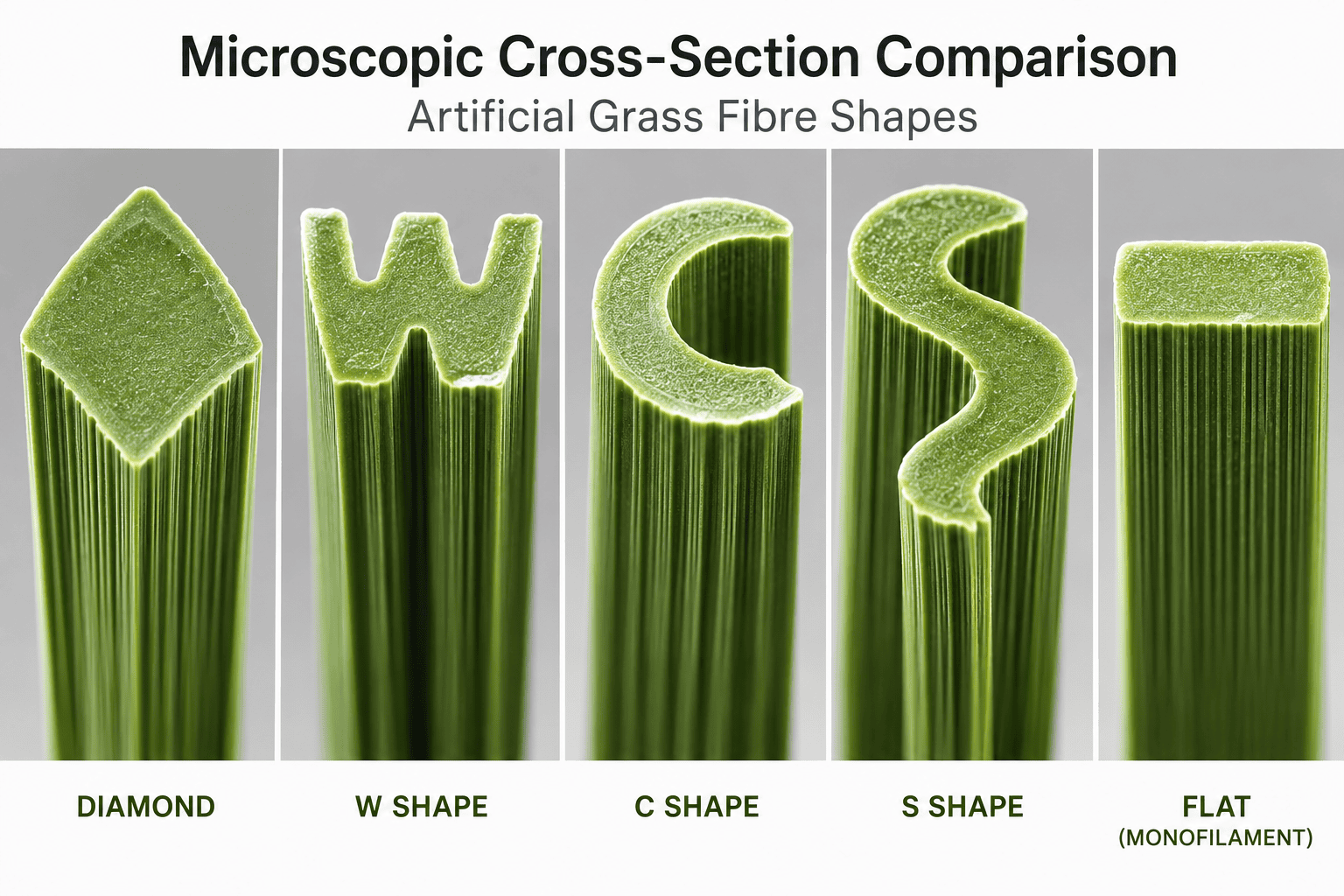
Every artificial grass fibre has a cross-sectional shape the profile you would see if you cut the fibre cleanly across its width and looked at the cut end under a microscope.This shape is determined during the extrusion process,when the molten polymer is pushed through a die with precisely machined holes whose shape determines the profile of the emerging fibre.Different die shapes produce different cross-sectional profiles and these profiles have fundamentally different mechanical and optical properties that directly affect how the finished turf performs.
The physics underlying fibre shape performance is straightforward.A flat fibre lies easily under its own weight which is why early generation artificial grass made from flat monofilament fibres tended to flatten permanently under foot traffic and required frequent brushing to maintain an upright appearance.A fibre with a shaped cross-section diamond,W,C,or S has structural ribs or curves that create resistance to bending along the fibre's length.This structural resistance is what gives the fibre its spring-back behaviour its ability to return to an upright position after being compressed by a foot,a ball,or a piece of furniture.The more effective the cross-sectional shape at creating bending resistance,the better the fibre recovers from compression and the longer the turf maintains its upright,full appearance under use.
Shape also affects optical performance.The way a fibre reflects light depends on its cross-sectional geometry and this in turn determines how natural or artificial the finished turf looks when viewed from different angles and under different lighting conditions.Fibres with multiple facets or curves create more complex light reflection patterns that more closely mimic the way real grass reflects light contributing to the realistic appearance that premium artificial turf products achieve.
Diamond Shape Fibre Strength,Durability,and Sports Performance
Diamond Shape Fibre Strength,Durability,and Sports Performance
The diamond cross-section is one of the most structurally efficient fibre shapes in the artificial grass industry.In cross-section,the fibre profile resembles a diamond or rhombus with four faces meeting at sharp or slightly rounded edges that create structural stiffness across two axes simultaneously.This dual-axis stiffness gives diamond fibres exceptional resistance to compression and lateral bending making them the shape of choice for high-traffic applications where the fibre must recover from heavy and repeated use.
Performance Characteristics
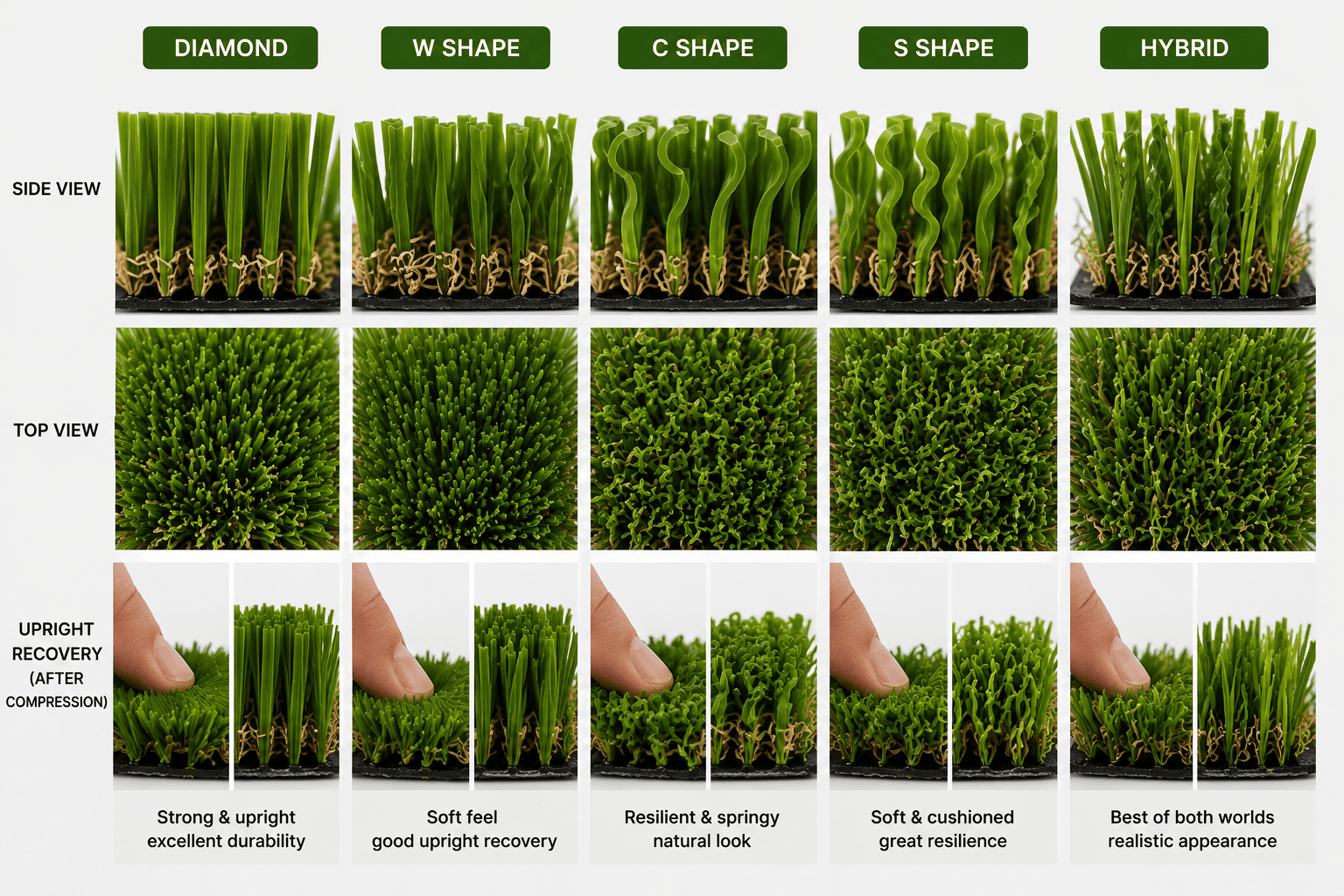
Diamond fibres stand upright more readily than most other shapes because their structural geometry resists bending along both the flat and the edge orientation.Under foot traffic,the diamond profile distributes compressive force across four faces rather than concentrating it along a single plane which significantly reduces the permanent set (the inability to recover to full upright position) that flat fibres develop under sustained use.In sports turf applications where thousands of footsteps,falls,and ball impacts are accumulated over a playing season,this recovery performance is the primary determinant of how long the surface continues to play consistently.
Typical Applications
Diamond fibres are most commonly specified for football pitches,rugby fields,multi-use sports surfaces,and any high-traffic application where durability and recovery performance take priority over softness or premium aesthetics.Many FIFA-certified turf products use diamond or diamond-hybrid fibres as the primary pile component because the shape's mechanical properties contribute directly to the ball-roll consistency and surface resilience that FIFA's testing protocols require.
Limitations
The structural stiffness that makes diamond fibres excellent for sports performance makes them less comfortable underfoot in barefoot or contact applications which limits their suitability for residential gardens,children's play areas,and poolside installations where a softer surface feel is expected.Diamond fibres also reflect light in a more uniform and slightly more artificial-looking pattern than the more complex profiles of W or C shape fibres,which can affect the realism of the installed surface when viewed in close-up or under low-angle lighting.
W Shape Fibre The Landscape and Residential Standard
W Shape Fibre The Landscape and Residential Standard
The W cross-section is the most widely used fibre shape in residential and commercial landscaping artificial grass in 2026.Named for the W profile visible in cross-section,this shape creates a fibre with two curved ribs that run along its length providing structural support that keeps the fibre upright while simultaneously allowing a degree of softness and flex that makes the surface comfortable to walk on,sit on,and touch.Why the W Shape Dominates Landscape ApplicationsThe W shape achieves a balance between structural performance and tactile comfort that no other single-shape fibre fully replicates.The two internal ribs provide enough structural resistance to maintain good upright recovery under moderate foot traffic appropriate for residential gardens,terrace lawns,and commercial landscaping where the surface receives regular but not intense use.At the same time,the curved profile and the inherent flexibility of the W geometry produce a surface that yields slightly under foot pressure creating a softer,more natural underfoot experience than the stiffer diamond profile delivers.The W shape also excels at optical naturalness.The curved faces of the fibre create multiple reflection planes that produce a varied,multi-tonal light response when the surface is viewed from different angles closely mimicking the way natural grass reflects sunlight.This optical complexity is one of the primary reasons W shape turf looks more realistic than flat or diamond fibre products at the same pile height and colour specification.Performance CharacteristicsW shape fibres perform best in applications where foot traffic is moderate and recovery from compression is needed within hours rather than minutes.They are not as resilient under intense or high-frequency use as diamond fibres in high-traffic zones of a W shape turf installation,some flattening over time is normal and expected.Regular brushing particularly in areas of concentrated use such as pathways,play zones,and seating areas is the primary maintenance action that preserves W shape turf appearance over time.
C Shape and S Shape Fibres Softness,Aesthetics,and Specialised Applications
C Shape and S Shape Fibres Softness,Aesthetics,and Specialised Applications
C shape and S shape fibres represent the softer end of the artificial grass fibre spectrum optimised for tactile comfort,aesthetic realism,and applications where the surface is touched and experienced at close range rather than subjected to heavy repeated use.
C Shape Fibre
The C cross-section profile shaped like a curved arc or half-cylinder is designed to maximise softness while maintaining enough structural curvature to prevent the fibre from lying completely flat under its own weight.C shape fibres are significantly softer to touch than diamond or W fibres because their single-curve geometry offers less resistance to compression along the axis perpendicular to the curve.This softness makes C shape fibres the preferred specification for children's play areas,pet turf,and any application where the surface will be used for ground-level sitting,crawling,or lying where direct skin contact with the fibre surface is the primary use experience.
The limitation of C shape fibres is their recovery performance.The same softness that makes them comfortable to touch means they recover more slowly from compression than diamond or W shapes.In areas of concentrated foot traffic a pathway across a C shape turf garden,a frequently used entry point some permanent flattening will develop faster than it would in a W or diamond shape product at equivalent density.
S Shape Fibre
The S cross-section shaped like the letter S in cross-section is a more recent development designed to combine the optical naturalness of the C shape with improved structural recovery.The S curve creates two structural rib points along the fibre's cross-section that provide recovery support in two orientations simultaneously meaning the fibre recovers from compression in multiple directions rather than only along its primary curve axis.S shape fibres produce a surface that moves and reflects light in a way that is considered among the most natural-looking of any monofilament fibre profile currently available making them increasingly popular in premium residential,villa,and hotel landscaping applications where aesthetic quality is the primary specification driver.
Application Comparison
Application Comparison
| Factor | C Shape | S Shape |
| Softness underfoot | Excellent most soft of all shapes | Very good softer than W,firmer than C |
| Recovery from compression | Moderate slower recovery than W or diamond | Good better than C due to dual-curve structure |
| Optical naturalness | Very good curved surface creates natural light play | Excellent considered most realistic single profile |
| Durability under traffic | Moderate not ideal for high-traffic zones | Good better than C,suitable for moderate use |
| Best application | Children's play areas,pet turf,decorative installations | Premium residential,villa,hotel landscaping |
| Typical pile height | 25mm to 35mm | 30mm to 45mm |
Hybrid Fibre Systems Combining Shapes for Optimised Performance
Hybrid Fibre Systems Combining Shapes for Optimised Performance
The most sophisticated artificial grass products in 2026 do not use a single fibre shape throughout the pile.Instead,they combine two or more fibre shapes each contributing specific performance characteristics in a single tufted system that delivers a combination of properties no single shape can achieve alone.These hybrid systems represent the current frontier of artificial grass fibre engineering and are increasingly specified in premium residential,commercial landscaping,and high-performance sports surface applications.
The W and Diamond Hybrid
The most commercially common hybrid system combines W shape fibres with diamond fibres in the same tuft.The W fibres provide the aesthetic naturalness,colour depth,and tactile softness that make the surface look and feel like quality landscape turf.The diamond fibres provide the structural backbone the resilience and recovery performance that prevents the surface from flattening permanently in high-use areas.The proportion of each fibre type in the mix can be adjusted to tune the balance between softness and durability for specific applications.A residential villa garden might use a 70% W / 30% diamond mix.A hotel rooftop terrace with higher foot traffic might specify 50% / 50% or even a greater diamond proportion.
The S and C Hybrid for Premium Residential
A growing number of premium landscape products now combine S shape fibres with C shape fibres using the S shape's structural recovery as the backbone and the C shape's extreme softness as the tactile surface element.The result is a product that feels as soft as a pure C shape turf but recovers from compression significantly faster extending the lifespan of the premium aesthetic appearance that villa and hotel landscape buyers are paying for.
Thatch Layer Integration
Many hybrid systems also incorporate a thatch layer short,curled,typically brown or olive-coloured fibres tufted between the primary pile fibres at a lower pile height.The thatch layer mimics the dead grass and soil-level material visible in natural turf,adding depth and naturalness to the visual appearance of the surface.It also plays a functional role holding infill material in position,providing a base layer of cushioning,and creating a visual transition at ground level that makes the interface between the turf and any hard surface edge look more natural.Premium hybrid turf systems with integrated thatch layers consistently achieve higher naturalness ratings in buyer evaluations than equivalent density single-shape products without thatch.
Choosing the Right Fibre Shape A Buyer's Application Guide
Choosing the Right Fibre Shape A Buyer's Application Guide
The right fibre shape for any artificial grass project depends on three factors: the intensity of use the surface will experience,the aesthetic standard expected by the buyer,and the tactile experience required by the end user.This guide provides clear,application-specific recommendations across the most common project types in the India,Middle East,and Southeast Asia markets.
| Application | Recommended Fibre Shape | Key Reason |
| Residential garden (villa) | W shape or S shape | Optical naturalness,good recovery for moderate garden use |
| Children's play area | C shape or W/C hybrid | Maximum softness for ground-level contact and play |
| Pet turf | W shape or C shape | Soft,easy to clean,good drainage compatibility |
| Rooftop terrace or balcony | W shape or S/W hybrid | Good recovery,natural appearance,UV stability |
| Hotel or resort landscaping | S shape or S/C hybrid | Premium aesthetics,softness,impressive to guests |
| Football pitch (5-a-side) | Diamond or W/Diamond hybrid | Durability and recovery under intensive play |
| FIFA-certified sports pitch | Diamond or Diamond hybrid | Ball-roll consistency,FIFA testing compliance |
| Decorative commercial display | S shape or W shape | Maximum naturalness for visual impact |
| School sports facility | W/Diamond hybrid | Balance of durability,safety,and recovery |
For buyers new to fibre shape specification,start with W shape — The W shape is the broadest market specification because it delivers a good balance of aesthetics,recovery,and durability across the widest range of applications.If you are building a product range for the Indian residential and commercial landscaping market and can only specify one fibre shape,W shape in a premium dtex and pile height specification is the strongest single choice.
For premium projects,upgrade to S shape or S/W hybrid — The optical naturalness advantage of S shape and S hybrid products is clearly visible to discerning buyers and justifies a meaningful price premium in villa,hotel,and luxury commercial applications where the surface is a design feature as much as a functional one.
For sports applications,always specify diamond or hybrid with diamond content — The recovery performance advantage of diamond fibres in high-traffic applications is not marginal it is the difference between a pitch that plays consistently throughout a season and one that shows visible flattening patterns within months.For any sports specification,diamond content is a non-negotiable requirement.
Request physical samples of each fibre shape before specifying — The performance differences between fibre shapes are partly visible and partly tactile and reading about them is not a substitute for feeling the difference between a W shape and a C shape product or observing the recovery behaviour of a diamond hybrid versus a pure W shape under compression.Always evaluate physical samples before making a final specification decision.
Need artificial grass in the right fibre shape for your project
Decospaa International supplies premium artificial grass across all major fibre shapes Diamond,W,C,S,and hybrid systems for residential,commercial,sports,and hospitality applications across India,the Middle East,Africa,and Southeast Asia.Contact our team for fibre shape samples,technical specifications,and competitive wholesale pricing.
store.decospaainternational.com | info@decospaainternational.com | +91 86002 04089