

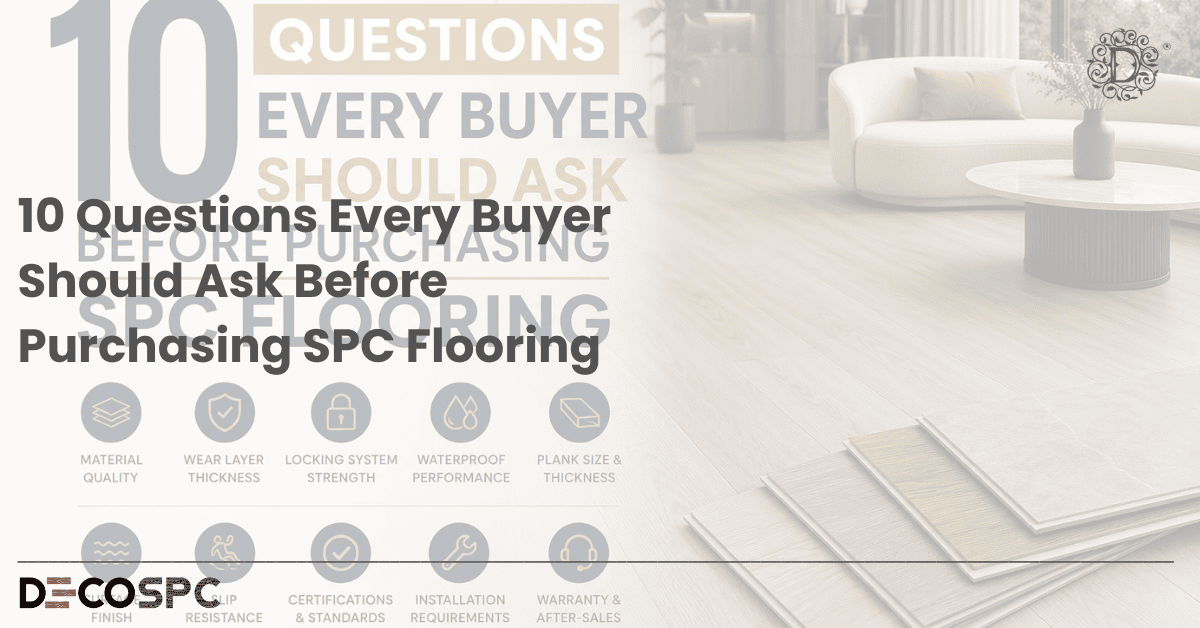
SPC flooring is one of the most significant purchases a homeowner,developer,or commercial project manager makes.Get it right and the floor performs beautifully for 15 to 20 years with minimal upkeep.Get it wrong and the consequences premature wear,UV fading,joint failure,or certification non-compliance are expensive and disruptive to fix.The difference between a good SPC purchase decision and a poor one almost always comes down to the questions that were asked or not asked before the order was placed.This guide gives buyers,importers,and project specifiers the ten most important questions to ask any SPC flooring supplier before committing to a purchase.
Table of Contents
Why Asking the Right Questions Protects Your Investment
Why Asking the Right Questions Protects Your Investment
The SPC flooring market in 2026 contains an enormous range of product quality from genuinely premium,fully certified product that will perform for two decades,to budget product that looks acceptable in a sample but begins showing wear within the first year of real use.The price difference between these extremes at the ex-factory level is often 15% to 30%.The performance difference over a five year installation is the difference between a satisfied customer and an expensive replacement project.
The challenge for buyers is that low quality and high quality SPC can look almost identical in a showroom sample.The difference is in the specification parameters that are not visible to the naked eye wear layer thickness,UV stabiliser content,locking system engineering,core density,and backing weight.Asking the right questions and demanding verifiable answers is the only reliable way to establish whether the product you are evaluating will actually deliver the performance it claims.
This is true whether you are a homeowner buying 50 square metres for a renovation,an importer ordering a container for distribution,or a project manager specifying flooring for a 300-room hotel.The questions are the same.What changes is the scale of the financial consequence if the wrong answers are accepted.

The 10 Essential Questions With What Good Answers Look Like
The 10 Essential Questions With What Good Answers Look Like
What is the exact wear layer thickness and can you provide a third-party certificate confirming it?
The wear layer is the protective coating on the surface of the SPC plank that determines how long the floor resists scratching,scuffing,and surface degradation.It is measured in millimetres 0.3mm,0.5mm,0.7mm,1.0mm and the difference between these specifications is significant in real-world performance terms.A 0.3mm wear layer is appropriate for light residential use in low-traffic areas.A 0.5mm wear layer is the minimum for standard residential use.Commercial and hospitality applications require 0.7mm or above.
Good answer: "The wear layer is 0.5mm.Here is the SGS laboratory test certificate from the production batch confirming that measurement."
Red flag answer: "It meets standard specifications" or "approximately 0.5mm" without a supporting certificate.
Which locking system does the product use and is it licensed?
The locking system is the mechanical joint that connects SPC planks at their edges and ends.Licensed systems from Unilin (Uniclic/5G),Välinge,or I4F are engineered to precise tolerances and tested for joint integrity over years of thermal cycling the expansion and contraction that occurs as floor temperatures change with seasons.Proprietary unlicensed systems are produced without these standards and are one of the most common sources of joint failure complaints in installed SPC flooring.
Good answer: "The product uses a Unilin Uniclic locking system.Here is our licence number."
Red flag answer: "Our own locking system" or "patented click system" without identifying the licensor.
What certifications does the product hold and can I see the original certificates?
Certification confirms that the product has been tested by an independent third-party laboratory and meets defined performance standards.The most important certifications for SPC flooring include FloorScore (indoor air quality critical for US and Australian markets),REACH compliance (chemical safety required for European markets),ISO 9001 (manufacturing quality management),and SGS or Bureau Veritas lab reports for specific performance parameters.In commercial applications,fire rating certification may also be a project requirement.
Good answer: Supplier provides original certificate documents not PDFs of PDFs with laboratory reference numbers that can be independently verified.
Red flag answer: "We are certified" without producing documents,or providing certificates that cannot be traced back to a verifiable laboratory report.
What is the total board thickness and core density?
Total board thickness (typically 4mm to 8mm) and core density (measured in kg per cubic metre) are two specifications that significantly affect how the floor feels underfoot,its acoustic performance,and its dimensional stability under load and temperature change.A thicker,denser board feels more solid,transmits less impact sound between floors,and is more resistant to denting under heavy furniture.Lightweight boards even at the same stated thickness indicate a lower-density core that compromises these performance characteristics.
Good answer: "Total thickness is 6mm,core density is 1,850kg per cubic metre." Supplier provides technical data sheet confirming both figures.
Red flag answer: Supplier can confirm total thickness but is unable or unwilling to specify core density.
What UV stability testing has been done and to what standard?
UV stability determines how well the SPC flooring maintains its colour when exposed to sunlight over time.This is particularly critical in markets with high UV exposure India,the Middle East,Southeast Asia,and Australia where direct sunlight through windows can degrade insufficiently stabilised flooring visibly within 12 to 24 months.The relevant test standard is ISO 4892-2 (accelerated UV weathering).Premium product is tested to a minimum of 2,500 hours.Budget product is often not tested to this standard at all.
Good answer: "The product is tested to ISO 4892-2 at 2,500 hours with no significant colour change.Here is the test certificate."
Red flag answer: "UV resistant" claimed on packaging without a supporting test certificate from an accredited laboratory.

Is the product suitable for my specific application and climate?SPC flooring is not a single specification product it comes in a range of specifications designed for different use intensities and climate conditions.A product suitable for a dry,air-conditioned bedroom in a temperate climate may not be the right specification for a kitchen in a monsoon-prone Indian city,a hotel corridor in Dubai,or an outdoor adjacent space in a coastal villa.The supplier should be able to advise specifically on whether the product's wear layer,UV stabilisation,backing specification,and dimensional stability are appropriate for your exact application and climate.Good answer: Supplier asks about your specific application,usage intensity,and climate before recommending a product and backs the recommendation with specification data.Red flag answer: "This product is suitable for all applications" without any qualification or application-specific guidance.What are the exact warranty terms and what do they actually cover?Warranty terms in the SPC flooring market vary enormously from genuinely meaningful coverage that protects the buyer's investment to documents so hedged with exclusions that they offer almost no practical protection.The key questions within the warranty question are: what specific failure modes are covered (wear layer degradation,dimensional stability,joint integrity,UV fading); what is the claim procedure and is it practical from your location; and what is the remedy offered (replacement,repair,or refund).Good answer: "We offer a 15 year residential warranty covering wear layer performance,dimensional stability,and joint integrity.Claims are handled by submitting photographic evidence to our regional office.Remedy is product replacement."Red flag answer: "Lifetime warranty" with extensive exclusions that effectively cover nothing,or warranty terms that require returning product to the factory in China for inspection.Are you the manufacturer or a trading company?This question matters more than most buyers realise.A direct manufacturer has full visibility and control over production quality,can verify specifications against actual manufacturing processes,and can be held accountable for product performance in a way that a trading company which sources from multiple factories depending on price structurally cannot.Trading companies cannot guarantee production consistency between orders because they are not in control of the manufacturing process.For any significant purchase,always verify you are dealing with the actual manufacturer.Good answer: Supplier provides business licence,factory registration documentation,and offers factory audit access or a third-party audit report.Red flag answer: Vague or evasive responses about manufacturing capacity,inability to provide factory documentation,or refusal of factory visit access.What is the production lead time and how is quality controlled before shipment?Lead time management is a practical issue that directly affects project timelines and inventory planning.For import orders,the realistic production-to-delivery timeline is 45 to 75 days for most destinations and buyers who underestimate this create project delays that damage relationships and generate additional costs.Equally important is the quality control process between production completion and shipment.Does the manufacturer conduct internal QC checks? Will they accommodate an independent pre-shipment inspection? What documentation accompanies the shipment to confirm it matches the approved specification?Good answer: "Production lead time is 25 to 35 days.We conduct internal QC checks at each production stage and welcome pre shipment inspection by your appointed agency.Full test reports accompany every shipment."Red flag answer: Vague lead time estimates,resistance to pre-shipment inspection,or inability to provide production stage QC documentation.Can you provide references from buyers in similar markets or applications?A supplier with a genuine track record of successful supply to buyers in markets or applications similar to yours will be able to provide verifiable references without hesitation.References from distributors in your target region,from project managers who have specified the product in similar commercial applications,or from importers who have been buying from this supplier for multiple years are the most reliable indicator of consistent quality and supply reliability available.No marketing material,no website,and no sample is a substitute for a real buyer who can speak to real experience.Good answer: Supplier provides two or three verifiable contact references with names,companies,and contact details from buyers in comparable markets or applications.Red flag answer: "We supply major brands globally" without providing specific,verifiable references on request.
Red Flag Answers That Signal a Supplier to Avoid
Red Flag Answers That Signal a Supplier to Avoid
| Red Flag Response Pattern | What It Signals |
| Our product meets all international standards | Vague claim with no specific standards named and no certificates offered |
| Certificates provided as low resolution PDFs without verifiable laboratory reference numbers | Potential document falsification always verify directly with the issuing laboratory |
| Price significantly below market average for the claimed specification | Specification compromise somewhere wear layer,UV stabiliser,locking system,or backing |
| Reluctance to allow pre-shipment inspection | Supplier is not confident the production batch will match the approved sample |
| Communication becomes slow or vague after deposit is paid | Production or quality issues being managed without buyer awareness |
| Warranty document full of exclusions with no clear claim procedure | Supplier does not expect to honour warranty claims in practice |
| Unable to provide factory location or factory audit access | Trading company not manufacturer with no production control |
Questions for Specific Applications Residential,Commercial,Export
Questions for Specific Applications Residential,Commercial,Export
The ten core questions above apply to every SPC purchase.These additional application-specific questions help buyers address the particular requirements of their specific context.
For Residential Buyers
- Is the product suitable for installation over underfloor heating and what is the maximum operating temperature?
- What is the recommended subfloor preparation and what subfloor flatness tolerance does the locking system require?
- Is the acoustic underlay pre-attached or does it need to be purchased and installed separately?
- What cleaning products and methods are recommended and which should be avoided to protect the wear layer?
For Commercial and Hospitality Buyers
- What is the slip resistance rating and has it been independently tested to R10 or R11 for wet area applications?
- What is the fire rating and does it meet the fire safety requirements for the specific building type and jurisdiction?
- Has the product been tested for resistance to commercial cleaning chemicals including the specific products used in your cleaning programme?
- What is the recommended maintenance programme for commercial applications and what does the warranty require in terms of maintenance records?
For Import and Wholesale Buyers
- What is the minimum order quantity and is partial container ordering available for initial trial orders?
- What import documentation is provided with each shipment commercial invoice,packing list,bill of lading,certificate of origin,and product certifications?
- What is the batch to batch colour consistency tolerance and how is it measured and documented?
- What payment terms are available and at what stage is the final balance required relative to shipment?
How to Evaluate Supplier Responses A Scoring Framework
How to Evaluate Supplier Responses A Scoring Framework
After asking the ten core questions,use this simple scoring framework to compare suppliers objectively and make a sourcing decision based on documented evidence rather than impression.
| Question | Full Score Answer | Partial Score | Zero Score |
| Wear layer thickness | Verified by original third-party certificate | Stated in data sheet only | Vague or unspecified |
| Locking system | Named licensed system with licence number | Licensed but no number provided | Proprietary or unspecified |
| Certifications | Full portfolio original documents provided | Some certificates not all | Self-declared only |
| Core density | Specified in kg/m³ with data sheet | Total thickness only | Unable to specify |
| UV stability | ISO 4892-2 test certificate 2500 hours plus | UV stable claimed with partial data | No test data available |
| Application suitability | Specific guidance with supporting spec data | General guidance only | No guidance offered |
Your Pre Purchase Checklist A Summary
Your Pre Purchase Checklist A Summary
Before placing any SPC flooring order residential,commercial,or wholesale import confirm that the following have been completed.
- Wear layer thickness confirmed by original third-party laboratory certificate from the production batch
- Locking system identified as a named licensed system with verifiable licence number
- Full certification portfolio received as original documents FloorScore,REACH,SGS,or equivalent for your target market
- Total board thickness and core density specified in the technical data sheet
- UV stability test certificate received confirming ISO 4892-2 testing to minimum 2,500 hours
- Supplier confirmed as direct manufacturer with factory documentation and audit access available
- Warranty terms reviewed in full coverage,exclusions,claim procedure,and remedy all clearly stated
- Application suitability confirmed for your specific space,usage intensity,and climate conditions
- Pre-shipment inspection arranged through an independent QC agency for the production batch
- Payment terms structured to retain minimum 30% until satisfactory pre-shipment inspection report received
Want a supplier who can answer all ten questions with full documentation?
Decospaa International supplies certified premium SPC flooring with verified wear layer specifications,licensed locking systems third-party documentation for residential,and wholesale buyers across India,the Middle East,Africa,and Southeast Asia.Contact our team for product samples,technical data sheets,competitive pricing
store.decospaainternational.com | info@decospaainternational.com | +91 86002 04089